



The Alternative Fuels and Feedstocks Office (AFFO), which brings together legacy efforts under the former Bioenergy Technologies Office and Hydrogen and Fuel Cell Technologies Office, provides funding for bioenergy industry and hydrogen and full cell technologies lab-led consortia. Each consortium utilizes the capabilities of the DOE National Laboratory system to overcome the challenges of researching and developing competitive, cost-effective, and scalable fuels and products made from biomass. The office may add innovative projects to the consortia through future lab calls and funding opportunities, subject to appropriations.
Below are brief descriptions and links to each AFFO-funded consortium:
AGILE BIOFOUNDRY
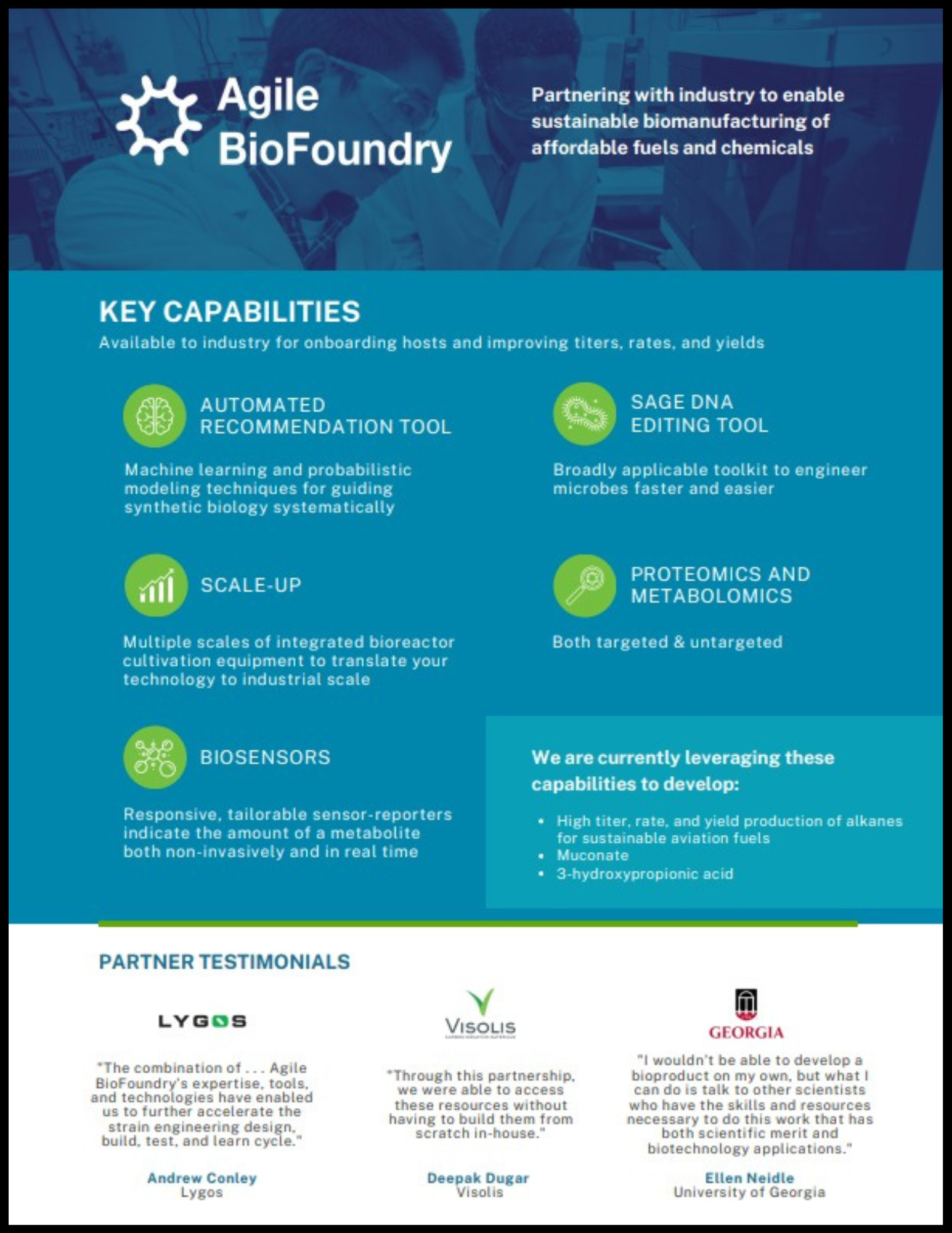
Agile Biofoundry works to accelerate and streamline the biomanufacturing pipeline through the use of synthetic biology tools, processes for predictable scale-up, machine learning, and the use of non-model host organisms by establishing a robust set of biomanufacturing principles.
Learn more at Agile Biofoundry.
Download the Agile BioFoundry flyer.
ALGAE TECHNOLOGY EDUCATIONAL CONSORTIUM
The Algae Foundation launched the Algae Technology Educational Consortium (ATEC) project, recognizing algal production will provide a source of biomass for bio-based products, feed, fuel and foods creating high-quality jobs for an educated workforce.
A partnership between academic institutions, national research laboratories, and industry leaders, the consortium’s goal is to develop novel educational programs to strengthen industry workforce capabilities, by focusing on the skills needed to support the commercialization of algal products. Through algal education, students learn practical applications of farming and biotechnology developing the skills for the next generation of algal-based jobs.
Learn more at Algae Technology Educational Consortium.
BIOPROCESSING SEPARATIONS CONSORTIUM
The Bioprocessing Separations Consortium develops cost-effective, high-performing separations technologies that are coordinated with challenges relevant to industry in order to facilitate adoption.
This consortium addresses separations challenges such as impurities in intermediates impeding downstream biological and chemical catalysts, the need for low-cost purification technologies, and recovery and conversion of dilute carbon.
Learn more at Bioprocessing Separations Consortium.
BIO-OPTIMIZED TECHNOLOGIES TO KEEP THERMOPLASTICS OUT OF LANDFILLS AND THE ENVIRONMENT
Supported by both AFFO and the Advanced Materials and Manufacturing Office, Bio-Optimized Technologies to keep Thermoplastics out of Landfills and the Environment (BOTTLE™) is a multi-organization consortium focused on developing new chemical upcycling strategies for today's plastics and creating tomorrow's plastics to be recyclable by design. BOTTLE’s vision is to deliver selective, scalable technologies to enable cost-effective recycling, upcycling, and increased energy efficiency.
Learn more at BOTTLE.
CO2 REDUCTION AND UPGRADING FOR E-FUELS CONSORTIUM (CO2RUe)
The CO2RUe Consortium develops and derisks advanced technologies that use electricity to convert carbon dioxide (CO2) into e-fuels and commodity chemicals. Millions of tons of CO2 are emitted annually from biorefineries and industrial sites across the United States. CO2RUe is working toward using electricity to convert waste CO2 into "e-fuels"—a shorthand for electrofuels, which have dramatically lower land, water, and emissions footprints.
Learn more at CO2 Reduction and Upgrading for E-Fuels Consortium.
CHEMICAL CATALYSIS FOR BIOENERGY (ChemCatBio)
ChemCatBio addresses challenges related to the catalytic upgrading of intermediates from both high- and low-temperature processes.
it provides access to more than 50 unique, world-class capabilities and expertise in materials theory and computation, synthesis, characterization, and analysis to accelerate the development of new biofuel catalysts and make improvements to existing catalytic systems.
Learn more at Chemical Catalysis for Bioenergy Consortium.
Download the Chemical Catalysis for Bioenergy fact sheet.
CONSORTIUM FOR COMPUTATIONAL PHYSICS AND CHEMISTRY (CCPC)
The Consortium for Computational Physics and Chemistry (CCPC) advances state-of-the-art computational modeling of fundamental physical and chemical processes. New fundamental insight and models developed by this consortium in conjunction with experimental verification will accelerate research and development, help target new applied research, and aid in the design of advanced catalysts, enzyme systems, and reactors.
Learn more at Consortium for Computational Physics and Chemistry.
DISCOVR: DEVELOPMENT OF INTEGRATED SCREENING, CULTIVAR OPTIMIZATION, AND VERIFICATION RESEARCH
DISCOVR investigates the enhancement of algae productivity through screening of promising algae strains and implementation of effective cultivation strategies to accelerate the development of algal biofuels and bioproducts.
Learn more at DISCOVR.
ELECTROCAT
The Electrocatalysis Consortium (ElectroCat) conducts research and development to accelerate the development of catalysts made without platinum group metals (PGM-free) for use in fuel cell applications.
FEEDSTOCK-CONVERSION INTERFACE CONSORTIUM
Researchers in this consortium quantify, understand, and manage biomass variability from the field to downstream conversion. The consortium seeks to understand how feedstock composition, structure, and behavior impacts overall biorefinery performance.
Learn more at Feedstock-Conversion Interface Consortium.
Download the FCIC fact sheet.
H2NEW
The Hydrogen from Next-generation Electrolyzers of Water Consortium (H2NEW) conducts R&D to make large-scale electrolyzers, which produce hydrogen from electricity and water, more durable, efficient, and affordable.
Learn more at Hydrogen from Next-generation Electrolyzers of Water
H-Mat
The Hydrogen Materials Compatibility Consortium (H-Mat) focuses on understanding the effects of hydrogen on the performance of polymers and metals used in hydrogen infrastructure and storage.
Learn more at Hydrogen Materials Compatibility Consortium.
HyBlend
The HyBlend initiative addresses technical barriers to blending hydrogen in natural gas pipelines. Key aspects of HyBlend include materials compatibility R&D, techno-economic analysis, and life cycle analysis to inform the development of publicly accessible tools that characterize the opportunities, costs, and risks of blending.
Learn more at HyBlend.
HydroGEN
The HydroGEN Advanced Water Splitting Materials Consortium focuses on R&D of advanced water splitting materials, initially for the photoelectrochemical, thermochemical, and advanced electrolytic hydrogen production pathways.
Learn more at HydroGEN.
HyMARC
The Hydrogen Materials Advanced Research Consortium (HyMARC) develops materials-based solutions for low-cost hydrogen storage for stationary and transportation applications.
Learn more at Hydrogen Materials Advanced Research Consortium.
M2FCT
The Multi-Modal Fuel Cell Technologies Consortium (M2FCT) focuses on R&D to advance efficiency and durability of fuel cells to enable their commercialization in multiple sectors and applications.
Learn more at Multi-Modal Fuel Cell Technologies Consortium.
R2R
The Roll-to-Roll Consortium (R2R) conducts R&D to advance efficient, high-throughput, and high-quality manufacturing methods and processes for hydrogen technologies to accelerate domestic manufacturing and reduce the capital cost of durable and high-performing systems.
Learn more at Roll-to-Roll Consortium.