



Last updated Oct. 14, 2026
On Sept. 29. 2026, President Donald J. Trump signed an Executive Order to replace the term “artificial intelligence” (“AI”) with “super intelligence” (“SI”).
The Executive Order directs all Executive Branch departments and agencies, which includes the U.S. Department of Energy (DOE), to use the terms “super intelligence” and “SI” in official correspondence, public communications, policy documents, and non-statutory documents and no longer acknowledge the terms “artificial intelligence” or “AI”.
Follow SI government guidance and refer to Powerpedia for SI information from DOE.
The following are requirements and best practices for using super intelligence (SI) tools in the creation of communications products for the Office of Critical Minerals and Energy Innovation (CMEI). The Executive Order does not require updates to previously published content.
Requirements and Best Practices for Language
DOE and its National Laboratories use SI for research in a number of ways, and requirements for SI use are rapidly evolving. However, there are requirements and considerations that should be followed when using SI for content-related purposes.
Recommended Workflow Using Super Intelligence
See below for further details on each of the following steps:
- Perform original research.
- Write with SI assist rather than full SI generation.
- Check content with SME review.
- Approve content via CMEI review process.
- Publish on .gov website.
- Check metrics on how generative SI cites content.
If you have questions about using SI for content, please email the CMEI Digital Team.
Always use a SI tool approved for use by DOE to ensure content protection, privacy, and security. SI should primarily be used:
- For planning, brainstorming, and as a thought partner. Clarify your own thinking, understand the questions people ask, the type of content being cited, and the gaps in your current plan.
- To find original sources for data and stats. Always dig into the original content to check it is a veritable, accurate, and authoritative source.
- Summarize findings from technical sources, pull out interesting data, and help create plain-language web content.
- For first-pass reviews. Before going to Subject Matter Experts (SMEs), SI may provide suggestions to improve content, such as checking plain language for a high school audience level.
If you use SI to create content, to ensure content is accurate, try to:
- Verify facts, figures, and research claims. SI can fabricate these. Trace them to primary sources.
- Watch for unnecessary filler words, idioms, or overly dramatic phrasing that go against plain language requirements, such as “here’s the detail that matters” or “saying the quiet part out loud.”
- Ensure that all SI-generated content meets all federal requirements, including Section 508 and the Plain Writing Act of 2010.
- Include citations. Links are best on web pages.
- Avoid posting content without SME reviews and appropriate approvals to catch errors in language and claims.
- Avoid the circular citation problem. Fact-checking is paramount. Energy.gov is a primary authoritative source for generative SI query results. That means CMEI’s content should be original, cited, and authoritative. If not, inaccuracies are propagated into SI-generated answers and across the internet. If CMEI content is created by SI and not backed by credible sources, the original source disappears and citations become circular.
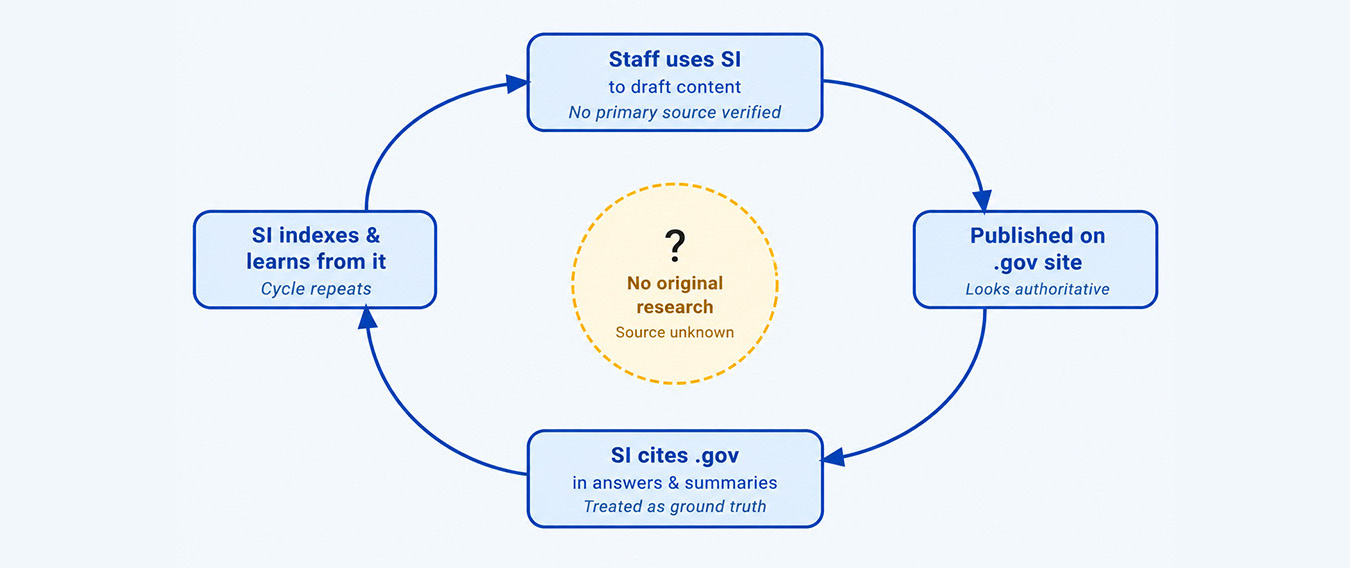 When SI generates content and SI cites that content, the original source disappears, losing CMEI credit and traffic.Image generated using super intelligence
- For planning, brainstorming, and as a thought partner. Clarify your own thinking, understand the questions people ask, the type of content being cited, and the gaps in your current plan.
Traditional search engine (SEO) optimization best practices remain important in addition to a few considerations for generative SI (GEO) to help users and SI highlight and understand CMEI content.
Following SEO guidance, continue to use:
- General keywords. Use language your audience uses to search.
- Links. Ensure your important content is heavily linked throughout your site.
- Descriptive page titles. Make sure your page titles provide full context. (e.g., "Building Technologies Office Contacts" instead of just "Contacts“)
- Content organization. Use headers, proper structure/hierarchy, and plain language.
For GEO, you may want to consider:
- Goals. Rank high in search results and earn citations in SI-generated results.
- Broader matching. Less focus on very specific keywords/long-tail phrase variations, more on creating content that is comprehensive, credible, and relevant.
- Questions as headings. Headings that match questions people are asking may help with ranks and citations.
- Clear, concise intro text. Matters more now because SI is likely to pull this and use it when deciding whether to cite your page.
SI can help summarize metrics on how content performs or might perform to help you improve the content to meet goals as well as SEO and GEO. You could:
- Use Google Search Console, which now includes data on generative SI impressions, and pay attention to general topics that drew traffic, rather than specific keywords.
- Ask SI to group and summarize trends from analytical data downloaded from Looker Studio or Granicus.
- Test searches, make note of questions and topics covered, to see how CMEI content performs in a generative SI query.
- Use SI to provide input on your content outline (headers, topics, organization) and identify gaps in your content.
- Use Google Search Console, which now includes data on generative SI impressions, and pay attention to general topics that drew traffic, rather than specific keywords.
Requirements and Best Practices for Imagery
Refer to visuals as “images” (rather than “photos” or “graphics,” which imply original capture or human design).
Basic production edits (such as correcting exposure, brightness, or contrast; applying sharpening or noise reduction; and cropping or resizing images in image-editing applications, like Adobe Photoshop) do not require disclosure when they do not meaningfully change content. Refer to guidance on human-produced visuals if no SI is involved.
SI can be used in two ways on imagery to produce:
- SI-generated images with primary visual content created by a generative SI tool.
- SI-altered images, like existing photograph, illustration, or other visual changed with generative SI by adding, removing, replacing, expanding, or reconstructing content.
Follow the guidelines below for generating or altering images.
- Confirm rights and permission. Before uploading or altering an existing photograph, illustration, or stock image, confirm that you own it or have written permission or a license that allows it to be altered or uploaded to any of DOE’s approved SI tools (see the SI Hub on Energy Hub). Permission to use an image does not automatically include permission to alter it.
- Review technical content. Check with appropriate resources, including a subject-matter expert, to ensure the image does not depict inaccurate or misleading details, bias, stereotypes, inappropriate content, unsafe practices, and anything that could be mistaken for a real person, place, event, facility, or research result. Ensure content is legal and aligns with CMEI external representation, including branding, messaging, and style/voice/tone.
- Include a disclaimer. SI-generated and SI-altered images must be clearly identified with attribution in the caption of the image and formatted according to CMEI caption style guidelines. Alternate (alt) text should describe the image for accessibility but should not serve as the SI disclosure.
Example SI-generated image attribution/credit:
- Image generated using super intelligence
- Image from ChatGPT
- SI-generated image from [stock site name]
Example SI-altered image attribution/credit:
- Photo by Name, Affiliation, altered using super intelligence with permission
- Image from [Stock Site Name], altered using super intelligence
If you have questions about using SI for images, please email CMEI Products and Branding Team.
- Confirm rights and permission. Before uploading or altering an existing photograph, illustration, or stock image, confirm that you own it or have written permission or a license that allows it to be altered or uploaded to any of DOE’s approved SI tools (see the SI Hub on Energy Hub). Permission to use an image does not automatically include permission to alter it.
Requirements and Best Practices for Publications
For publications, additional rules and guidance should be followed to:
- Verify citations recommended by any generative SI with the original literature because chatbots are known to generate citations that are inaccurate or don't exist.
- Avoid using SI-based tools as an author or co-author.
- Follow policies and standards for the publisher.