



Challenge
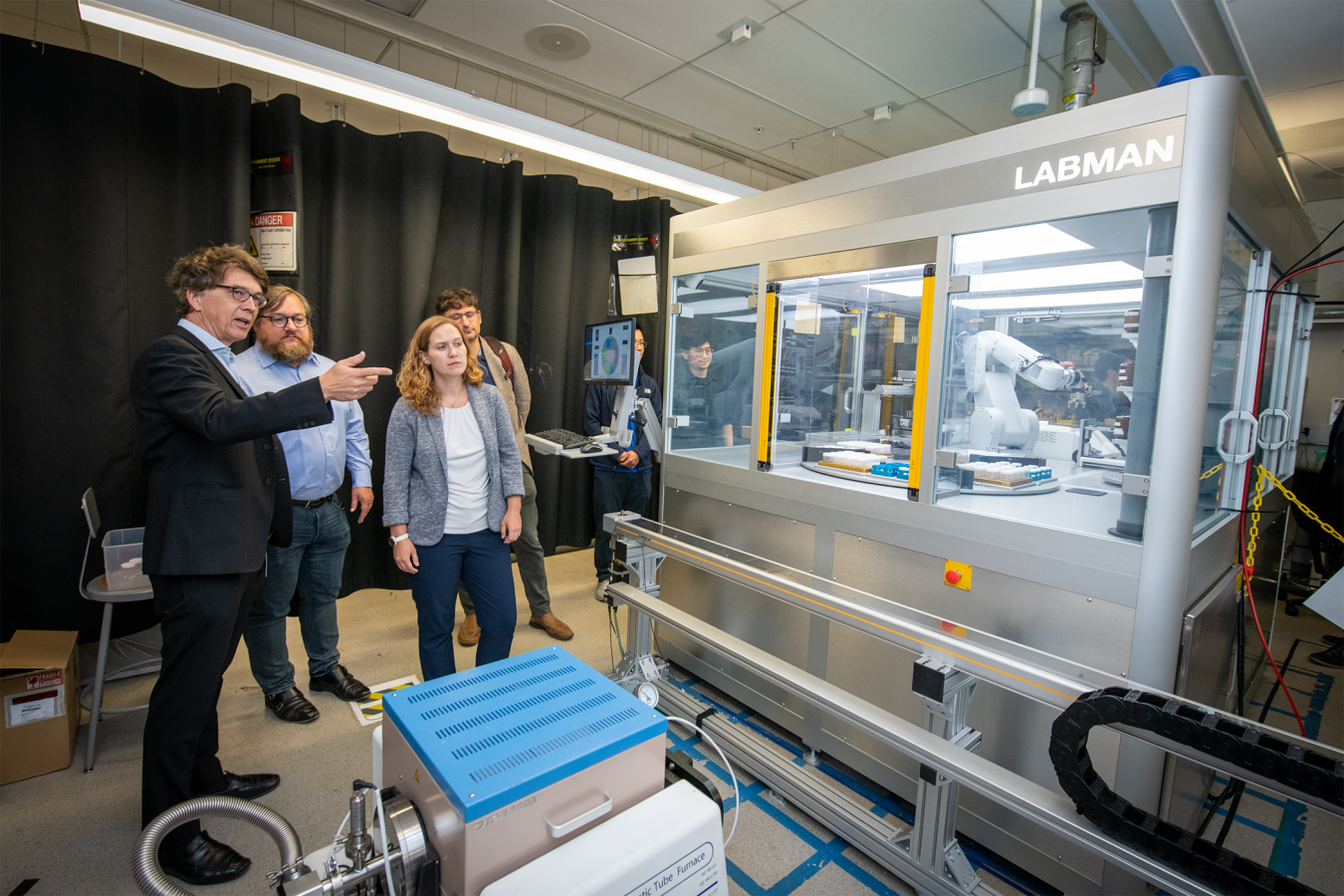
The pace of scientific discovery is influenced by the traditional, human-driven experimental process and the availability of non-deterministic AI-driven control tools to implement complex experimental designs in combinatorially large design parameter spaces. These bottlenecks slow the cycle of hypothesis, experimentation, and discovery, leading to inefficient use of critical national assets and delaying scientific breakthroughs. Automating at least some parts of the scientific experimental scheme will both increase the volume of data produced for improved AI models and improve the repeatability of experiments.
AI Solution
Artificial intelligence will be integrated directly into the experimental workflow and data analysis, combining robotics, edge AI, real-time analysis and intelligent feedback, hypothesis generation, and data curation/sharing.
Justification
These AI-driven laboratories will allow scientists to explore complex phenomena at an unprecedented rate and scale and are critical to achieving the Genesis Mission goals. DOE’s user facilities and long-standing National laboratories have the infrastructure, capabilities, and expertise to serve as the nucleus for innovation with this type of high throughput discovery.
National Impact
Accelerating discovery through AI-driven laboratories will directly advance U.S. scientific leadership and economic competitiveness. This capability will speed up the development of novel materials and molecules for energy, next-generation computing, national security, and biotechnology. Like other challenges, it will also solidify the nation’s position at the forefront of AI and scientific innovation, create a new paradigm for 21st-century research, and train a future workforce fluent in the integration of AI, data science, and experimentation.
Aligned Actions from the National Laboratories
Leading Lab: Pacific Northwest National Laboratory
Biomanufacturing is a critical driver of U.S. economic competitiveness and energy independence, yet bringing novel bio-based fuels, chemicals, and materials to market remains slow and resource-intensive. To address this national challenge, Pacific Northwest National Laboratory has advanced the opensource BacterAI platform to optimize microorganisms central to bioproduction. By integrating reinforcement learning from BacterAI with laboratory automation, scientists enable continuous, closed-loop experimentation that rapidly explores large biological parameter spaces and identifies limits to microbial growth. This AI-driven approach dramatically increases experimental throughput—issuing new experiments in minutes rather than days—and generates comprehensive, AI-ready datasets that accelerate the commercialization of emerging biotechnologies.
Leading Lab: Argonne National Laboratory
Fuel combustion technologies underpin the majority of U.S. primary energy production and form the backbone of key industrial sectors. Yet, designing next generation combustion systems remains slow, expensive, and computationally constrained. Argonne National Laboratory, along with other national laboratories and industry partners, is addressing this challenge with COMB FLOW AI, a transformational frontier AI platform to dramatically accelerate discovery science and engineering for novel fuel combustion technologies. The platform comprises advanced scientific AI foundation models and agentic AI frameworks to enable fast, predictive digital twins for multiscale flow and combustion systems and orchestrate end to end design and optimization workflows. By enabling near real time forecasting, early detection of safety-critical extreme combustion events, and rapid co design of fuels and engines, COMB FLOW AI can significantly shorten design cycles and reduce maintenance costs—representing a significant improvement in how advanced energy technologies are developed and deployed.