



Addressing technical challenges is necessary but not sufficient to successfully commercialize and scale a new technology. Technology commercialization also requires addressing non-technical market and adoption challenges.
The Adoption Readiness Level (ARL) framework can help identify adoption risks and opportunities and support the successful commercialization of new technologies.
The Adoption Readiness Level framework is a commercialization guide—covering a comprehensive range of adoption risks that technologies can face. Identifying and addressing adoption risks early and often can accelerate technology commercialization.
What is the ARL framework?
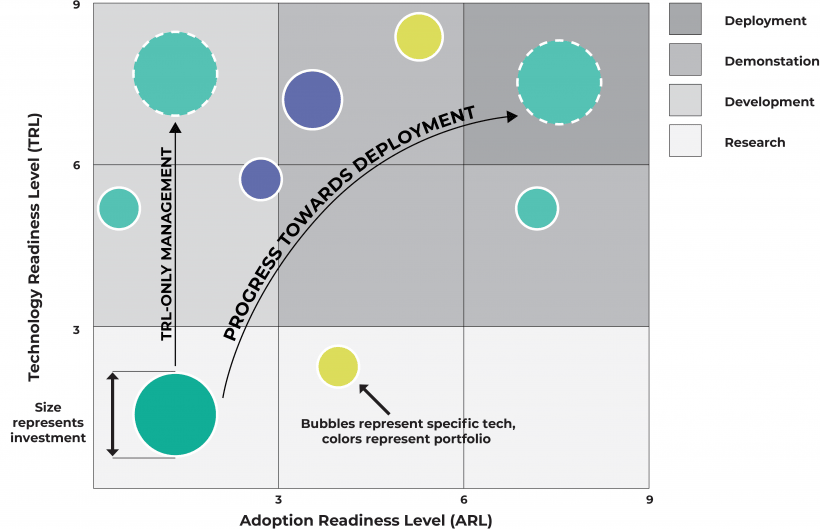
The ARL framework is a tool to assess the commercialization risks facing a technology as it crosses the Research, Development, Demonstration, and Deployment (RDD&D) continuum to reach successful commercialization. The ARL framework complements the widely adopted Technology Readiness Levels (TRL) framework by extending beyond the technical risks that technologies face on their commercialization journeys to capture other commercialization risks. It consists of 17 dimensions that fall into four risk buckets:
- Value Proposition—Assesses the ability for a new technology to meet the functionality required by the market at a price point that customers are willing to pay, to meet the market demand (a broadened definition of “product-market fit”).
- Market Acceptance—Captures the target market(s) demand characteristics and risks posed by existing players — including competitors, customers, and other value chain players.
- Resource Maturity—Determines risks standing in the way of inputs that are needed to produce the technology solution.
- License to Operate—Identifies the societal (national, state, and local), non-economic risks that can hinder the deployment of a technology.
Learn more about the core risk areas assessed in the ARL framework HERE.
ARL risk dimensions can be assessed and translated into a 1 to 9 adoption readiness score (ARL score) that generally indicates a technology’s status. However, the value of the ARL framework lies in its ability to show exactly which dimensions present the key barriers to commercial adoption.
To learn more about how ARLs can be applied in real-world technology commercialization efforts, watch the ARL Framework Overview webinar HERE.
Download the Adoption Readiness Assessment Tool HERE.
Why use ARLs?
The ARL framework was developed by the U.S. Department of Energy’s Office of Technology Commercialization (OTC) in partnership with industry stakeholders to support OTC's mission—enabling technology commercialization across the Department of Energy and beyond.
Commercialization is a core part of the U.S. Department of Energy’s (DOE) mission. The public dollars DOE invests in its technology portfolio can achieve their maximum impact when technologies traverse the RDD&D continuum to attain commercial deployment. The ARL framework is one of a suite of tools, programs, and activities developed by OTC to support the DOE’s mission.
Watch the video below for an in-depth introduction to ARLs.
Who uses ARLs?
The ARL framework can be used by all participants in the commercialization ecosystem: from technologists and entrepreneurs to National Lab commercialization professionals and technology incubators to financial institutions providing funding. DOE offices use ARLs to inform program design, investment, and risk management decisions.
Today’s ARL users include:
- Technologists, incubators, researchers
- National Labs
- Universities and academia
- DOE program offices
- Project managers
- Industry think tanks, investors, and insurance
Learn more about ARL users HERE.
We continue to develop and refine this framework via ongoing engagement with private and public sector stakeholders. For further information, please reach out to us at ARL@hq.doe.gov.
- Image

Sandia National Lab, in partnership with the Office of Technology Commercialization, conducted an ARL pilot program focused on emerging technologies in their ecosystem. The program helped technology teams reduce adoption risks, clarify commercialization roadmaps, and apply for funding more effectively. By using ARLs, the teams deepened their understanding of market needs and communicated their technologies’ value more clearly. This pilot established a repeatable process for evaluating adoption risks, contributing to faster commercial deployment.
- Image
The Geneva Association leveraged the ARL framework to drive innovation in the insurance sector by addressing climate tech risks. A new Insurability Readiness Framework (IRF) was developed, aligning insurance risk categories with ARL-based commercialization risks. This framework has improved risk management conversations between insurers and stakeholders and facilitated the development of insurance solutions for climate technologies like green hydrogen and CCUS.
- Image

BRITE Energy Innovators integrated the ARL framework into its BRITEelevate program to help startups assess market viability. The framework enabled companies, such as AnywherEnergy Systems, to align their co-founders on commercialization risks and develop strategic plans with clear, achievable milestones. ARLs provided a structured approach to understanding and addressing commercialization challenges, helping teams prepare for funding and customer engagement.
- Image

OCED’s latest Portfolio Insight report, Learning from Case Studies: Financing & Development Approaches from Recent First-of-a-Kind Projects, evaluated First-of-a-Kind (FOAK) projects through the lens of the ARL framework, using ARLs both to assess risks and identify mitigation strategies.
- Image

PNNL, in partnership with the Office of Technology Commercialization, conducted an ARL pilot evaluating the commercialization challenges faced by redox flow batteries. The project enabled PNNL researchers to gain experience conducting market research and assessing adoption challenges while building in-house ARL expertise. This pilot created a replicable methodology for ARL technology evaluations which will inform PNNL funding priorities.


ARL in the news
After Decades of Focus on Technology Innovation, It’s Time for Climate Companies to Ask: “Can we Scale this?” - B Capital, (October 2024), B Capital Group.
The Department of Energy has gotten serious about technology commercialization (October 2024), Volts.
Putting Clean Energy Pilots on a Commercialization Fast Track (May 2024), Federation of American Scientists.