Physical storage is the most mature hydrogen storage technology. The current near-term technology for onboard automotive physical hydrogen storage is 350 and 700 bar (5,000 and 10,000 psi) nominal working-pressure compressed gas vessels—that is, "tanks."
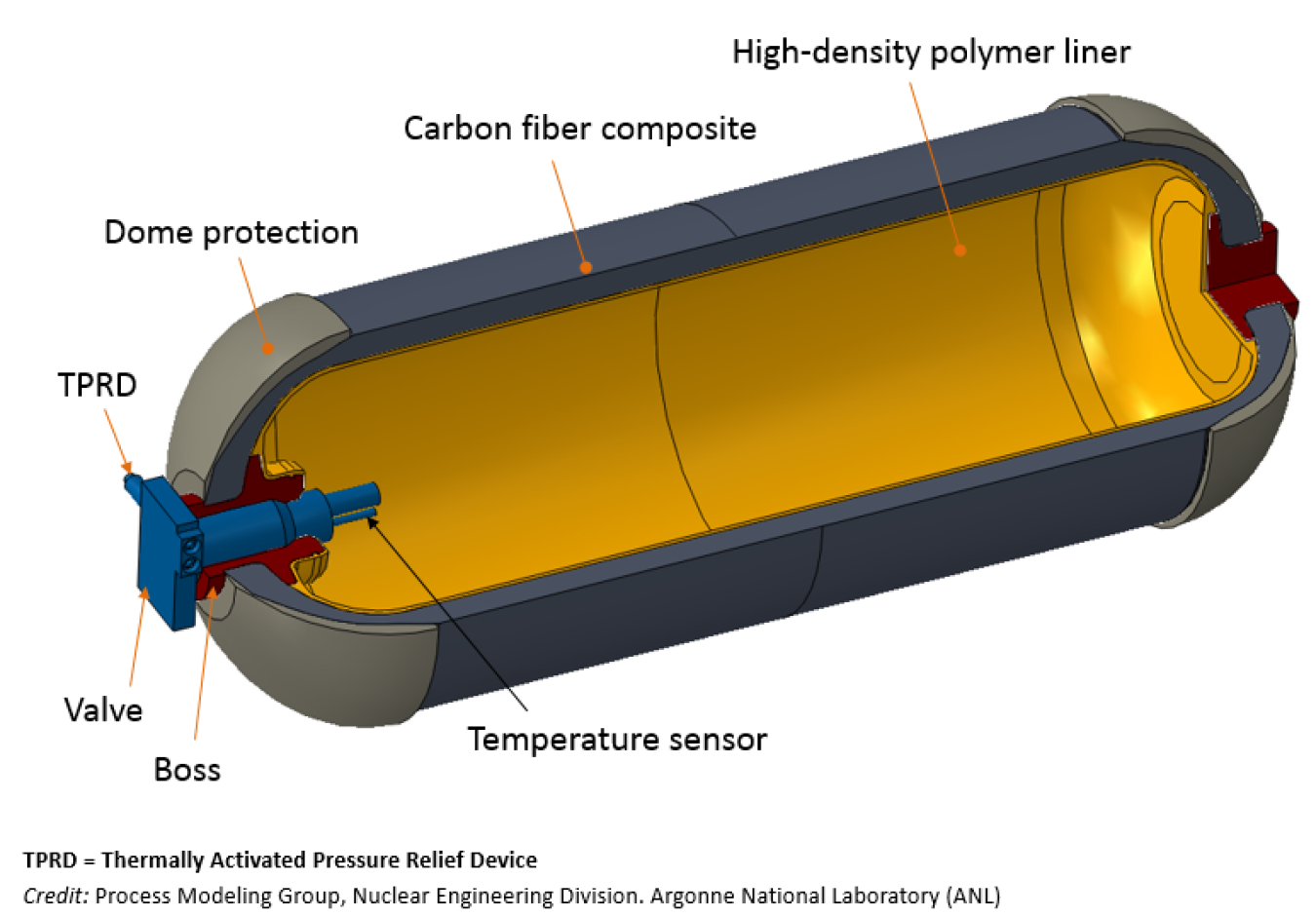
Components of a pressurized hydrogen storage tank.
While low-pressure liquid hydrogen, near the normal boiling point of 20 K, is routinely used for bulk hydrogen storage and transport, there is currently little activity in developing it for onboard automotive use. While compressed hydrogen typically is stored at near-ambient temperatures, "cold" (sub-ambient but greater than 150 K) and "cryogenic" (150 K and below) compressed hydrogen storage are being investigated due to the higher hydrogen densities that can be achieved at reduced temperatures.
Technical Targets and Status
Compressed hydrogen storage systems have been demonstrated in hundreds of prototype fuel cell vehicles and are available commercially at low production volumes. While physical storage has not yet met all of the U.S. Department of Energy (DOE) targets for onboard automotive storage, many targets have been achieved with only a few key areas requiring further improvement, including gravimetric density, volumetric density, and cost.
Expand each of the menu items below to learn more about the performance and cost of compressed hydrogen storage systems.
Projected Performance and Cost of Compressed Automotive Hydrogen Storage Systems Compared to 2020 and Ultimate DOE Targetsa
Storage System Targets Gravimetric Density
kWh/kg system (kg H2/kg system)Volumetric Density
kWh/L system (kg H2/L system)Cost
$/kWh ($/kg H2)2020 1.5 (0.045) 1.0 (0.030) $10 ($333) Ultimate 2.2 (0.065) 1.7 (0.050) $8 ($266) Current Status
(from Argonne National Laboratory)Gravimetric Density
kWh/kg system (kg H2/kg system)Volumetric Density
kWh/L system (kg H2/L system)Costb
$/kWh ($/kg H2)700 bar compressed (Type IV, single tank) 1.4 (0.042) 0.8 (0.024) $15c ($500) a Assumes a storage capacity of 5.6 kg of usable hydrogen.
b Cost projections are estimated at 500,000 units per year and are reported in 2007$.
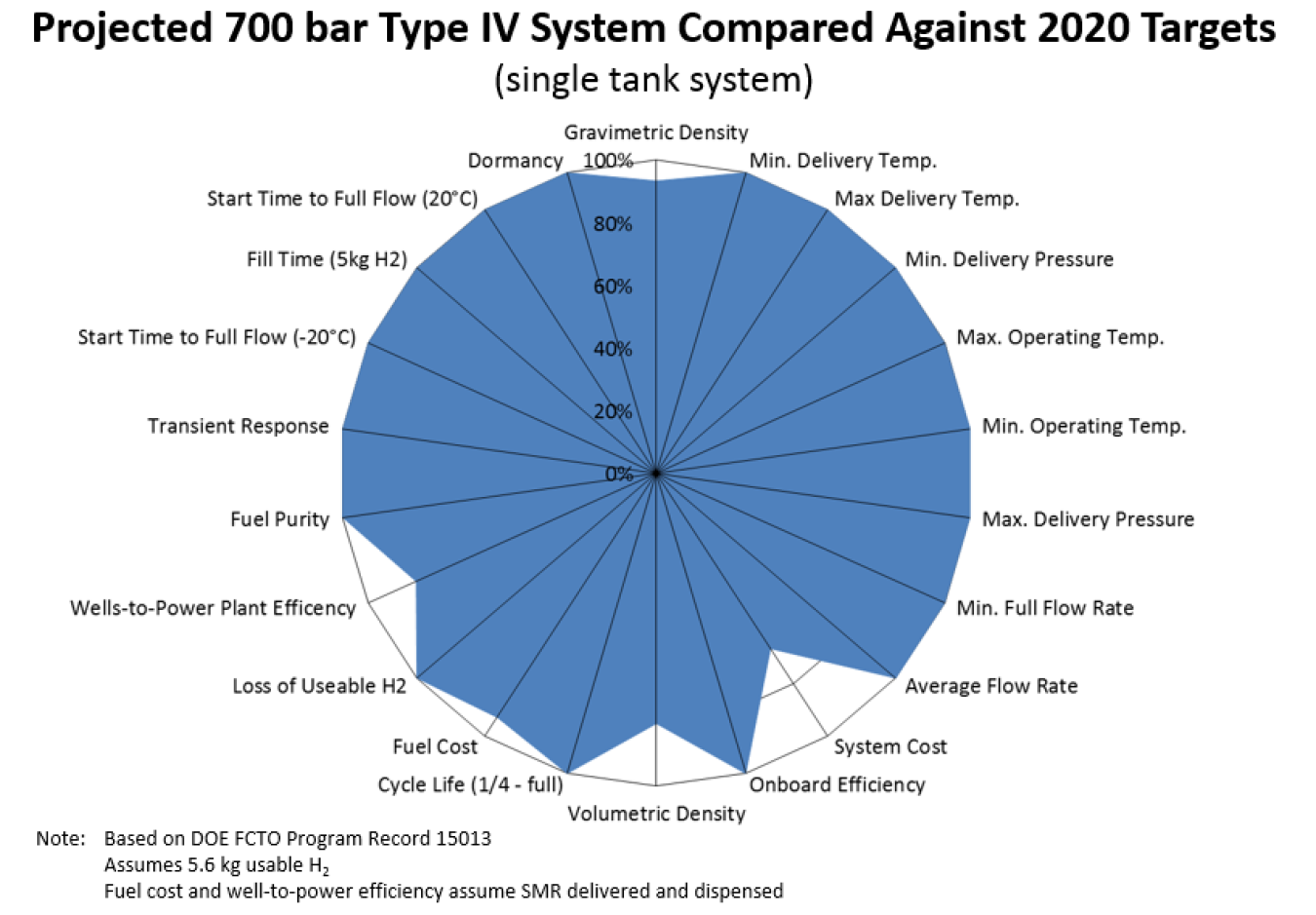
c Cost projection from Strategic Analysis (November 2015).This system projections graph conveniently shows how a conventional 700 bar Type IV compressed hydrogen storage system at 300 K compares against all of DOE's 2020 onboard vehicle storage targets. The blue space indicates current performance and the white space indicates the areas in which 700 bar compressed systems currently fall short of DOE's 2020 targets.
The cost of current compressed gas systems for automotive applications is dominated by the carbon fiber composite with a significant impact from balance of plant (BOP) components. Current physical storage research and development efforts focus on reducing the cost of the fiber reinforced composite portion of the pressure vessel to help meet DOE targets. These pie charts show cost distributions for 350 bar and 700 bar Type IV single-tank compressed hydrogen systems at 500,000 units. See DOE Hydrogen and Fuel Cells Program Record 15013.
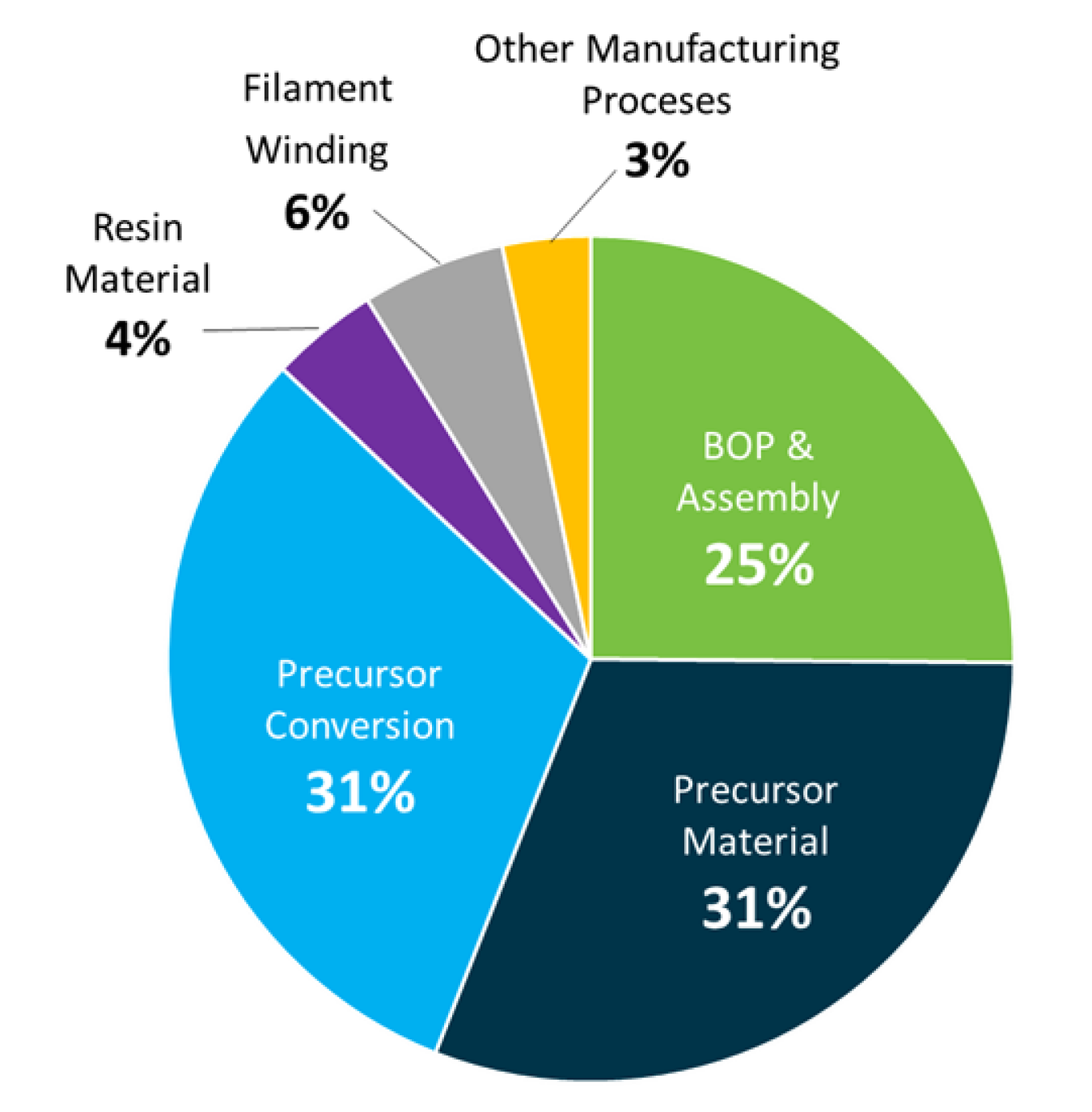
700-bar compressed hydrogen storage system cost breakout (single tank system) from 2015 DOE Hydrogen and Fuel Cells Program Record #15013.
DOE also has conducted analysis to determine the cost for the low volumes that are expected during the initial ramp up of fuel cell electric vehicles. These bar charts show how the estimated system costs vary based on production volume for 350 bar (top) and 700 bar (bottom) compressed hydrogen storage systems. See DOE Hydrogen and Fuel Cells Program Record 15013.

700-bar compressed hydrogen storage system cost breakout by volume from 2015 DOE Hydrogen and Fuel Cells Program Record #15013.
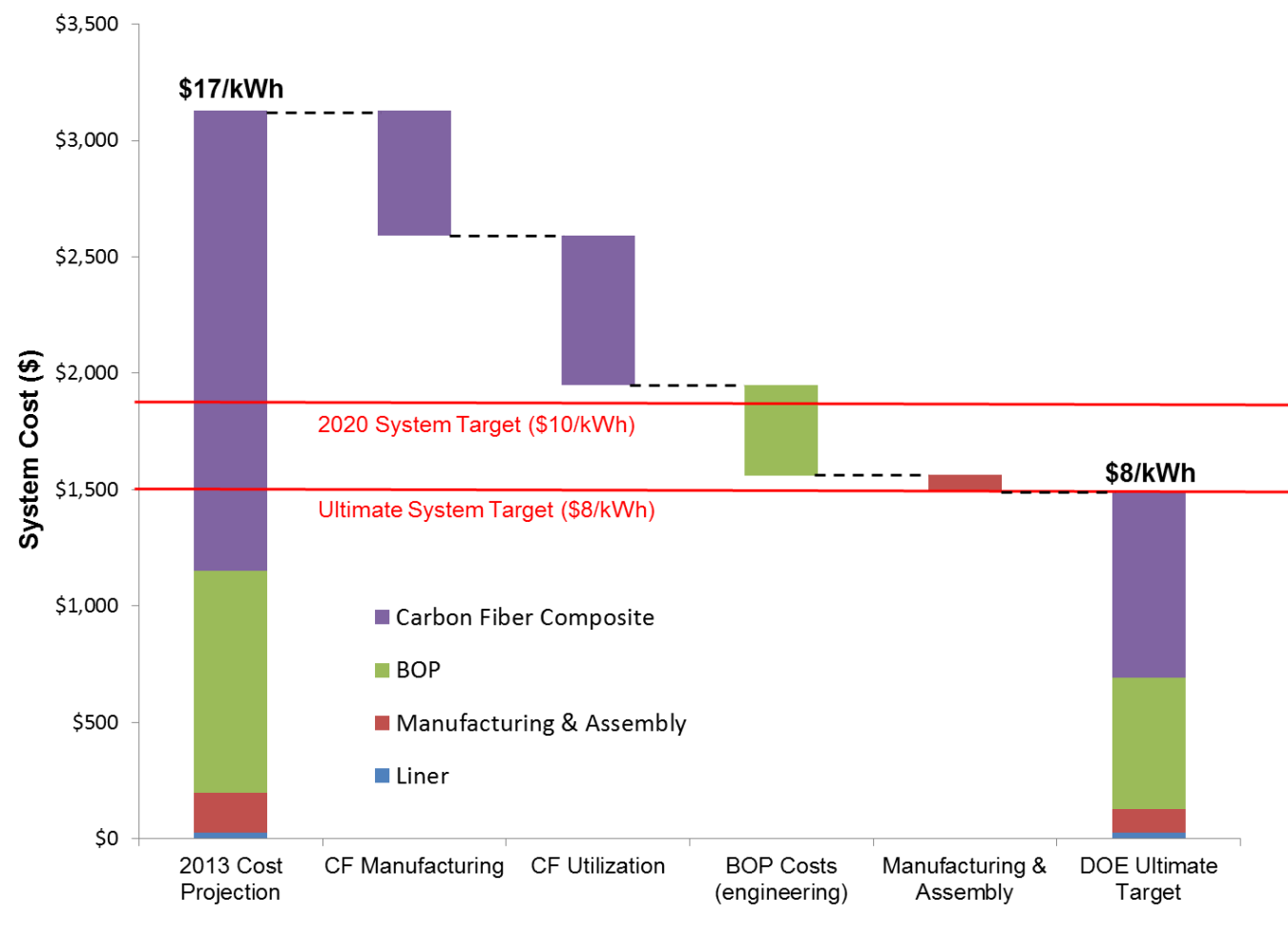
Finally, DOE has determined potential pathways to reduce the cost of compressed tanks. This includes reducing the cost of carbon fiber composites and/or developing lower cost alternative fiber reinforced composites, better utilizing and therefore reducing the amount the fiber reinforcement included in the tank, and reducing the amount and cost of balance of plant components. This chart shows one potential cost reduction strategy for 700 bar compressed systems.