



Cleanup crews in the Oak Ridge National Laboratory central campus have filled 120 feet of underground ductwork connecting multiple facilities with a cement mixture to isolate them for safe demolition and avoid potential impacts to neighboring buildings. April 28, 2026
Office of Environmental Management
April 28, 2026 Estimated Read Time min
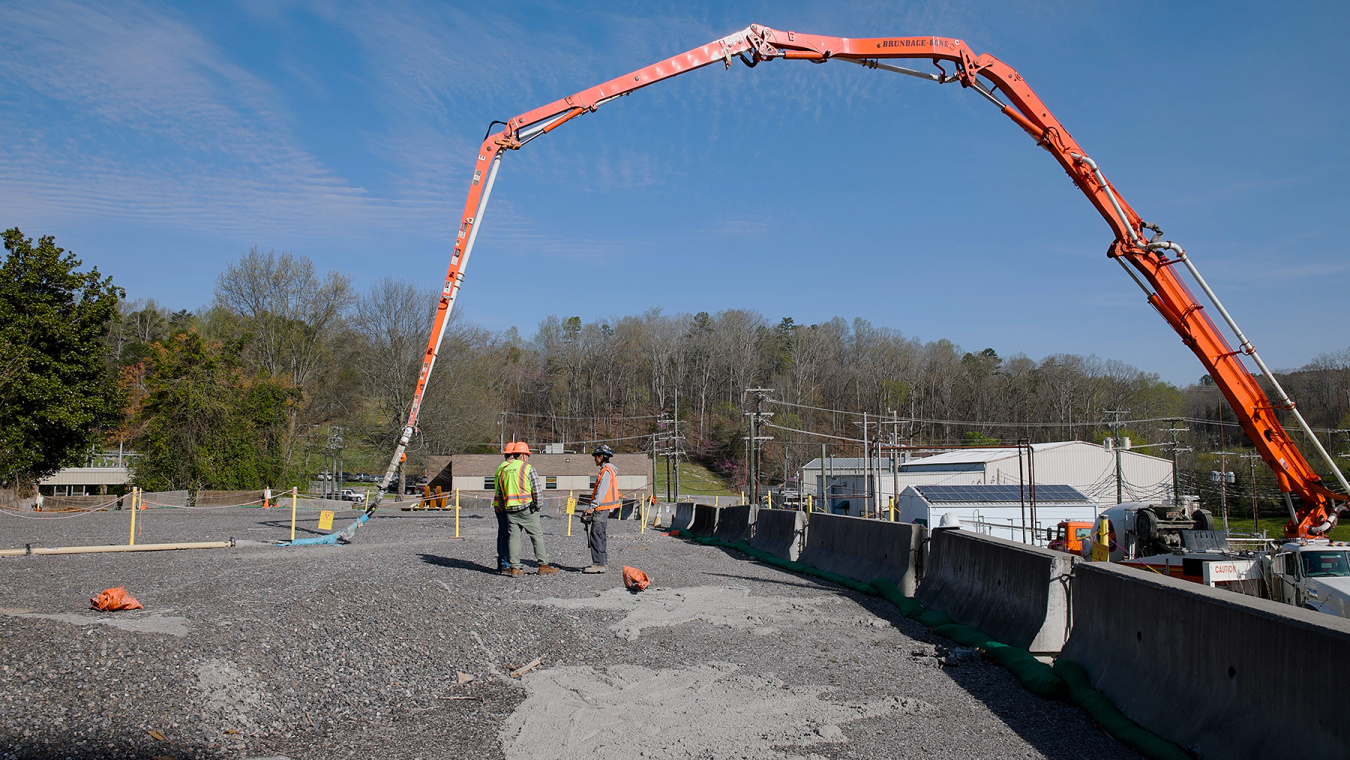
A pump truck, stationed outside a high-security area in the heart of the Oak Ridge National Laboratory central campus, uses 400 feet of piping to fill underground ducts with a cement mixture. This task isolates Building 3002 from neighboring facilities for safe demolition.
OAK RIDGE, Tenn. — Cleanup crews in the Oak Ridge National Laboratory (ORNL) central campus have filled 120 feet of underground ductwork connecting multiple facilities with a cement mixture to isolate them for safe demolition and avoid potential impacts to neighboring buildings.
The Oak Ridge Office of Environmental Management and cleanup contractor United Cleanup Oak Ridge (UCOR) completed the project to prepare for demolition of Building 3002, a former filter house used to clean exhaust from the nearby historic Graphite Reactor. The two buildings are connected by the concrete ductwork, which posed a potential pathway for contaminants when the demolition begins.
The work at Building 3002 is part of a broader cleanup that’s steadily removing risks and transforming the heart of the ORNL central campus to enable future modernization.
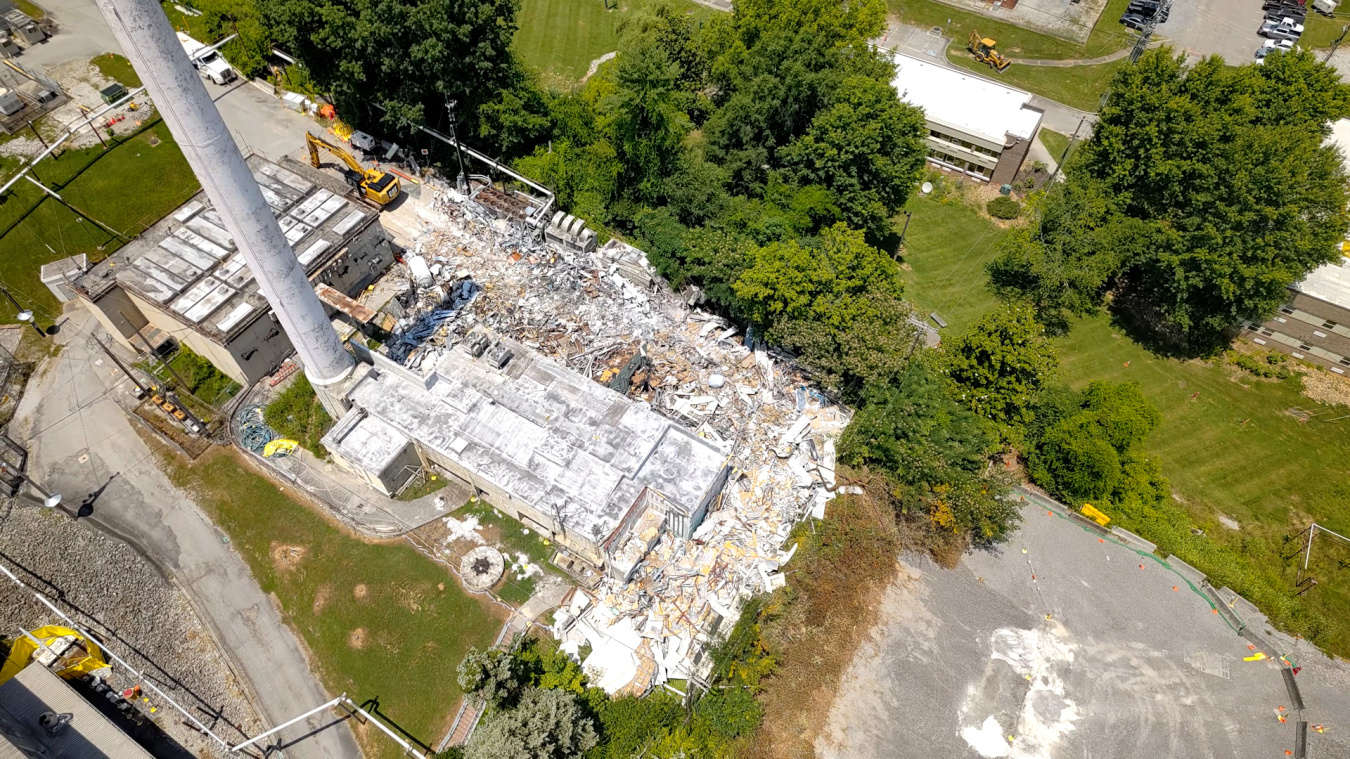
An aerial view of the Graphite Reactor support facilities, which are comprised of Building 3002, at left, and Building 3018, a 200-foot-tall stack, at center. Crews took down Building 3003, at right, last year.
Crews previously demolished Building 3003 — a fan house that provided essential ventilation to the Graphite Reactor — opening 10,000 square feet to prepare for this next demolition.
Constructed in only nine months, the Graphite Reactor achieved criticality in 1943, and it was the world’s first continuously operating nuclear reactor. Its initial mission involved showing plutonium could be extracted from irradiated uranium. After the Manhattan Project, it supported nuclear energy and medical research missions.
The reactor was shut down in 1963, and it was designated a national historic landmark in 1965. Today, the facility is part of the Manhattan Project National Historical Park at Oak Ridge.
“The team’s ability to safely isolate these facilities protects a nationally significant historic landmark while advancing cleanup in a complex operating environment,” said Steve Clemons, ORNL portfolio federal project director. “This work moves us another step closer to our next project that will continue ORNL’s transformation.”
Conducting the concrete mixture pours presented challenges, including a steep hillside that complicated equipment placement and identifying alternate routes for concrete trucks through nearby high-security areas.
The solution involved crews assembling 400 feet of piping and connecting it to a pump truck staged outside the protected area. This approach enabled precise placement of 200 cubic yards of the concrete mixture while avoiding disruption to the historic facility and minimizing security challenges.
“This innovative approach allowed our crews to safely execute complex work while maintaining security boundaries and protecting critical infrastructure,” said UCOR Project Manager Zachary Dew. “It’s a strong example of how we’re solving challenges in the field to keep cleanup moving forward.”
-Contributor: Ryan Getsi
To receive the latest news and updates about the Office of Environmental Management, submit your e-mail address.