A scientific mystery involving the muon that has vexed scientists for decades has reached a resolution.
April 29, 2026 Estimated Read Time min
Shannon Brescher Shea

Shannon Brescher Shea (shannon.shea@science.doe.gov) is the social media manager and senior writer/editor in the Office of Science’s Office of Communications and Public Affairs. She writes and curates content for the Office of Science’s Twitter and LinkedIn accounts as well as contributes to the Department of Energy’s overall social media accounts. In addition, she writes and edits feature stories covering the Office of Science’s discovery research and manages the Science Public Outreach Community (SPOC). Previously, she was a communications specialist in the Vehicle Technologies Office in the Office of Energy Efficiency and Renewable Energy. She began at the Energy Department in 2008 as a Presidential Management Fellow. In her free time, she enjoys bicycling, gardening, writing, volunteering, and parenting two awesome kids.
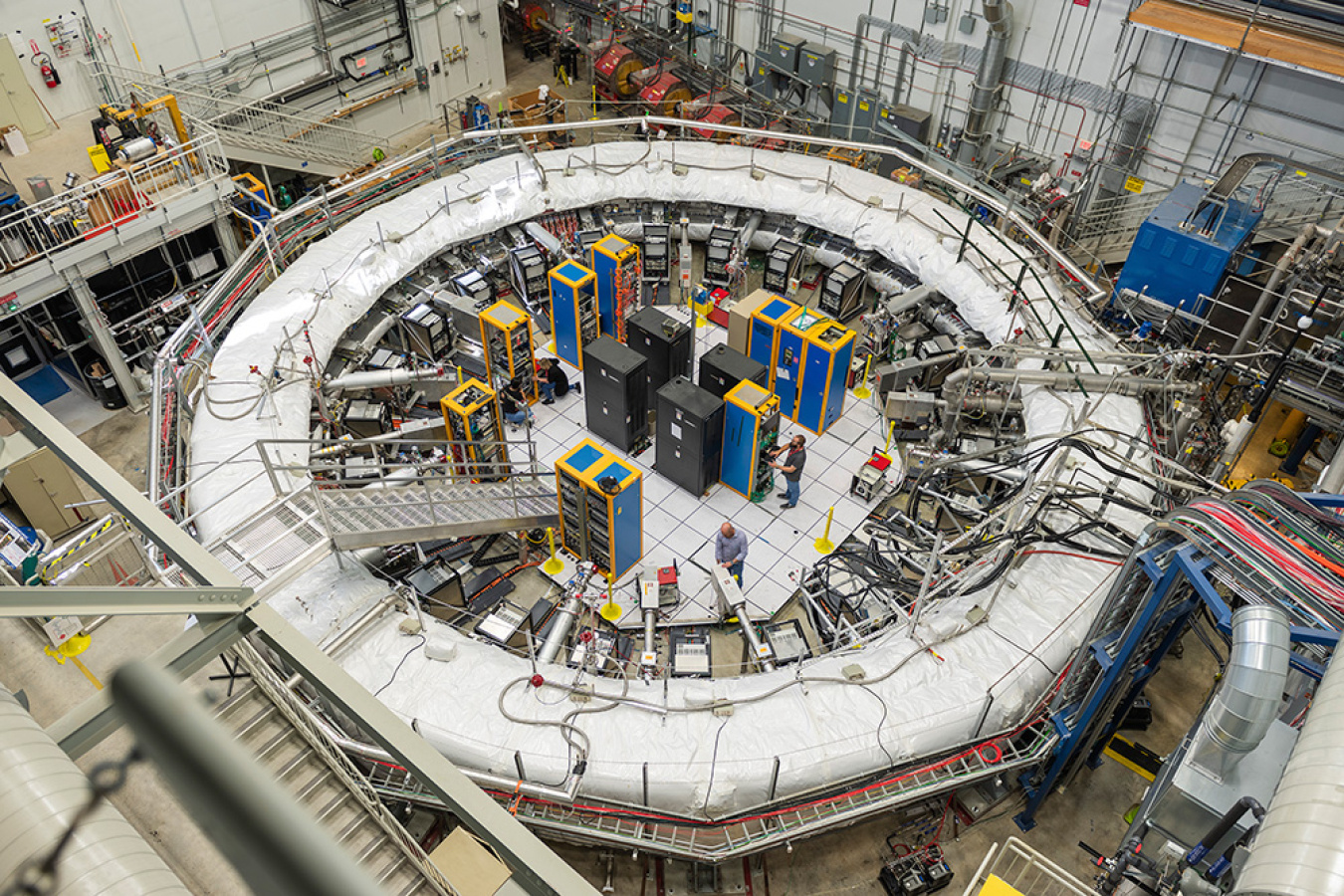
A small wobble may not seem like a big deal. But when that small wobble could answer some of the most important questions in physics, scientists pay attention. The wobble in question belongs to the muon, a fundamental particle that’s the cousin of the more familiar electron.
For tackling the question of why experimental measurements of this wobble didn’t match what theory predicted, the Muon g-2 collaboration received this year’s Breakthrough Prize in Fundamental Physics. The Breakthrough Prize recognizes the world’s top scientists working in the fundamental sciences – the disciplines that ask the biggest questions and find the deepest explanations. The Muon g-2 collaboration spanned nearly 60 years of scientific research, most of it supported by the Department of Energy’s (DOE) Office of Science.
A strange measurement for a strange particle
The muon is a fundamental particle that’s smaller than an atom. It’s part of the Standard Model of Particle Physics, the best framework that scientists currently have for explaining the building blocks of the universe. In nature, cosmic rays striking our atmosphere create muons. In the laboratory, scientists smash particles together to create them.
The Muon g-2 collaboration addressed a strange phenomenon that scientists had noticed about the muon.
Back in 2001, researchers at the DOE’s Brookhaven National Laboratory found that a certain measurement of the muon didn’t seem to match up with what theory would predict. While the Standard Model of Particle Physics is scientists’ current best explanation, there are a number of scientific phenomena it doesn’t explain, such as dark matter. Experimental measurements that conflict with the Standard Model have the potential to radically expand scientists’ understanding of the universe.
Measuring g
The specific measurement scientists noticed could conflict is called the muon’s “g” factor.
Early theoretical predictions suggested this value should be exactly 2. However, according to the more complete Standard Model, the “g”-factor is predicted to be slightly larger than 2. The "g-2" in the collaboration's name refers to the experiment's goal of measuring this tiny deviation from 2. This deviation is known as the anomalous magnetic moment. This "g"-factor relates the muon's magnetic moment to its spin. When scientists produce muons in particle accelerators, the particles have a quantum property called spin. This property can be visualized as a tiny internal magnet. When these muons are placed in a strong magnetic field, they precess, or “wobble,” much like a spinning top. The “g”-factor measures the rate of this wobble. Any unexpected deviation in that rate could point to new particles or forces not yet described by the Standard Model.
The researchers at Brookhaven were attempting to measure the value of “g” as precisely as possible. Scientists at CERN had measured it in a previous experiment that had run from 1959 to 1979. However, the Brookhaven experiment was supposed to be six times more precise.
After taking four years of data, the researchers at Brookhaven found a three-sigma anomaly between the measurements and theory. A three-sigma anomaly is essentially a hint or some evidence that there may be a conflict with the Standard Model. If there isn’t a difference between the two, this sort of result should only happen about three out of a thousand times you run an experiment. However, that isn’t enough for physicists to declare a solid discovery of “new physics” beyond the Standard Model.
Although scientists hoped the rest of the data would provide more certainty, the final result of the experiment was also a three-sigma anomaly. The hint remained, but so did the ambiguity.
Investigating with more precision than ever
It wasn’t until almost 20 years later that researchers were able to follow up on those promising results. In 2011, scientists began developing the Muon g-2 experiment at DOE’s Fermi National Accelerator Laboratory. Recycling $100 million worth of equipment – including hauling a massive storage ring from Long Island to the Chicago suburbs – they constructed the new, even more precise experiment.
The new Muon g-2 experiment announced its final results in June 2025. This result had incredible precision – far more than any other experiment. It also confirmed the previous sets of measurements – both the prior results from the Fermilab experiment and the Brookhaven experiment.
But this time, there was a key change. The three-sigma difference no longer remained.
Rethinking theoretical calculations
While scientists thought that perhaps the difference between experiment and theory would reveal new physics, the change came from the theoretical side instead.
While scientists were collecting data at Fermilab, a separate team was improving theoretical calculations. In 2020, this team released a set of predictions based on a new computational technique. These theoretical predictions were far closer to the experimental measurements than ever before. They vastly reduced the discrepancy between the experimental and theoretical results.
Recently, the team put out another prediction that completely agrees with the final Muon g-2 measurement.
There is still some discrepancy between the computational approaches and a different, data-driven approach. But many of the questions have now been resolved.
A dynamic relationship
While the Muon g-2 experiments most likely did not reveal physics beyond the Standard Model, they did lead to major improvements in our understanding of the muon. The discrepancy between the theoretical and experimental results raised questions about theory that may not have been otherwise addressed. It drove scientists to use new tools to investigate those assumptions. Those inquiries further sharpened our explanations of the fundamentals of the universe.
Physics is often a dance between experimental observations and theory. As measurements improve, they diverge from theory. Then physicists attempt to figure out where that difference comes from, whether it is a measurement issue, a theoretical issue, or truly new physics. In the case of Muon g-2, the two have finally harmonized.