



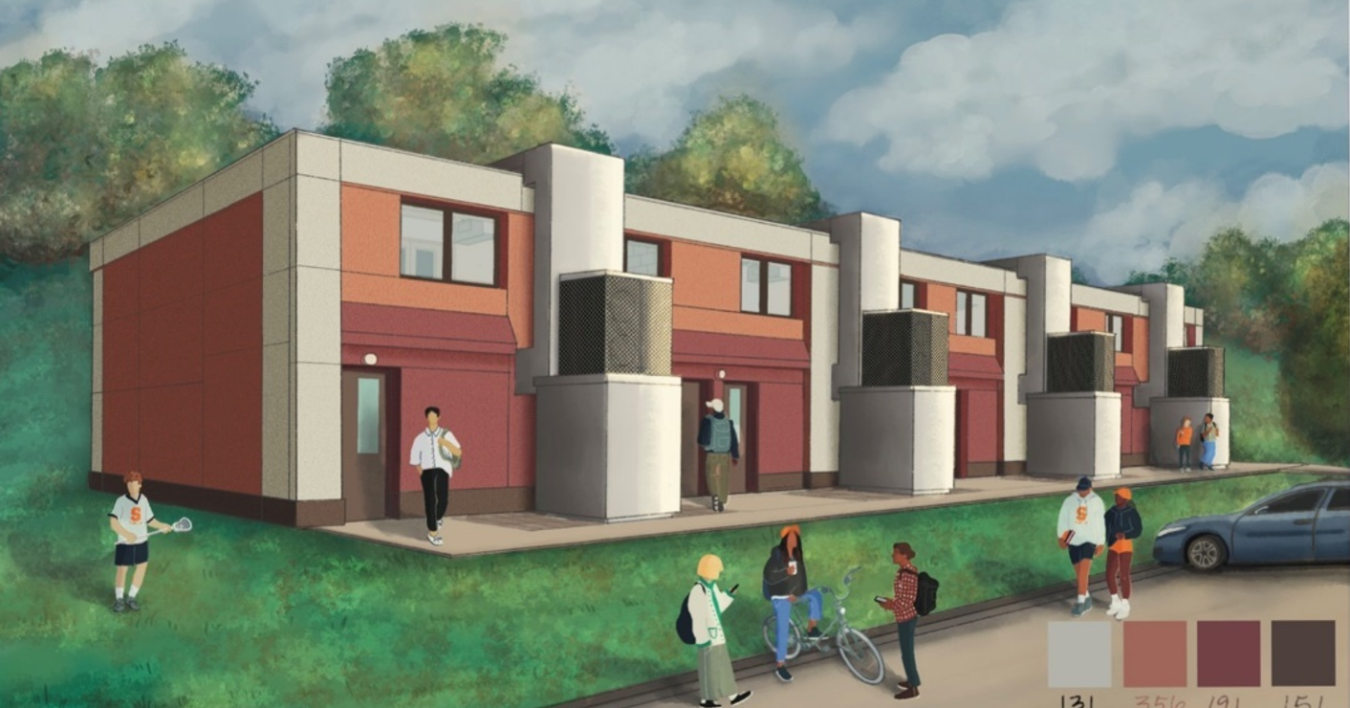
The Syracuse University retrofit system is designed for rapid deployment of insulated retrofit panels and a prefabricated mechanical pod system for low-rise buildings.
Overview
The Syracuse University project demonstrates a transformative solution for whole-building energy efficiency retrofits of single-family attached residences in cold/very cold climates. The solution integrates a prefabricated panel system, a high-efficiency mechanical pod solution, and 3D information capture to model and configure the retrofit system.
| Project Type | Problem to Solve | Solution | Location | Timeline | Partners |
| Residential retrofit | Time and cost of deep energy retrofits | Integrated whole-building retrofit with mechanical pod system | Syracuse, NY | August 2022–June 2026 |
|
Project Goals
Retrofit components will be fabricated, delivered, and installed on two occupied buildings to demonstrate a whole-building retrofit solution that is fast to implement, minimizes disruption to occupants, improves comfort and indoor air quality, and delivers 75% thermal energy savings.
Impacts
This project is addressing the pressing need for innovation in retrofit processes. It maximizes energy performance while emphasizing health and comfort by integrating design, analysis, monitoring, fabrication, and installation.
Technology Impact
The integrated retrofit solution is designed from the outside in, minimizing time on-site and disruption to residents. It leverages a 3D scanning workflow for building assessment and retrofit configuration. The insulated panel system will provide airtightness of 1.05 air changes per hour at a 50 Pa pressure differential. Combined with high-efficiency mechanical pods for heating, cooling, ventilation, and domestic hot water, the solution promises improvements in thermal comfort and ventilation, with a 75% reduction in thermal energy consumption.
Market Impact
The approach holds the potential for annual thermal energy savings of 114.45 TBtu for single-family housing alone. This extends to solutions for single-family detached and multifamily (two- to four-unit) buildings, resulting in an overall potential energy savings of 1,812 TBtu/year.
We believe the proposed approach can facilitate the widespread adoption of deep energy retrofit technologies and accelerate the creation of a large-scale, self-sustaining market for these types of solutions in New York state and nationally.
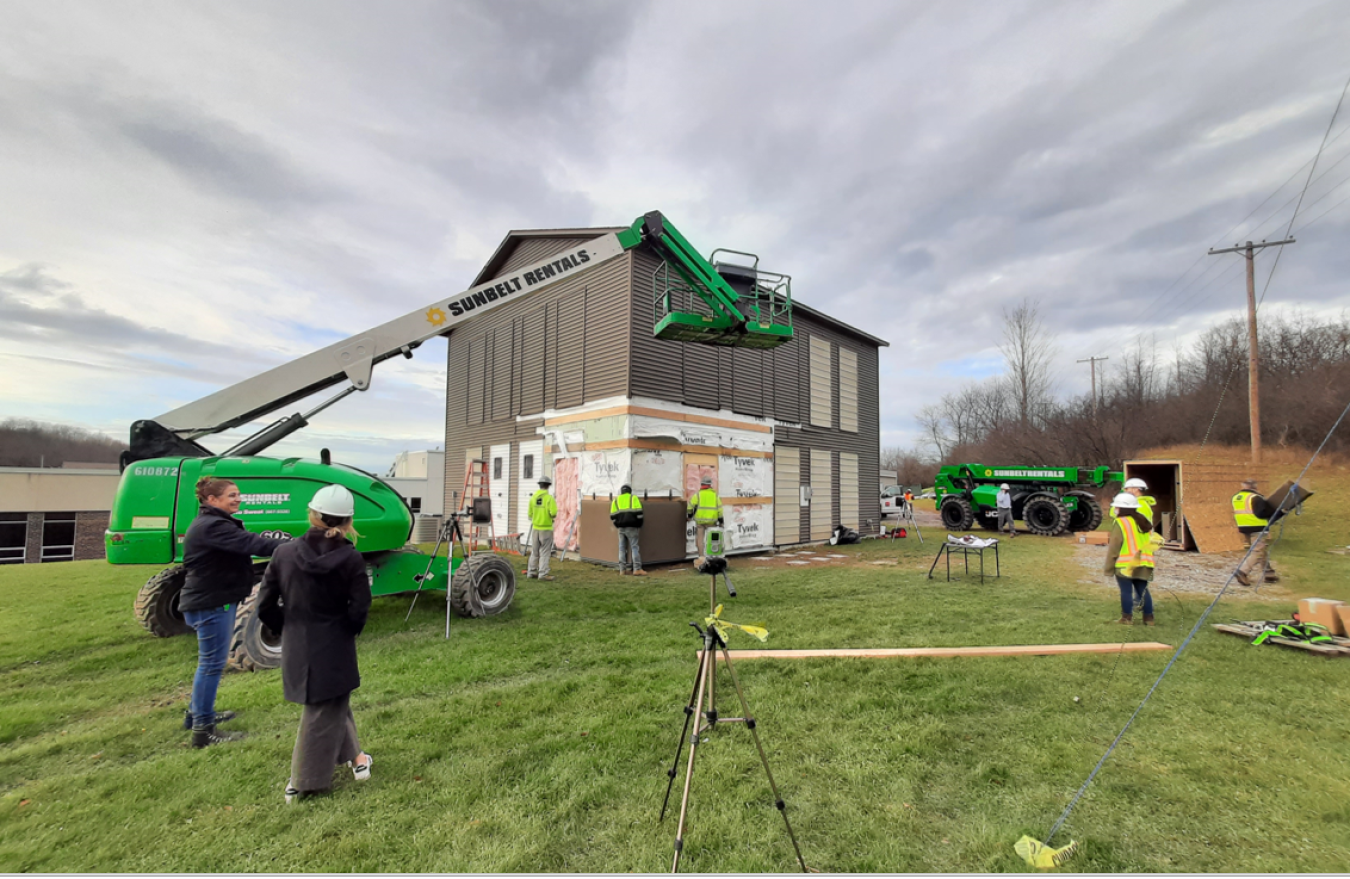
Installation of the retrofit prototype on Syracuse University’s Building Envelope Systems Test (BEST) lab during Phase I of the DOE ABC project.
- Pre-retrofit planning and coordination in 2022–2023 included resident engagement and the development of a monitoring and verification plan.
- Monitoring systems were installed in 2023 to measure pre-retrofit energy use, indoor air quality, and building envelope performance.
- A coordinated team effort led to a design, bidding, and value-engineering process that meets the goals of the project on time and within the budget.
- Permit application materials were submitted for the retrofit installation, which is scheduled for summer 2024.
- Retrofit demonstration projects require time and effort for research, design, and iteration.
- Begin design early and ensure the budget is monitored through design stages, building in contingency for uncertainties and engagement with contractors.
- Identify schedule constraints and downstream effects of a potential value-engineering process.
- Plan for assumed risk with unfamiliar products; engage building owners, contractors, and residents to communicate plans for retrofit operation and maintenance.
- The retrofit installation will take place on two demonstration buildings at Syracuse University in summer 2024.
- Documentation of the installation process will include time and labor tracking, video footage, and interviews with contractors.
- Monitoring and surveys will track improvements in energy performance, indoor air quality, and comfort.
- Analysis of the entire process—from assessment to post-retrofit—will highlight time- and cost-effective strategies and targeted areas for the scaling of deep energy retrofits.
General Inquiries: abc@ee.doe.gov
About the ABC Initiative
The Advanced Building Construction (ABC) Initiative, led by the Building Technologies Office (BTO), integrates energy efficiency and advanced technology solutions into industrialized construction processes to drastically increase the speed and scale of high-performance building retrofits and new construction.
.....
Page last updated: May 8, 2025