



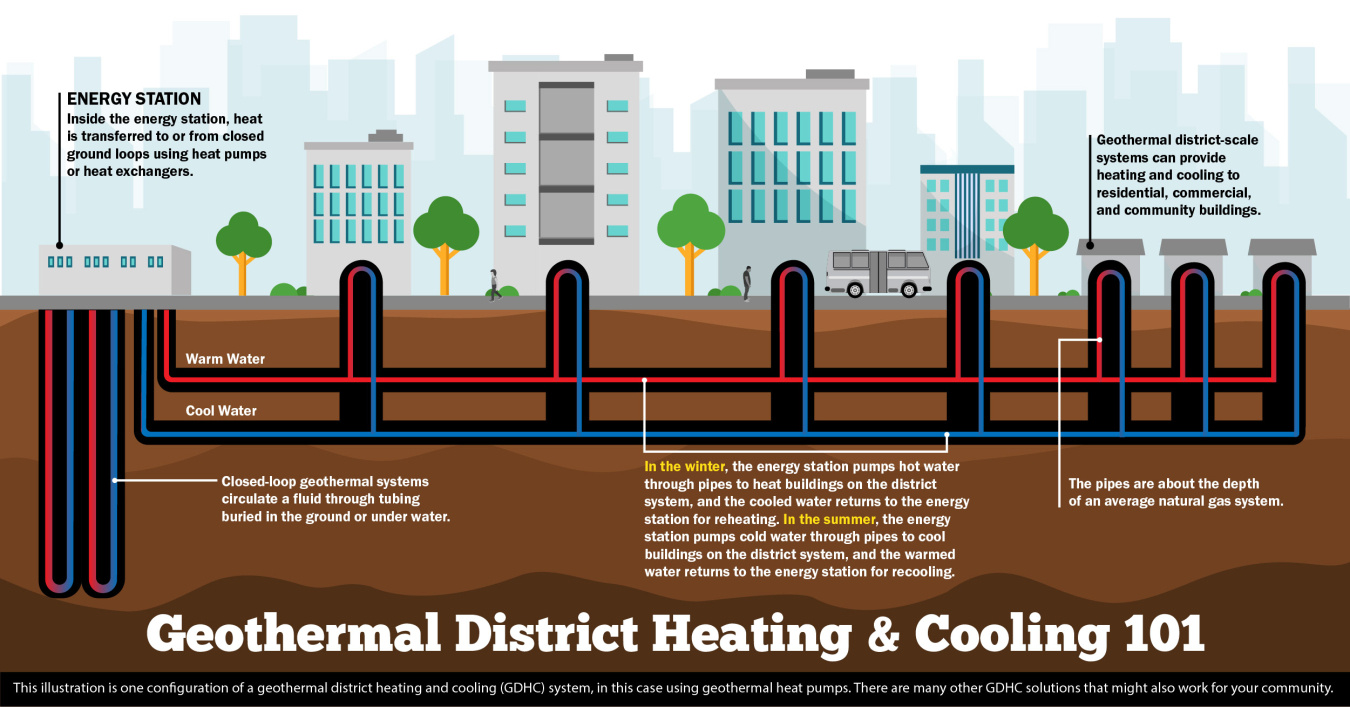
Networked geothermal systems offer a community- or district-scale heating and cooling solution, using shared infrastructure among many buildings. Networked geothermal systems can have a variety of different configurations using single or multiple piping loops, boreholes, wells, heat exchangers, and more.
What Are Thermal Energy Networks?
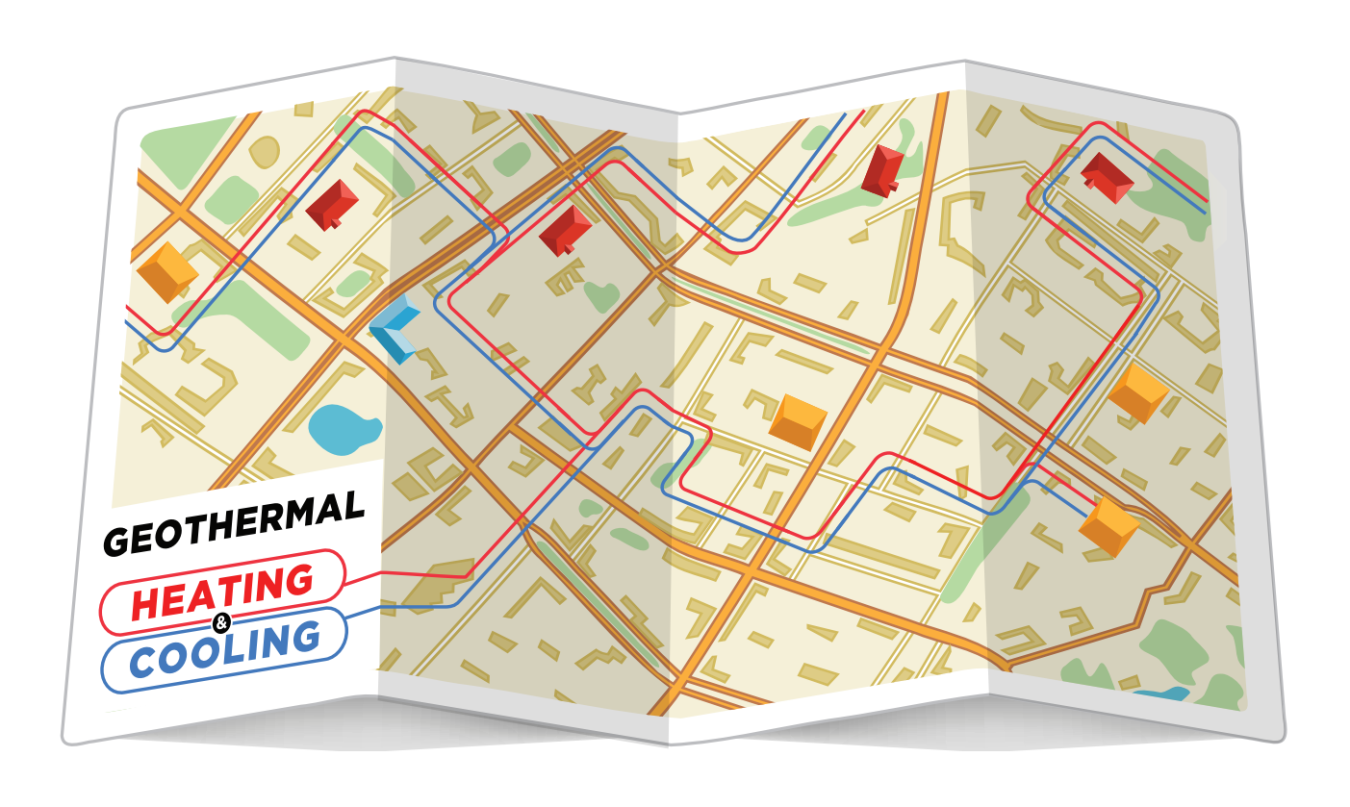
Networked geothermal is sometimes referred to as Thermal Energy Networks (TENs)—again, geothermal systems connecting many buildings in a shared network, which can serve entire neighborhoods, city blocks, campuses, and communities. Rather than supporting one building at a time, these systems provide heating and/or cooling to multiple homes or businesses together.
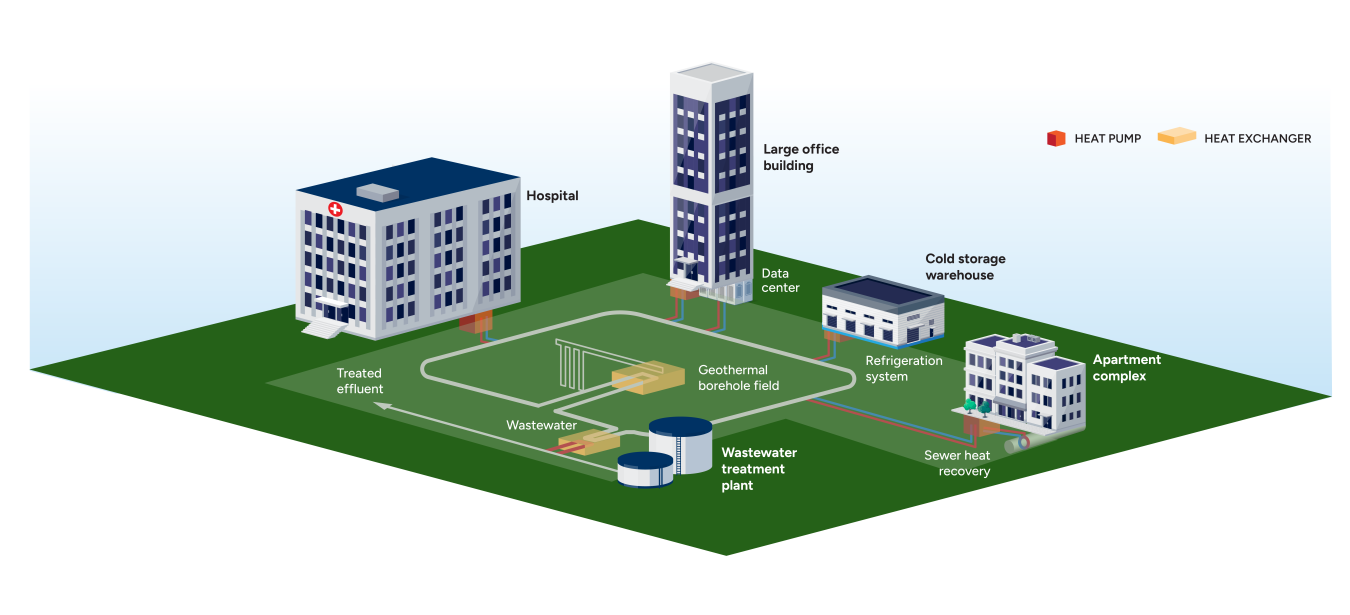
TENs can draw from a variety of heat sources, including bodies of water, excess heat from buildings in the networked system, wastewater systems, or the stable temperature of the earth. TENs can also use shallow boreholes for heat storage. Systems can have many configurations of loops and network connections and might include non-geothermal components, such as back-up boilers or solar panels. Variations can include:
- Standalone systems or those coupled with other energy systems
- Systems with an underground thermal loop
- Systems using geothermal (ground source) heat pumps, direct use of geothermal heat, or both
- Systems that provide heating and cooling, or potentially heating only
TENs are an important part of the geothermal technology portfolio. By leveraging the heat and thermal storage properties of the earth to provide efficient heating and cooling, they can balance out buildings with different heating and cooling needs as well as help communities have more ownership over their energy choices.
Networked Geothermal Across the United States
The many existing or in-progress networked geothermal systems nationwide span various locations, coalitions, climates, and geographies—illustrating the truly nationwide versatility of this solution.
The first networked geothermal installation in the United States sprang from the “hot” idea of a businessman in Boise, ID, in the 1890s: Use the geothermal water at Kelly Hot Springs to create a hot-water bathing resort. With design help from architect John C. Paulson, banker C.W. Moore built The Natatorium Resort, the centerpiece of which was a 125-foot swimming pool that was 98 degrees year-round. But Moore didn’t stop with the resort—he also heated his Victorian mansion with geothermal water and soon convinced many affluent neighbors to do the same.
Today, the city of Boise is home to the largest municipally operated geothermal heating utility in the country, with more than 20 miles of pipeline warming over six million square feet of building space throughout the city. The system delivers naturally heated water at a toasty 177 degrees through this extensive network of pipes, providing heat to buildings like City Hall and the local YMCA, melting snow from sidewalks—and heating what is now a city recreation pool at the former Natatorium.
Klamath Falls, OR, is home to another long-standing geothermal district-scale heating and cooling system. The city started tapping geothermal heat in the early 1990s, and the system now serves 23 commercial, non-profit, and government facilities. The standout success for the Klamath Falls system is its geothermal sidewalk and bridge snow melt systems. By tapping into the geothermal reservoir below the town, which ranges from 200–220 degrees, the utility circulates hot water through a district heating loop and heat exchanger to ensure safe conditions for pedestrians and drivers.
In the academic sphere, numerous universities and colleges are using or developing community geothermal solutions. One example is Ball State University, which pioneered the largest ground-source, closed-loop district geothermal energy system in the nation. This innovative system involves drilling approximately 3,600 boreholes across campus and seamlessly integrating them into the landscape. The project has created an estimated 2,300 direct and indirect jobs, and once fully operational, Ball State will be able to efficiently heat and cool 47 buildings—resulting in $2 million in annual savings—and shutter the university’s aging boilers. The U.S. Department of Energy (DOE) funded the project in part with a $5 million grant under the American Recovery and Reinvestment Act in 2009.
Not all district-scale systems are as large as Ball State’s—each system is unique to the needs of the buildings it serves. For instance, the Preservation for Affordable Housing’s community geothermal pilot project at Barry Farm Redevelopment in Washington, D.C., aims to replace conventional fossil fuel systems with cost-effective community heat pump system for heating and cooling. This pilot project offers D.C.’s first community geothermal system, serving residential apartments as well as retail and service spaces, and setting a standard for other projects in the area.
Additional communities and organizations are taking advantage of TENs and other district-scale geothermal heating and cooling solutions, including Brown University; Notre Dame; Whisper Valley in Austin, TX; Seattle Public Schools, the city of Framingham, MA; and New York City—demonstrating the versatility and nationwide appeal of using the “heat beneath our feet” to meet community energy needs. The Office of Geothermal prepared a collection of geothermal heat pump (GHP) case studies across the United States, including numerous TENs.

DOE's Networked Geothermal Research
The Office of Geothermal's primary effort to support advances in networked geothermal is the District-Scale Geothermal Energy Pilots initiative, formerly the Community Geothermal Heating and Cooling (CommGeo) initiative. Under this initiative, the Office of Geothermal selected 11 community coalitions in 10 states to plan and design community-scale geothermal heating and cooling systems. Based on results from the planning phase of those 11 projects, the Office of Geothermal selected three to install their TENs. The systems being installed include a utility-owned heating and cooling system in Framingham, Massachusetts; a district-scale system to be retrofitted in 1950s buildings in Ann Arbor, Michigan, providing more affordable heating and cooling for residents; and a project to support multiple buildings on Tribal lands in Oklahoma. The initiative's projects are using a collaborative approach, designed to ensure community needs are represented and job training is developed for local workers. Not only will these projects serve their own communities; their installed designs will also provide case studies that can be replicated nationwide so other cities and towns can benefit from geothermal heating and cooling.
The Office of Geothermal has supported other initiatives to expand the use of geothermal heating and cooling nationwide, including analysis to quantify the grid and impacts of GHPs, and outreach tools to help communities understand geothermal energy.
To learn more about the Office of Geothermal's research related to networked geothermal, visit the District-Scale Geothermal Energy Pilots page and Low Temperature & Coproduced Resources page.
Office of Geothermal emails brings funding opportunities, events, publications, & activities directly to your inbox.