



Underground thermal energy storage (UTES) is a geothermal technology where thermal energy, or heat energy, is stored in the subsurface. By taking advantage of relatively constant underground temperatures and geothermal gradients at increasing depths, large subsurface storage capacities, and thermal insulation associated with deep geologic formations, UTES systems store thermal energy so that it can be extracted later for beneficial uses. Such uses include smaller-scale heating and cooling, larger-scale thermal energy networks (TENs) or direct use, industrial heating and processing, and providing industrial heat for processes like paper and pulp drying, food processing, and pasteurization.
UTES systems have many benefits. They can help shift heating and cooling demand away from peak electricity use periods, reducing strain on the grid. Once installed, they have low operating costs and long lifespans. They also offer flexibility: they are compatible with many kinds of heat sources, excess heat can be stored in the summer for use in the winter and vice versa, many configuration types facilitate broad geographic applicability, and systems can be deployed at various scales.
As part of its research in low temperature and coproduced resources, the Office of Geothermal supports advances in methods to use and maximize the value of geothermal for storage and enhance grid reliability. Learn more about other Office of Geothermal initiatives.
Types of UTES Systems
There are three main types of UTES, reflecting three methods for storing thermal energy in the subsurface.
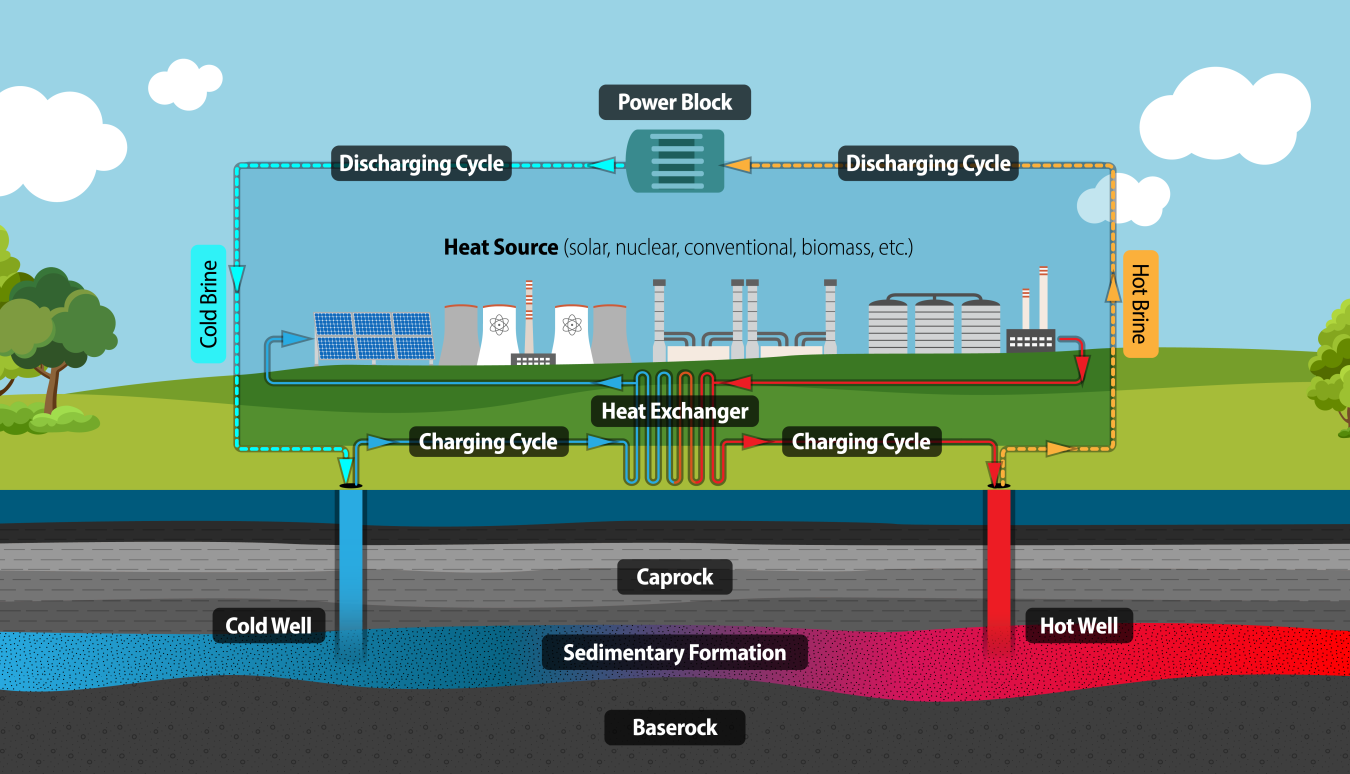
ATES systems store thermal energy in subsurface aquifers, which are shallow geologic formations of permeable rock through which fluid can travel. In ATES, groundwater and the thermal energy it carries is extracted from and reinjected back into the subsurface using wells in an open system. ATES systems typically operate in seasonal modes. In summer, cool groundwater is brought up to absorb excess heat and provide cooling; in winter, heated groundwater is brought up so it can be used for heating. Many European nations have widely adopted ATES as a solution to provide direct heating and cooling.
BTES systems also store thermal energy underground for extraction seasonally and during demand periods; but where ATES uses an open-system flow of groundwater through permeable zones in the subsurface, BTES does not rely on the exchange of groundwater or subsurface permeability. Instead, BTES employs a closed system that stores thermal energy in subsurface bedrock. During the summer, excess heat is stored in the subsurface via a heat transfer fluid that is circulated through the system; during the winter, reversing the circulation allows for the recovery of previously stored heat. While there are several BTES installations throughout Europe and Canada, this form of UTES has the barrier of higher installation costs due to drilling and materials.
RTES systems tap into subsurface reservoirs to store and extract thermal energy as demand or seasons require in a manner similar to ATES. Where the two systems differ is that RTES systems typically use deeper formations that are isolated from shallow aquifers, involve low-quality, non-potable waters/brines, and are envisioned to be used at much higher temperatures than those in ATES systems. The Office of Geothermal is funding Project Development Solutions to demonstrate RTES for an industrial project in California, which will help move RTES technology closer to commercial use for industrial heating processes.
Configurations of UTES Systems
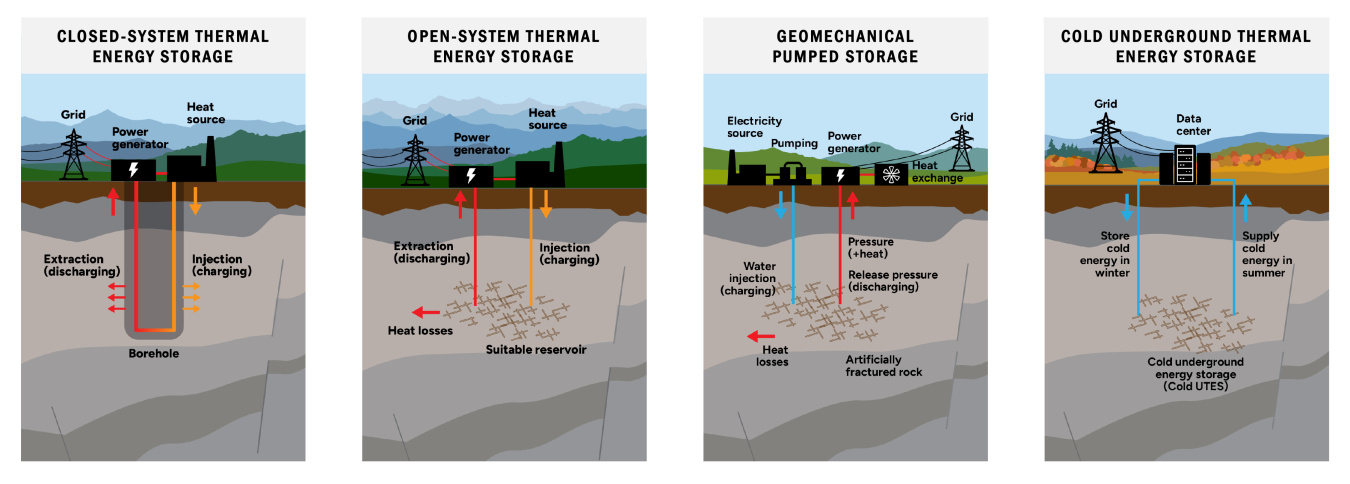
UTES systems can be configured in many ways depending on the subsurface characteristics at their sites and the need they are being employed to serve.
ATES uses an open-system configuration where wells circulate groundwater through an aquifer; BTES uses a closed-system configuration where wells circulate fluid through a borehole in the bedrock. A Geomechanical Pumped Storage system functions similarly to pumped storage hydropower; this type of system pumps pressurized water into a subsurface storage well in order to generate electricity. Cold Underground Thermal Energy Storage systems, or Cold UTES systems, inject cold water into the subsurface where it is stored underground and then drawn back to the surface to be dispatched as needed to offset peak cooling demands. As a long duration energy storage solution, Cold UTES offers a way to reduce and shift peak cooling loads for energy-intensive operations like data centers, helping to reduce demands on the electricity grid while also improving cooling efficiency compared with other cooling methods.
Geothermal Storage Projects
Project Lead: NrgTEK, Inc.
This NrgTEK project in California, selected through DOE’s Small Business Innovation Research program, had the goal of helping move RTES technology closer to commercial use for industrial heating processes. The project team explored how to use geothermal power plant emissions of non-condensable gases such as CO2 and H2S as an additional form of energy, using polymers developed in Phase I and II of the project. The Phase II project successfully demonstrated flexible power generation with thermal and electrical energy storage: thermal energy was stored in concentrated osmotic solutions and converted to electric energy, while electrical energy was stored in hydrogen for power generation on demand.
Project Lead: National Laboratory of the Rockies (Sub: Lawrence Berkeley National Laboratory)
The Office of Geothermal is funding a project led by the National Laboratory of the Rockies (NLR) exploring how Cold Underground Thermal Energy Storage (Cold UTES) can help reduce and shift peak cooling loads for energy-intensive operations like data centers. This emerging technology offers a unique opportunity to reduce data center cooling loads while building more resilient infrastructure that creates a stable source of cooling—in turn reducing the need to build power plants to serve data centers. By using off-peak power to create a cold energy reserve underground, Cold UTES can be incorporated into existing data center cooling technologies and used during grid peak load hours. This charge/discharge cycling allows the technology to be optimized based on time-of-use and other key grid parameters, similar to a conventional battery charge/discharge cycling, thereby reducing the overall operating cost of the grid. The key difference between Cold UTES and conventional grid batteries is that Cold UTES can not only do the same diurnal storage, but can also achieve long-duration energy storage at seasonal time scales.
Read this project’s final technical report and learn more about this work to understand the grid and system-wide value, costs, and impacts of large-scale and widespread deployment of Cold UTES.
Project Lead: West Virginia University (WVU)
Through this project, WVU is performing a risk assessment and resource quantification for the development of an integrated Geothermal District Heating and Cooling (GDHC) and UTES system for WVU Morgantown campus, in order to update the current steam heating and cooling system. As of June 2026, the project team characterized campus energy demand, drilled an exploratory well, analyzed collected samples and data, and created and refined models (geomechanical, geothermal sources and storage, fluid flow and fracture stimulation) to aid in evaluating the technical and economic feasibility of a geothermal district heating system at this site, and is moving into the project’s next phase.
Project Leads: National Laboratory of the Rockies (NLR), Idaho National Laboratory (INL), and Lawrence Berkeley National Laboratory (LBNL)
This project focuses on investigating RTES as a solution for long-term and/or seasonal energy storage, where excess thermal energy can be stored in permeable reservoirs such as aquifers and depleted hydrocarbon reservoirs for days or months at a time, and at terawatt-hour storage capacities - enough energy to power a mid-sized U.S. city for a whole year. These systems improve the possibility of deploying geothermal-type technologies in non-traditional regions, thereby expanding the market. The stored thermal energy can be used to generate electricity and – uniquely – also directly produce heat that can be used by industrial processes.
NLR, INL, and LBNL are each leading tasks within this project. As of July 2026, the NLR project team charged an RTES with two different energy sources: (1) concentrating solar power (CSP) and (2) industrial scale heat pumps as part of a carnot-battery arrangement. The team also developed a techno-economic analysis model on geological thermal energy storage (GeoTES) and assessed system performance in two different case studies with validation by collaboration with industrial partners.
Project Lead: National Laboratory of the Rockies (NLR)
This project employed the Regional Energy Deployment System (ReEDS™) tool, NLR’s flagship electric power capacity expansion model, to examine the interaction between locational favorability of long-duration storage and geothermal resource information. The project team examined the value potential of geothermal energy storage for the U.S. power system, considering opportunities for storage through geothermal heating and cooling (demand side) as well as geothermal power generation (supply side). The team’s analysis found that storage discharge duration was the strongest driver of geothermal energy storage value on the supply side, and on the demand side found that seasonal storage for direct heating and cooling of office buildings results in grid cost savings in most buildings.
Project Lead: Project Development Solutions
The Office of Geothermal is funding this industrial project to demonstrate RTES at Kern Front Oil Field in Bakersfield, California. The project team will investigate pairing subsurface geothermal reservoirs with a steam system and process heat off-taker, potentially helping move RTES technology closer to commercial use for industrial heating processes.
Further Reading
- GeoBridge - Thermal Energy Storage
- Grid Impact of Reservoir Thermal Energy Storage for Data Center Cooling (2026)
- Reservoir Thermal Energy Storage Pre-Assessment for the United States (2025)
- Preliminary Study on Utilizing Closed-Loop Geothermal Systems for Seasonal Storage of Surplus Solar and Wind Energy (2025)
- Geological Thermal Energy Storage (GeoTES) Charged with Solar Thermal Technology Using Depleted Oil/Gas Reservoirs and Carnot-Battery Technique Using Shallow Reservoirs (2024)
- Reservoir Thermal Energy Storage Benchmarking (2023)
- Hybridizing a Geothermal Plant with Solar and Thermal Energy Storage to Enhance Power Generation (2018)
Office of Geothermal emails brings funding opportunities, events, publications, & activities directly to your inbox.