



The liquid waste contractor at the Savannah River Site is doubling the number of employees using a wearable technology system to further protect against South Carolina’s summer heat and humidity. May 26, 2026
Office of Environmental Management
May 26, 2026 Estimated Read Time min
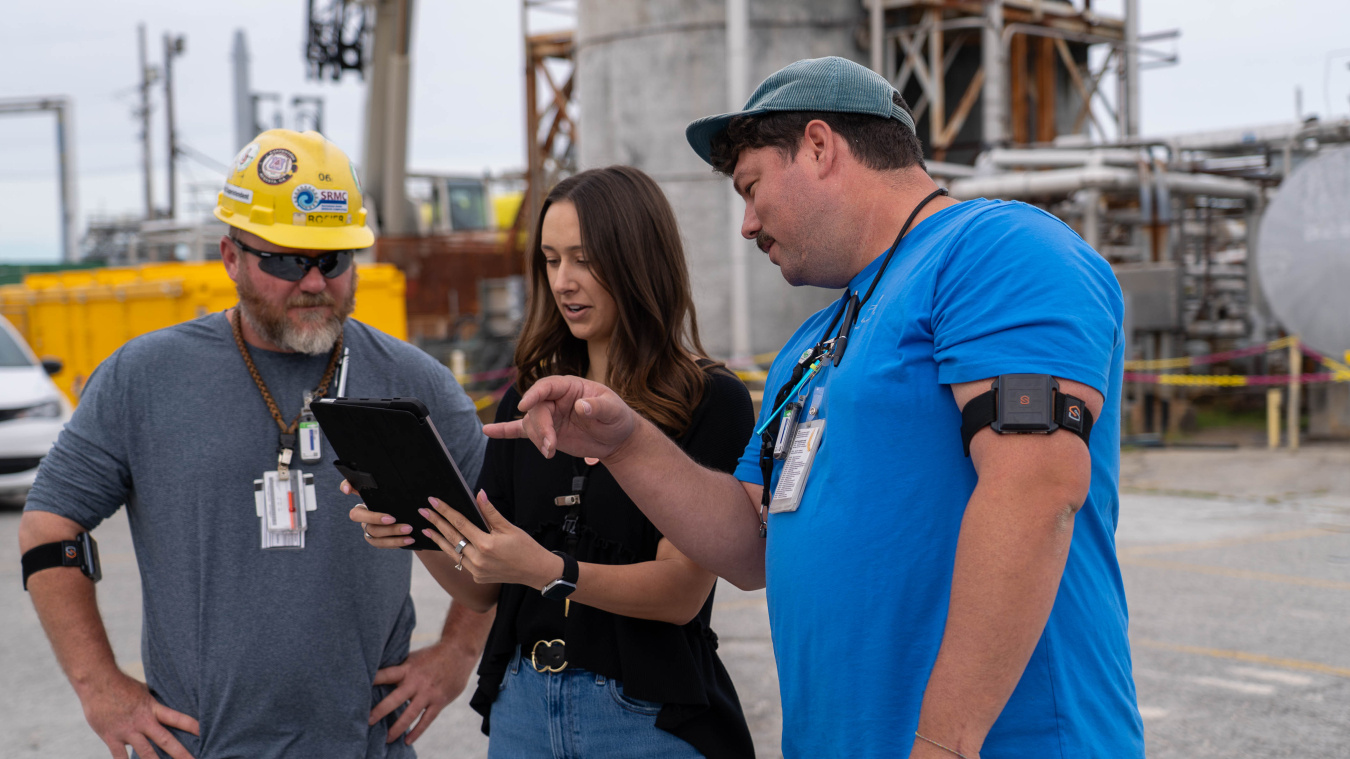
Liquid waste team members at Savannah River Site discuss their armband results, highlighting how the innovative device enhances workplace safety through real-time monitoring.
AIKEN, S.C. — The liquid waste contractor at the Savannah River Site (SRS) is doubling the number of employees using a wearable technology system to further protect against South Carolina’s summer heat and humidity.
Savannah River Mission Completion (SRMC) is providing 500 of the devices to team members supporting the U.S. Department of Energy's (DOE) Office of Environmental Management (EM) liquid waste mission at SRS, up from 250 in 2025.
SRMC is building on lessons learned from its inaugural summer last year implementing the armband designed with physiological monitoring to prevent heat-related illnesses for workers on the job.
Estimated core body temperature will replace heart rate as the primary metric for heat strain alerts, significantly improving the system’s accuracy and reliability. Field trials demonstrated that this metric — integrated from skin temperature and heart rate data — provides a more accurate indicator of heat strain.
In 2025, the devices recorded over 6,000 monitoring events, successfully triggering 2,000 proactive interventions that allowed supervisors to pause or modify activities so workers could cool down, ultimately preventing potential heat-related illnesses.
While the system’s success was evident, the large volume of alerts and feedback from the workforce highlighted the need for optimized metrics.
Tony Robinson, DOE-Savannah River’s acting assistant manager for waste disposition, said SRMC is proactively tackling the risks of extreme summer conditions by implementing and expanding the use of cutting-edge technology to improve worker safety.
“SRMC is demonstrating their commitment to DOE’s strong safety culture and prioritizing the health and safety of those who perform the critical work of the liquid waste mission,” Robinson said.
Alert notifications will expand beyond safety and health staff to include direct field supervision to further enhance the system, said Wes Bryan, SRMC senior vice president of environment, safety, health and quality.
“Proactively safeguarding our workforce is at the core of our mission,” Bryan said. “With updated metrics and expanded oversight capabilities, SRMC continues setting the standard for safety innovation, ensuring our employees continue to remain safe.”
With newly approved GPS functionality, the armbands allow industrial hygiene personnel to swiftly pinpoint the location of workers triggering alerts.
“A dedicated watch station ensures precise real-time tracking, while front-line managers now receive immediate notifications, further enhancing response efficiency and operational oversight,” Bryan said. “This advanced safety technology is now transforming the way we operate, significantly driving the mission forward.”
-Contributor: Dara Glass
To receive the latest news and updates about the Office of Environmental Management, submit your e-mail address.