



Renewable carbon research and development (R&D) efforts are designed to maximize supply chain system efficiencies and identify key feedstock quality and performance factors affecting biorefineries. In addition to increasing the efficiency of current conventional systems, the renewable carbon R&D assists in the development of innovative advanced supply chain systems that will be required to mobilize the entire billion tons of biomass and waste streams.
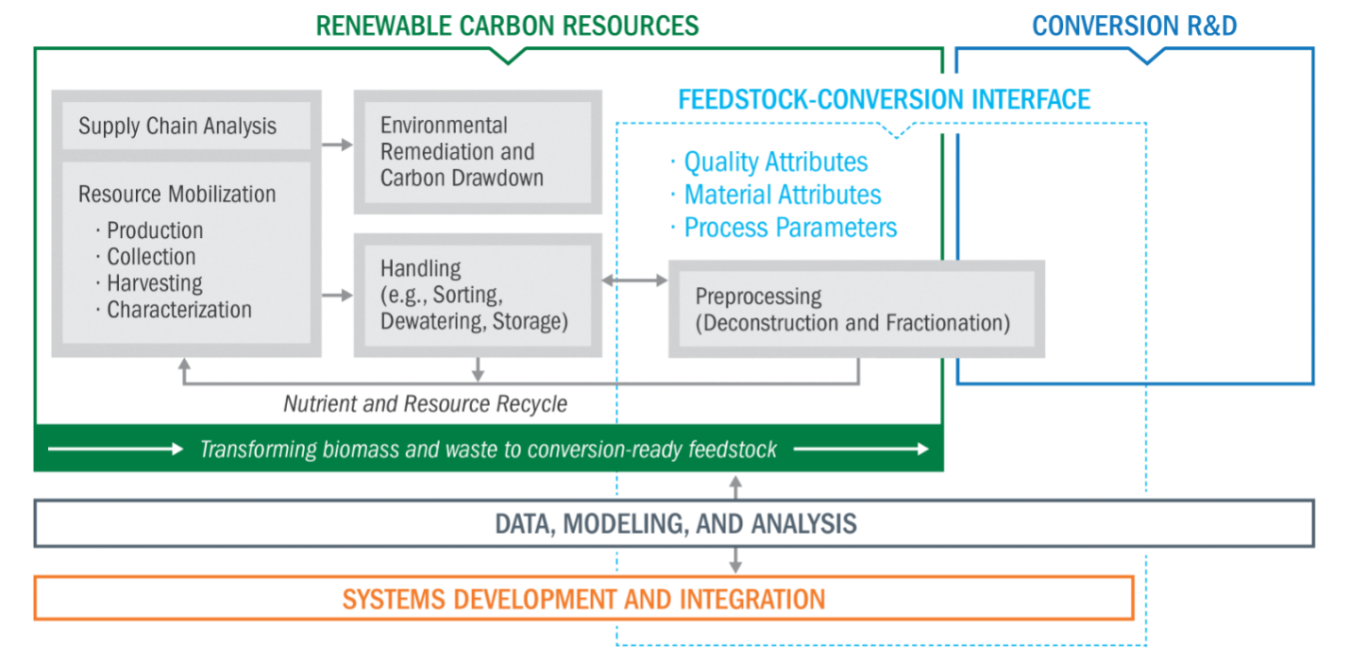
Renewable Carbon RD&D scope and interface diagram
Renewable carbon R&D supports both applied research projects and pilot-scale projects on the production, harvesting/collection, supply logistics, storage, and preprocessing of biomass and wastes to feedstock. Feedstocks are defined as renewable carbon resources that have undergone one or more preprocessing operations to meet the quality characteristics required for feeding into reactors and efficient conversion into bioenergy and bioproducts.
Responsibly and efficiently mobilizing the wide range of carbon resources takes close coordination with stakeholders and with many other federal offices and agencies. Broadly, the U.S. Department of Energy (DOE) Alternative Fuels and Feedstocks Office (AFFO) coordinates with U.S. Department of Agriculture on agricultural and forestry resources, DOE’s Office of Fossil Energy and Carbon Management on CO2 and industrial waste gases, and various other government agencies on algal resources primarily through the Biomass R&D Board.
According to AFFO's 2016 Billion-Ton Report, an estimated 1 billion tons of biomass could be produced for biofuel, bioproduct, or biopower applications in the United States. This biomass is enough to meet the U.S. government-wide Sustainable Aviation Fuel Grand Challenge goal to produce 35 billion gallons of sustainable aviation fuel by 2050.