



RSS
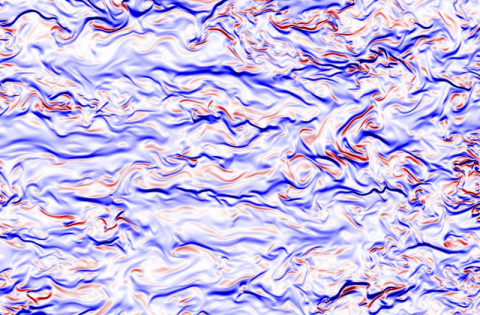
A new, more precise model of turbulence is helping scientists better understand how heat moves through the ocean.
Rice University physicists find evidence of exotic change transport in material.
The Southwestern Mountains Climate Resilience Center is one of six projects selected to receive funding from DOE to improve climate resilience.
Xilin Liang received an award for his “contributions to the STAR forward calorimeter and simulations for the EIC” from Brookhaven National Lab.
A newly funded calibration service will take LuSEE-Night to ultimate precision, paving the way for next-generation radio cosmology experiments.
In an AI-based exploration of 160 billion organic molecules, scientists found about 40 liquid hydrogen carriers that could one day generate energy.
The Spanish Centre for Energy, Environmental and Technological Research, known as CIEMAT, is a key contributor to the international experiment.
The study elucidates the underlying mechanisms of CISS and may have applications for quantum computing, energy generation, and lighting efficiency.
A team of researchers at Case Western Reserve University is part of a national effort to “reimagine” steel production.
Professor Pete Raymond is leading a DOE study that explores promising methods to remove carbon dioxide from the atmosphere & mitigate climate change.