



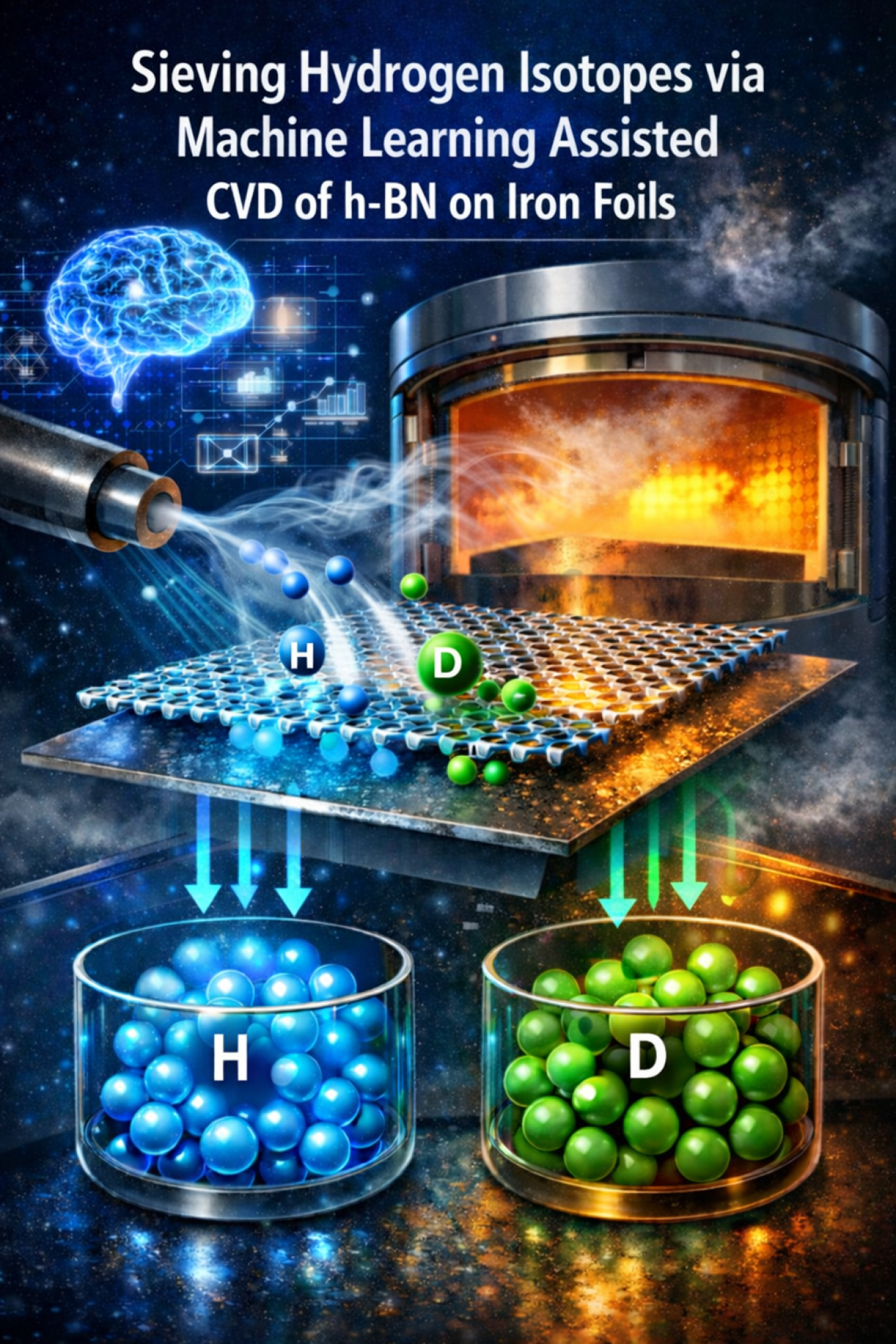
Scientists demonstrated that ultra-thin membranes made of 2D materials can act as filters to separate isotopes of hydrogen.
Isotope R&D and Production (DOE IP)
July 21, 2026 Estimated Read Time min
The Science
Ultra-thin two-dimensional (2D) materials are only one atom thick. They can act as powerful filters at the tiniest scales, even approaching sub-atomic dimensions. In this work, scientists used machine learning to develop a scalable method to grow high-quality (almost defect-free), atom-thin layers of boron and nitrogen. In these layers, the boron and nitrogen atoms are arranged in a honeycomb-like mesh. The study demonstrated that these ultra-thin membranes can separate isotopes of hydrogen. With only one proton, hydrogen is the simplest and smallest element. It has three naturally occurring isotopes, or different forms of the standard element. Hydrogen (H) has no neutrons, deuterium (D) has one neutron, and tritium (T) has two neutrons. In the past, it has been difficult to separate the smallest variations in isotopes of hydrogen. Because this new growth process is scalable, it provides a practical path toward solving that challenge.
The Impact
The isotopes of hydrogen are widely used for nuclear energy, national security, medical, and research applications. In nuclear energy, heavy water is critical for the function of nuclear power plants. Instead of two hydrogen atoms, heavy water contains two deuterium atoms and one oxygen atom (D2O). Producing heavy water (D2O) with conventional methods is expensive and extremely energy-intensive. This method takes so much energy because D is rare in nature and separating it from other forms of hydrogen is inefficient. The atomically-thin 2D materials produced in this study offer major advances that can improve the energy efficiency of separating H and D. Such membranes could enable advances in nuclear energy and many other sectors.
Summary
Atomically thin two-dimensional (2D) ceramics, such as monolayer hexagonal boron nitride (h-BN), offer exciting potential for ultra-precise separations. They could be particularly useful for hydrogen isotope (H/D) separation at sub-atomic scales. Achieving this requires nearly defect-free 2D membranes. However, scalable production of high-quality h-BN has been a major challenge. This study reports a scalable iron-catalyzed chemical vapor deposition (CVD) process to grow large-area, high-quality monolayer h-BN films. Using machine learning, the researchers found that using higher temperatures prevented the formation of multiple layers. Instead, these temperatures promoted a uniform single layer with reduced defects. The resulting iron-grown h-BN membranes achieved a H/D selectivity that approached the highest benchmarks of current practices. This scalable method provides high-quality monolayer membranes for sub-atomic separations. It also demonstrates the power of machine learning-guided CVD optimization for advancing 2D material synthesis. This study paves the way towards practical applications in hydrogen isotope separation and other ultra-precise filtration technologies.
Contact
Piran R. Kidambi
University of Florida
p.kidambi@ufl.edu
Funding
This work was primarily supported by the Department of Energy (DOE) Office of Science Early Career Research Program for the Office of Isotope R&D and Production and also supported in part by an National Science Foundation (NSF) CAREER award. P.R.K. acknowledges the Donald D. Harrington Faculty Fellowship at the University of Texas at Austin.
Publications
Chaturvedi, Pavan, et al., "Sieving hydrogen isotopes via machine learning assisted chemical vapor deposition (CVD) of high-quality monolayer hexagonal boron nitride (h-BN) on iron foils." Advanced Materials 38 (2025) [DOI: 10.1002/adma.202511868]