



A unified framework for fusion systems maps the best route to a self-sustaining steady-state fusion plasma.
October 29, 2026 Estimated Read Time min
The Science
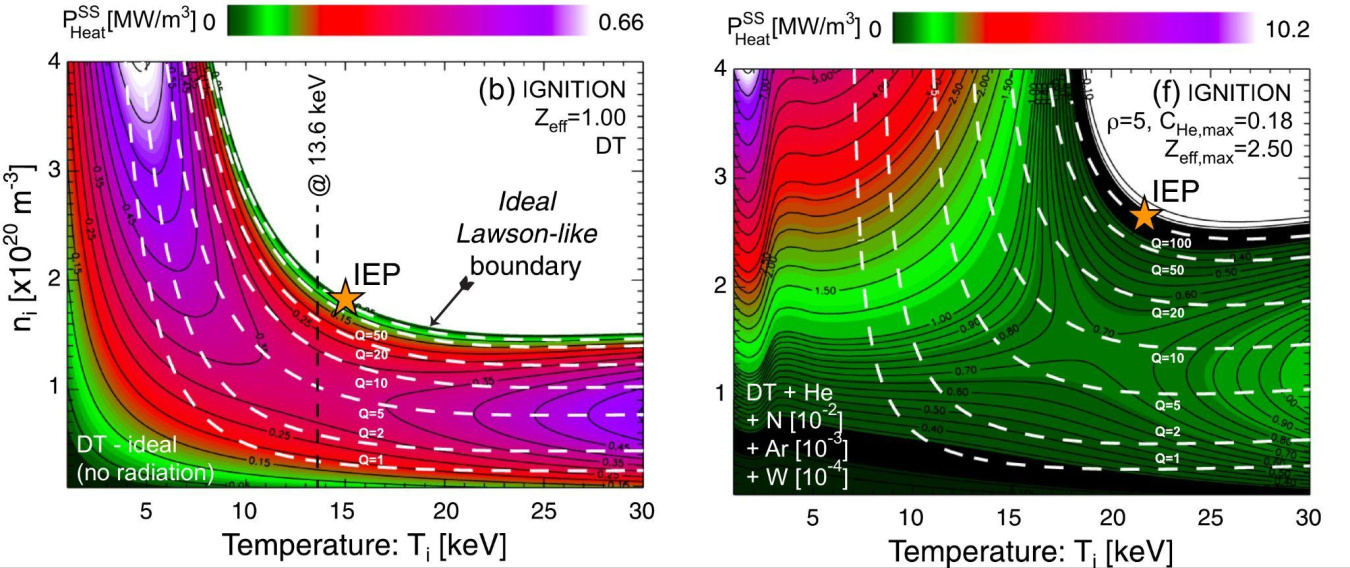
For 70 years, fusion researchers have relied on a critical equation known as the Lawson criterion. This equation describes how hot a plasma must be, how dense it must be, and how long it must hold its heat before it can power itself. To produce energy from fusion, plasma must be able to maintain itself without needing energy from outside sources, called ignition. But this equation is only “ideal.” It doesn’t take certain real-life conditions into account. In addition, it says nothing about the best way to get to this ignition point. New research shows the least demanding route to get there. This new framework combines a “modified” Lawson criteria with four other breakeven and ignition conditions. These conditions govern the transition from external heating to self-heating and include the types of issues a real fusion power plant will face.
The Impact
This new framework could change how fusion scientists bring their machines up to full power, improving the efficiency and effectiveness of fusion systems. It shows that the most efficient route to reaching a burning plasma is to heat the plasma first and then increase its density. Many fusion designs take the reverse approach, which requires putting far more energy into the system. This work also shows that tungsten sharply raises the pressure needed for ignition even at trace levels. Currently, most next-generation fusion systems use tungsten in their designs. Lastly, the work shows that the super-high magnetic fields these systems use to contain and control plasma may also increase losses and the pressure needed for systems to function. Designers can use the framework to check plans before building costly facilities. The framework also points to possible remedies for these issues, including lithium-coated walls, enhanced plasma confinement, and a spin polarized fuel. These changes should make it easier to reach ignition.
Summary
The “ideal” Lawson criterion sets the minimum product of density, temperature and confinement time for a pure hydrogen plasma to sustain itself. Researchers at the U.S. Department of Energy’s (DOE) Princeton Plasma Physics Laboratory (PPPL) have now unified a “modified” Lawson criterion with four other breakeven and ignition conditions that govern that transition into one power-balance framework. The new framework accounts for fuel mix and dilution, the accumulation of ash from helium, spin-polarized fuels, radiation from impurities such as tungsten, and synchrotron radiation that negatively-charged particles give off as they spiral around the system’s magnetic field lines.
The analysis finds that a heat-first, density second path requires the least amount of energy put into the system. The same energy losses that make ignition harder also act as a helpful brake. They keep a burning plasma from overheating on its own, so the burn can settle into a steady state. Better ways of holding in the plasma’s heat and a special form of fuel can make ignition easier to reach.
Contact
Luis F. Delgado-Aparicio
Princeton Plasma Physics Laboratory
Idelgado@pppl.gov
Funding
This work was supported by the DOE Office of Science, Office of Fusion Energy Sciences, including support for a 2015 Fusion Energy Sciences Early Career Award, a 2018 Diagnostic Innovation and Development award, and the 2021 and 2025 Long-Pulse Tokamak Research Program.
Publications
Delgado-Aparicio, L. F.; Ono, M.; and Menard, J.E. “Generalized Lawson-Cordey-Mills accessibility of fusion ignition,” Physical Review Letters 137, 115102 (2026). [DOI: 10.1103/mmc9-nzfx]
Related Links
A smarter path to fusion ignition: heat first, then add fuel, Princeton Plasma Physics Laboratory News