



Researchers developed a framework to extract the properties of ice crystals from 2D images of crystals taken from real clouds.
Biological and Environmental Research
October 20, 2026 Estimated Read Time min
The Science
Ice clouds are composed of many small ice crystals that come in various shapes. Probes inside real clouds capture images of these ice crystals. The images provide microphysical information that is relevant to identifying these shapes, such as mass and morphological features. However, these probes only provide single two-dimensional (2D) views of ice crystals. In a new study, researchers investigated machine learning’s potential to extract microphysical information from 2D crystal imagery within clouds.
The Impact
Representing clouds accurately in Earth system models is difficult. Complex microphysical properties and processes govern cloud behavior. As the shapes of ice crystals influence overall cloud behavior, ice clouds present a particularly acute challenge for models. The study’s results and frameworks pave the way for predicting ice crystal properties accurately and efficiently. These findings will help improve representations of clouds in computer models of the Earth’s atmosphere.
Summary
The microphysical properties of ice crystals significantly alter the overall behavior of clouds. In turn, clouds’ behavior strongly affect weather and Earth systems. However, it is challenging to measure key properties of ice crystals in real clouds.
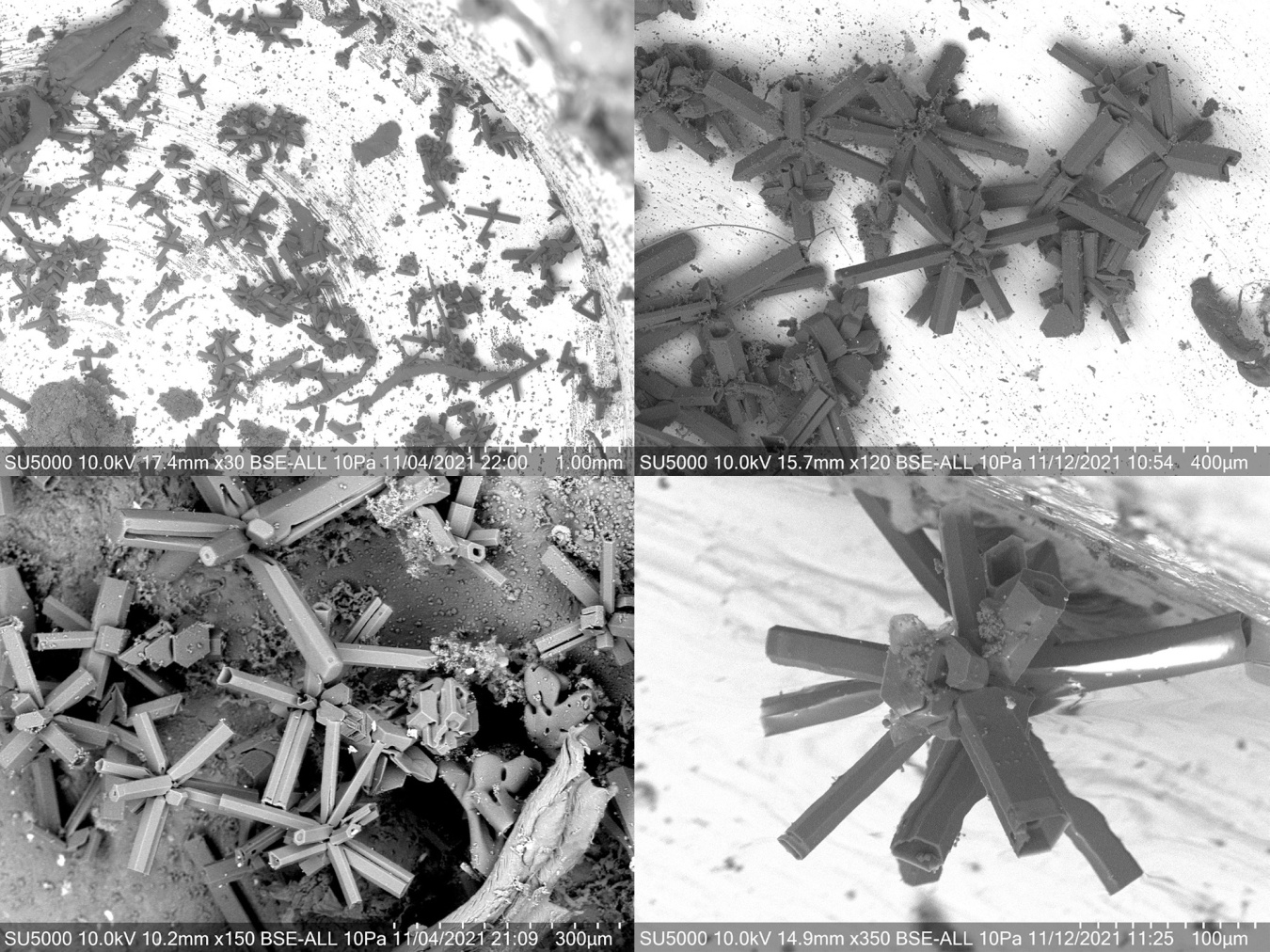
A team of researchers developed a proof-of-concept framework for predicting 3D microphysical properties of ice crystals from in-cloud 2D imagery. First, the team computationally generated synthetic ice crystals using 3D modeling software and geometric parameters estimated from Ice Cryo-Encapsulation Balloon (ICEBall). ICEBall was a 2021 field campaign conducted by the U.S. Department of Energy’s (DOE) Atmospheric Radiation Measurement Office of Science User Facility. Researchers used synthetic crystals to train machine learning models to predict mass, surface area, and the number of “spikes” of individual crystals. On unseen synthetic images, these machine learning models accurately predicted ice crystal properties.
This work provides a unique machine learning-driven framework for estimating ice microphysical properties from in-cloud imagery. These findings will enable downstream constraints on microphysical parameterizations, such as the relationship between mass and size.
Contact
Kara D. Lamb
Columbia University
kl3231@columbia.edu
Funding Source
This research was funded by the National Science Foundation (NSF) through the Learning the Earth with Artificial Intelligence and Physics (LEAP) Science and Technology Center. Support was also received from the U.S. Department of Energy Atmospheric System Research. The research also drew on the State University of New York–Albany’s Atmospheric Sciences Research Center Extreme Collaboration, Innovation, and Technology (xCITE). Lastly, the team received computing support from the Derecho and Casper systems provided by the NSF National Center for Atmospheric Research.
Publications
Ko, J., et al. “Machine learning framework for predicting microphysical properties of ice crystals from cloud particle imagery.” JGR: Machine Learning & Computation. 4 (2025) [DOI: 10.1029/2025JH000905]