The Alpha Magnetic Spectrometer (AMS-02) on the International Space Station is revealing new insights into our universe.
June 17, 2026 Estimated Read Time min
Shannon Brescher Shea

Shannon Brescher Shea (shannon.shea@science.doe.gov) is the social media manager and senior writer/editor in the Office of Science’s Office of Communications and Public Affairs. She writes and curates content for the Office of Science’s Twitter and LinkedIn accounts as well as contributes to the Department of Energy’s overall social media accounts. In addition, she writes and edits feature stories covering the Office of Science’s discovery research and manages the Science Public Outreach Community (SPOC). Previously, she was a communications specialist in the Vehicle Technologies Office in the Office of Energy Efficiency and Renewable Energy. She began at the Energy Department in 2008 as a Presidential Management Fellow. In her free time, she enjoys bicycling, gardening, writing, volunteering, and parenting two awesome kids.
Millions of light years away, millions of years ago, a star exploded.
In this violent process, it ejected incredible amounts of mass, including carbon, nitrogen, and oxygen – the building blocks of life. In fact, the star may have produced elements on the Periodic Table all the way up to iron. As it exploded, it spewed these elements into deep space. Only a burnt-out core remained.
No one on Earth noticed this exploding star at the time. Besides the fact that humans had not yet evolved, those cosmic sprays of particles – called cosmic rays – are just now reaching us. Even though millions of years separate us from their source, these particles can provide us with insight into the workings of our universe.
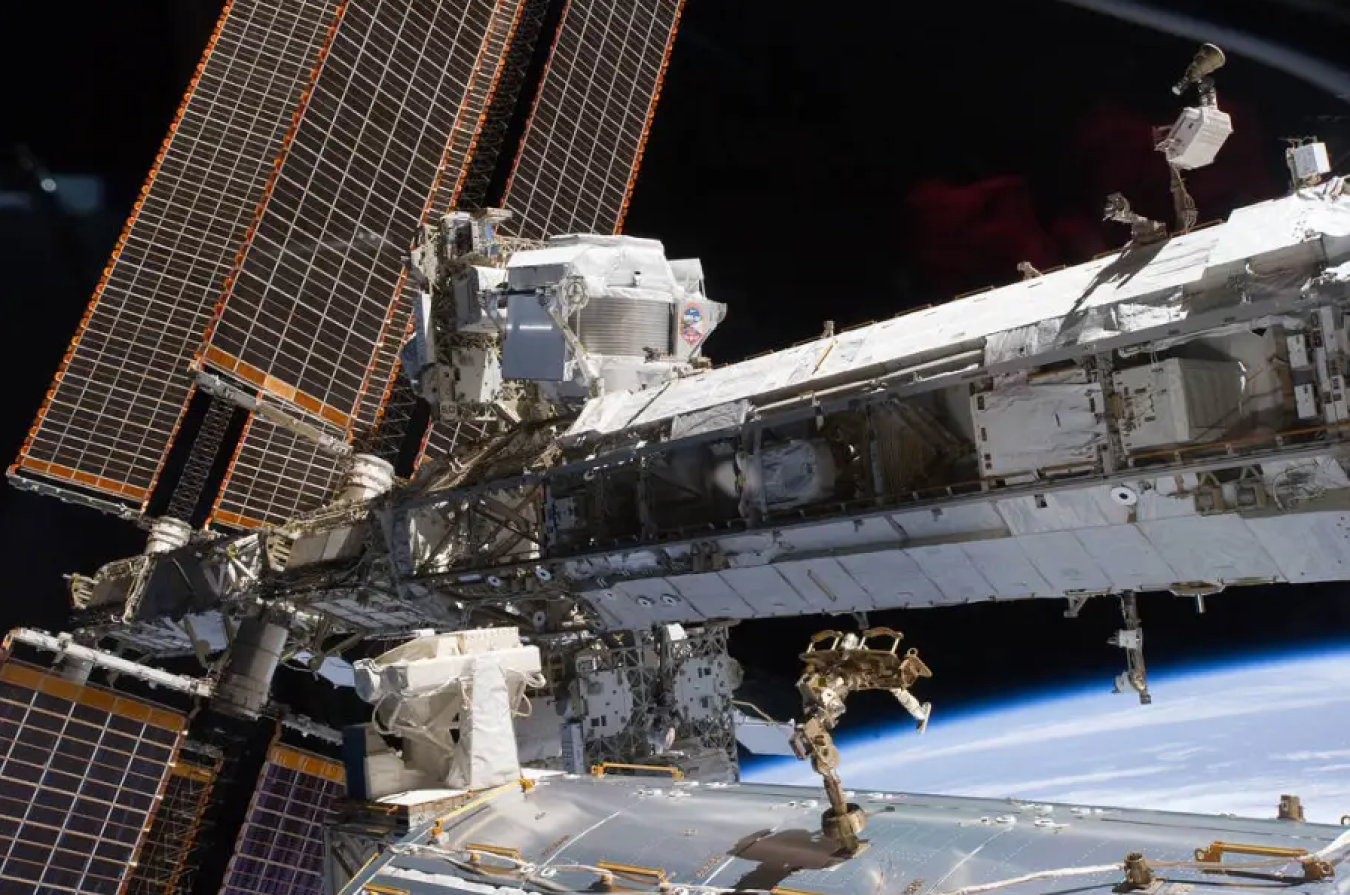
Recent results from the Alpha Magnetic Spectrometer (AMS-02) – an experiment on the International Space Station supported by the Department of Energy’s Office of Science – are expanding our understanding of these cosmic rays.
Particles from the stars
While X-rays or rays of UV light are forms of energy, cosmic rays are different. They’re groups of particles raining down from space. These cosmic rays can include a variety of elements, including phosphorous, chlorine, potassium, argon, and calcium. Exploding stars (supernovae) produce some of these elements. Others come about when nuclei from heavier elements (originally from supernovae) collide with gases in space. Or as astronomer Carl Sagan famously said, “We are made of star-stuff.”
Even though cosmic rays are constantly hitting Earth’s atmosphere, we don’t know much about them. One of the biggest questions is why these particles are moving so fast. While a star’s explosion provides an initial burst of speed, these particles should slow down over time. The fact that they’re still moving near the speed of light suggests that something has accelerated them.
What these rays may reveal
Decades ago, the United States studied cosmic rays to find out if the government of the former USSR was conducting nuclear testing. However, they realized that cosmic rays were coming down from the sky rather than up from the Earth, making it a moot point.
While they weren’t helpful for spying, NASA and the Department of Defense recognized other reasons to study cosmic rays. As space exploration expands, future astronauts will be exposed to more cosmic rays, whether in a space station or on the moon. Cosmic rays are also bombarding satellites used for communications, GPS, and other purposes. These agencies want to understand these rays’ effects on both humans and machinery.
Cosmic rays may also help us solve one of science’s biggest questions – dark matter.
Unlike ordinary matter, dark matter only interacts via gravity. Astronomers only know it exists because of its effects on stars, galaxies, and the astrophysical records of the early universe. Despite estimates that it makes up about a quarter of the universe’s mass-energy, scientists have yet to detect it directly or indirectly. The DOE’s Office of Science is interested in detecting dark matter as part of understanding the building blocks of the universe.
Some models of dark matter suggest that dark matter particles could collide and annihilate each other. If dark matter does act like this, the process would create positrons, the antimatter counterpart to electrons. This excess of positrons should show up in cosmic ray data.
On Earth, our atmosphere protects us from the potential harm of these cosmic rays. The amount of water vapor in the atmosphere is equivalent to 10 meters of water. However, this barrier means that it’s impossible to accurately measure cosmic rays on the ground. To study them, we must go into space itself.
Introducing the Alpha Magnetic Spectrometer
The AMS-02 isn’t just an instrument to measure cosmic rays in space – it’s the perfect instrument to measure cosmic rays in space. The AMS-02 is the only tool to have collected this data and has done so for a long time. It’s been on the ISS and exposed to the harsh conditions of space for more than 13 years.
At its most basic, the AMS-02 is a particle detector. Particle detectors on Earth are often attached to accelerators that smash particles into each other, like the Large Hadron Collider at CERN. Others are in remote locations to capture particles away from human interference. But the AMS-02’s location in space means that it doesn’t need a source of particles or a location away from humans. At the size of a large coffee table, it’s also much smaller than most particle detectors.
Since its installation in 2011, the AMS has collected 230 trillion cosmic ray events. Most of these events are from common elements in the universe, such as hydrogen and helium. These interactions are in the billions. Some are rarer, around 100,000 interactions with lithium. And some of the interactions with heavy elements like iron, nickel, and zinc are so rare that in those trillions counted, there are only a few hundred events.
Based on the data collected, scientists identify the particles’ parent element and momentum. With this information, they calculate a property called “rigidity.” This property provides information on how cosmic rays may be produced, accelerated, and spread over space. Data about these cosmic nuclei can also expand our understanding of nuclear physics here on Earth.
Insights into the cosmos
These trillions of data points are sparking new insights.
Previous analyses from the AMS-02 described its measurements of sodium, aluminum, neon, magnesium, and sulfur. These cosmic rays were made up of both primary and secondary rays. Primary rays are those that come relatively unscathed from deep space. Particles in secondary rays have interacted with interstellar gases over time. These rays are messier, with the ions mixed in with other particles like muons and electrons.
Interestingly, the ratio of the rays being primary or secondary depended on whether the element was “even” or “odd.” Perhaps logically, even elements have an even-number of protons (like neon, magnesium, and sulfur) while odd ones have an odd number (like sodium and aluminum). Despite being next to each other on the Periodic Table, even and odd elements are made differently in stars. In addition, odd nuclei are less stable. The fact that whether the ions were even or odd has a relationship to whether they interacted with anything during the journey through space may illuminate how these building blocks of our universe form and behave.
The AMS-02’s latest results extend that data out to interactions that are even more rare or harder to get good data about: phosphorus, chlorine, potassium, argon, and calcium. While past cosmic ray experiments have measured some of these elements, they had very high measurement errors.
This work showed that certain elements were mainly in primary cosmic rays while others were mainly in secondary ones. Within the data, they identified two classes of primary cosmic rays – one that’s a combination of helium, carbon, oxygen, and iron and one that’s a combination of neon, magnesium, silicon, and sulfur. Similarly, they identified two classes of secondary rays – one that’s made of lithium, beryllium, and boron and one that’s made of fluorine, phosphorus, and potassium.
When combined with the previous results, this study shows that the 20 elements the AMS-02 team has identified – all falling between helium and iron on the Periodic Table – can be sorted into four different classes.
Most importantly, this information conflicts with current models of cosmic rays. As the AMS-02 data is extremely precise, this shows something important may be going on that scientists’ models don’t explain. Figuring out the cause of this discrepancy could reveal even more about the workings of our universe.
The AMS-02 has been running for more than a decade and scientists are still finding surprises in the data. While supernovae only last a few days, their cosmic rays provide insights that scientists will be studying for years to come.