



Why DOE Launched Speed to Power
The U.S. Department of Energy (DOE) launched the Speed to Power (STP) initiative on September 18, 2025—a federal action to accelerate large-scale generation, transmission, and grid infrastructure development so the United States has the power needed to continue to meet growing demand for affordable, reliable, and secure energy, and win the global artificial intelligence (AI) race.
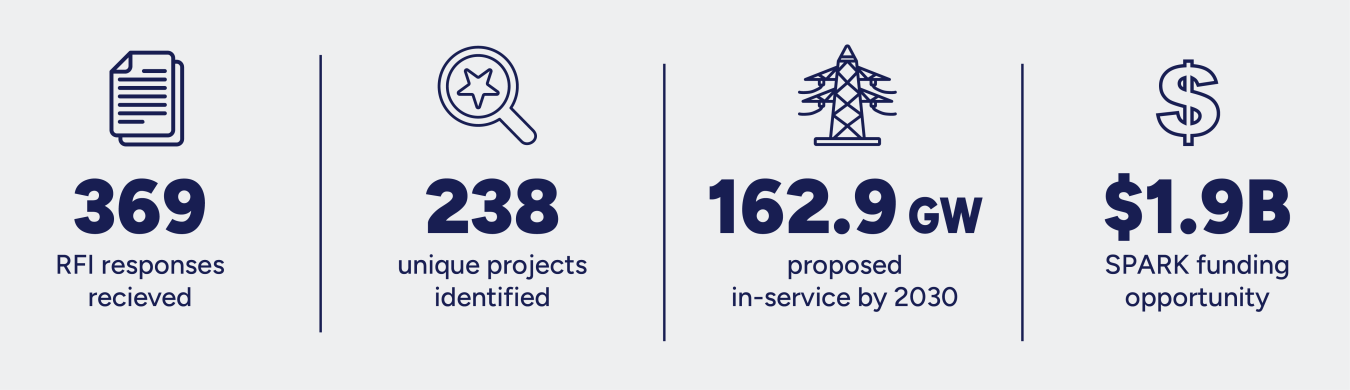
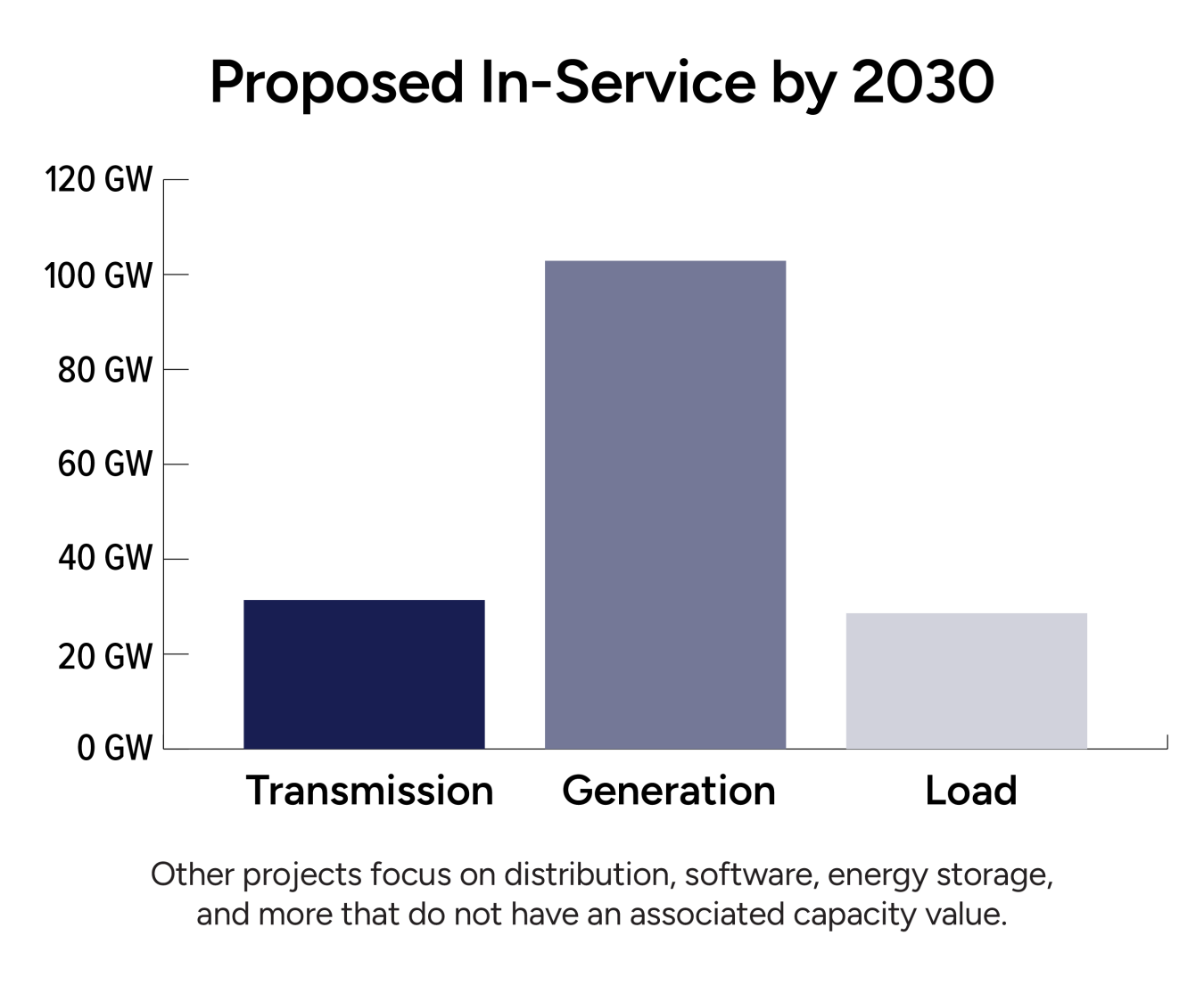
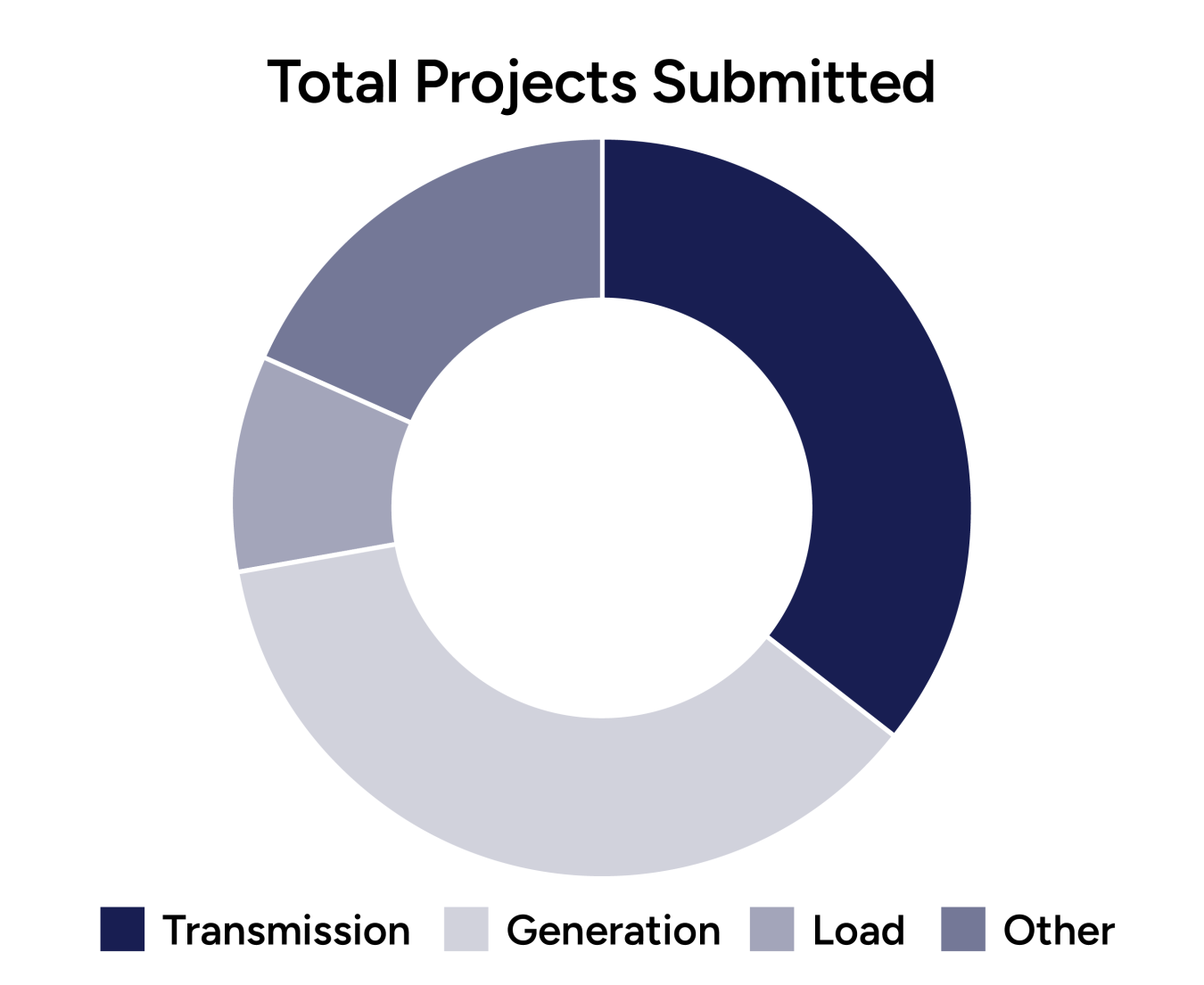
To inform the initiative, DOE issued a Request for Information (RFI) seeking data on large-scale grid infrastructure projects. Responses were due November 21, 2025. DOE received 369 responses and identified 238 unique projects primarily across transmission, generation, and load categories.
This document distinguishes among actions informed by the RFI, separate actions that align with issues raised through it, and recommendations that remain under consideration or require action by other authorities.
The RFI was not a funding opportunity and did not accept applications for financial assistance. Submitting a response did not provide an advantage or disadvantage in any later competition. DOE reviewed the submissions as planning information and did not treat any response as a binding project or policy commitment.
Speed To Power RFI Response Totals
| Category | Total Projects Submitted | Proposed in-service by 2030 |
|---|---|---|
| Transmission | 85 | 31.4GW |
| Generation | 87 | 102.9 GW |
| Load | 23 | 28.6 GW |
| Other | 43 | N/A |
| All Projects | 238 | 162.9 GW |
What DOE Heard Through the RFI
Faster Capacity for Large Loads
Rapid, location-specific demand growth from data centers, advanced manufacturing, semiconductor facilities, and other large users — needing connection on timelines shorter than current development allows.
Reliability, Resource Adequacy & Affordability
New capacity should strengthen dependable service and avoid shifting unreasonable costs or risks to residential, commercial, and industrial customers.
Capital Formation & Risk Reduction
Grants, loans, capacity contracts, cost sharing, and other tools to reduce early-stage or delivery risk and attract nonfederal investment.
Implementation Conditions
Grow domestic supply chains, workforce availability, cybersecurity, community and Tribal engagement, performance measurement, and sharing replicable practices to enhance implementation.
Better Use of Existing Grid Infrastructure
Reconductoring and advanced transmission technologies that increase the physical or usable capacity of existing lines and substations, often within existing rights-of-way.
Regional & Interregional Coordination
More transfer capability across planning regions and seams, together with coordinated modeling, planning, and cost-benefit analysis.
Siting, Permitting, Interconnection & Technical Capacity
Permitting delays, interconnection queues, inconsistent planning assumptions, data gaps, and limited staff or modeling capacity as material barriers.
Manufacturing expansion, including Intel's semiconductor mega-fab complex, is driving new loads.
Semiconductor | Manufacturing
"Data Center Alley" - one of the densest concentrations of data-center demand in the nation.
Data Centers
Data-center growth, cryptocurrency mining, and industrial electrification - including oil-and-gas and hydrogen production - are converging.
Data centers | Industrial
Transmission constraints from solar and wind variability compound the challenge of serving growing industrial load centers.
Transmission | Industrial
Ohio, Indiana, Michigan, Illinois
Data centers, advanced manufacturing, and industrial electrification; aging distribution and limited transmission import capability.
Semiconductor | Data centers | Transmission
A critical boundary for interregional transmission upgrades to relieve constraints between two of the nation's largest organized markets.
Transmission
Notable AI-driven demand growth adding load in an already capacity-constrained region.
Data centers
Geothermal resource potential and associated load-growth opportunities in Southern California.
Geothermal
Utah, Nevada, Arizona, Oregon, Montana, Wyoming
Rapid load growth from data centers and industrial development; Tahoe-Reno Industrial Center and Western Colorado geothermal. No single RTO covers the area.
Data centers | Geothermal | Industrial
Data centers and semiconductor manufacturing upstate, plus broad electrification, straining upstate-to-downstate transmission bottlenecks.
Semiconductor | Data centers | Transmission
ISO-NE projects significant peak-demand increases by 2050 with potential winter peaking. Intertie constraints with NY and Canada are key concerns.
Transmission | Data centers
Southern Company territory experiencing some of the highest load growth in the country — hyperscale data centers, advanced manufacturing, and federal defense installations.
Data centers | Manufacturing
Stakeholder Themes
Stakeholder perspective on urgency. Respondents conveyed a consistent message: the convergence of AI, advanced manufacturing, and broad electrification presents unprecedented demand growth that requires coordinated federal, state, and regional action — positioning DOE as a leader in transforming grid challenges into pathways for reliable, affordable, and secure electricity supply.
Speed to Power through Accelerated Reconductoring and other Key Advanced Transmission Technology Upgrades (SPARK)
The Office of Electricity’s approximately $1.9 billion SPARK Notice of Funding Opportunity (NOFO) was designed to accelerate investments in electric grid infrastructure that helps meet growing electricity demand, strengthen resource adequacy, and improve grid reliability and affordability. The funding opportunity prioritized projects that combined durable physical capacity upgrades, such as reconductoring, with advanced transmission technologies that improve operational efficiency and flexibility. Through these investments, SPARK will expand grid capacity and transfer capability while maximizing the value and performance of existing transmission infrastructure.
DOE Actions that Address or Align with RFI Themes
Some actions respond directly to the Request for Information (RFI); others were already under way, but address issues that stakeholders raised. Unless noted, sources do not establish that an action was created because of the RFI.
For more information about the projects selected under Speed to Power through Accelerated Reconductoring and Other Key Transmission Technology Upgrades (SPARK) Notice of Funding Opportunity, go here.
HARMONY
Office of Electricity Funding Opportunity
Enhances grid reliability and resilience amid growing uncertainties and big data, enabling rigorous quantification of risks and their communication to decision-makers and operators for enhanced grid visibility.
2026 Draft National Transmission Needs Study
Office of Electricity
Informs planning and investment nationally, but does not select specific projects. The study was released on July 9, 2026 for a 60-day comment period ending September 8, 2026.
Genesis Mission
National labs, industry, and academia
Unites partners to harness AI for breakthroughs in energy dominance, discovery science, and national security. An initial 26 national science and technology challenges have been identified.
DOE Boost Platform
Sandia National Labs and FedTech
Addresses energy challenges through commercialization of lab-created technologies, supporting multiple pathways to company creation.
Energy Dominance Financing Program
Powered by the Working Families Tax Cut
Creates new eligibility for clean coal and oil-and-gas power generation, secures critical mineral supply chains, and reinvigorates the nuclear industry.
Transmission Facilitation Program (TFP)
Office of Energy Dominance Financing
$2.5B
Provides an existing revolving fund using capacity contracts, loans, and public-private partnerships. Nearly fully obligated or in negotiations; future opportunities depend on funds becoming available.
WAPA Transmission Infrastructure Program (TIP)
Western Area Power Administration (WAPA)
$3.25B
Manages WAPA's statutory borrowing authority; makes strategic loans to leverage federal funds and attract nonfederal co-investment for critical transmission infrastructure.
Battery Materials Processing & Manufacturing/Recycling Grants
Funding Opportunity
$500M
Encourages demonstration and commercial facilities to increase domestic supply of critical minerals and materials for advanced batteries—critical for grid resilience, data centers, transportation, drones, and defense.
Critical Minerals & Materials Accelerator
Industry-led Partnerships
$69M
Programs support prototypes and pilots innovative critical-materials processing technologies proven only at bench scale, for a more secure, predictable, and affordable supply.
Interconnection Innovation e-Xchange (i2X)
DOE and National Laboratories
This program enables simple, fast, affordable interconnection while enhancing reliability and security — sharing data, developing roadmaps, and facilitating solutions across the ecosystem.
Interconnection Cost Reduction Solutions (iCRS)
i2X
i2x addresses distribution (iCRS-D) and transmission (iCRS-T) interconnection challenges; funds Lighthouse Projects to demonstrate new technologies and streamline services.
State Technical Assistance Program
DOE-funded
Provides free access for any state public utility commission or state energy office staff to national laboratory experts on electricity-related topics aligned with federal policy.
Utility & Grid Operator Technical Assistance
Provides technical assistance at the National Lab of the Rockies (NLR), Lawrence Berkeley National Lab (LBNL), Pacific Northwest National Lab (PNNL), Sandia National Lab (SNL), Idaho National Lab (INL), and Argonne National Lab (ANL)
Supports utilities and grid operators in modernizing systems along three pathways: Rolling Technical Assistance, Key Assist, and Interconnection Assistance.
Transmission Acceleration Grants (TAG)
Office of Electricity
$2.5M
Aligns actions to accelerate transmission projects. The awards were announced Feb 3, 2026 for Johns Hopkins University and the Pennsylvania Public Utilities Commission (PUC). TAG was established before the RFI as an aligned action. The application window is now closed.
Unleashing Tribal Energy Development
Funding Opportunity
~$50M
Advances affordable, reliable, secure development of Tribal energy resources—lowering or stabilizing costs, expanding access, and advancing development for Tribal economic benefit.
Technical Assistance for Tribal Energy Projects
Office of Indian Energy and Commercial Law Development Program (CLDP)
Provides no-cost assistance covering energy planning, efficiency and resource assessments, project planning, codes, utility formation, and legal-environment support for Tribes and Alaska Native corporations.
Voices of Experience
Structured Dialogue
Uses open dialogue and active listening to gather firsthand insights through multi- and single-stakeholder conversations on accelerating speed to power.
SPARK Metrics & Benefits Activities
Office of Electricity / Grid Resilience and Innovation Partnerships (GRIP)
If SPARK awards are made, DOE anticipates analyzing project data so recipients document capacity, reliability, cost, and other outcomes to support learning across utilities, states, and planners.
Beyond the Announced Actions
RFI respondents also proposed actions concerning new generation, nuclear and geothermal deployment, long-duration storage, demand-side flexibility, domestic manufacturing and workforce, federal permitting, interconnection and market rules, tax policy, and interagency coordination. The source materials do not establish that DOE has adopted each recommendation or created a new program for each issue. DOE will announce any additional funding opportunity, policy action, study, or engagement process through official channels.
How Stakeholders can Participate
- Apply for applicable state, utility, grid-operator, or Tribal technical assistance, subject to each program's eligibility and availability.
- Monitor DOE's official funding and financing pages for SPARK announcements and future opportunities.
- Participate in future public comment periods, webinars, workshops, and consultations announced by DOE.