



The U.S. Department of Energy’s Office of Electricity (OE) launched the Storage Design Strategies to Ease Production (STEP) Prize, a new competition to help the next generation of energy storage technologies move more smoothly from concept to real-world manufacturing.
July 14, 2026 Estimated Read Time min
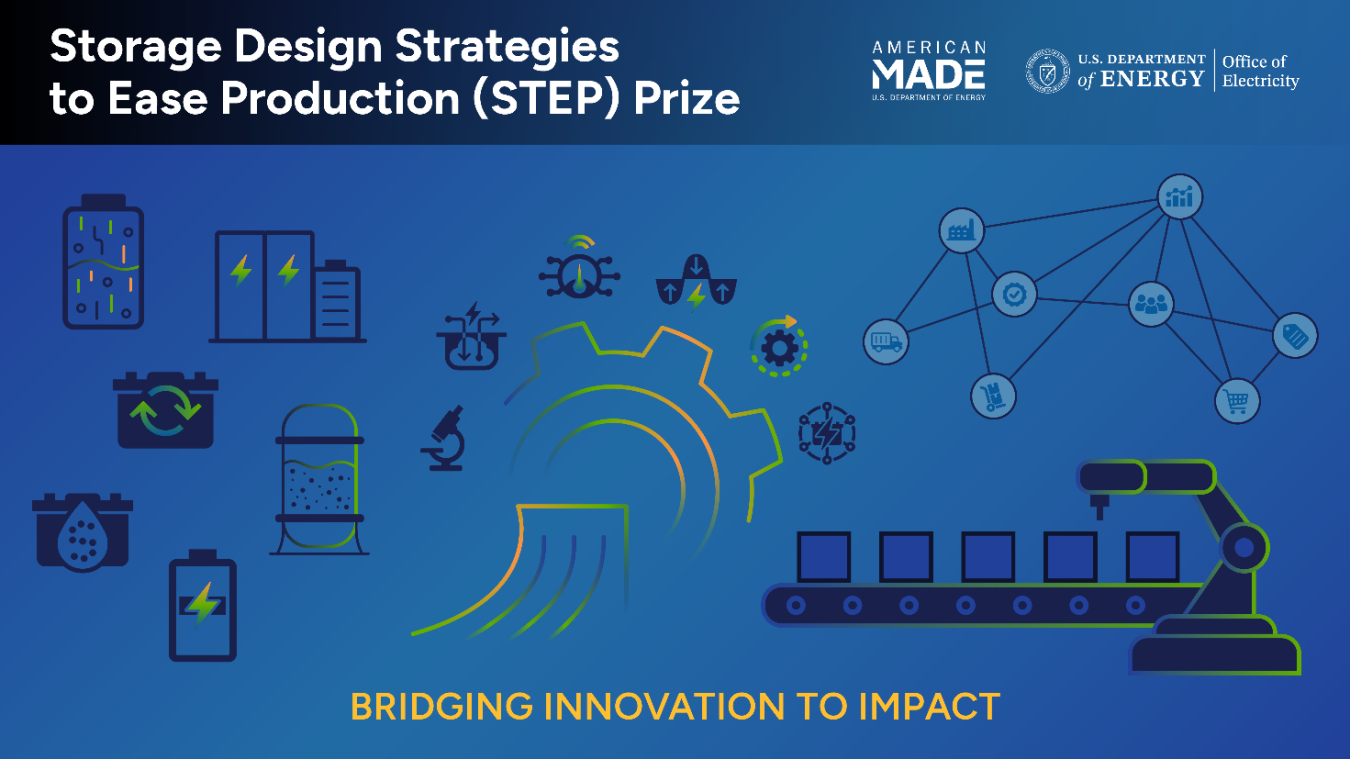
The U.S. Department of Energy’s Office of Electricity (OE) launched the Storage Design Strategies to Ease Production (STEP) Prize, a new competition to help the next generation of energy storage technologies move more smoothly from concept to real-world manufacturing. The Storage Design STEP Prize recognizes innovators who are working on novel energy storage technologies and encourages them to build production readiness into their designs from the start.
A New Kind of Challenge for a New Generation of Innovators
Across the energy sector, innovators developing breakthrough technologies often encounter a similar set of obstacles: even when a new system performs well in early testing, challenges with manufacturing, materials, or supply chains can slow or stop progress long before the technology reaches commercial scale. These challenges can range from specialized components that are difficult to source, to manufacturing steps that become costly or inconsistent when scaled up.
The Storage Design STEP Prize addresses these hurdles directly. Rather than focusing solely on performance, the prize asks competitors to think early about manufacturability and supply chain resilience, two factors that have historically slowed emerging storage technologies. By supporting teams who consider these issues up front, DOE aims to cultivate technologies that are not only innovative but also practical to produce at scale.
How the Storage Design STEP Prize Works
The Storage Design STEP Prize is structured in two phases, each helping participants build the foundations for future commercial success.
Phase 1: Identifying Challenges and Design Solutions
Competitors begin by evaluating how their storage concept might face manufacturability or supply chain barriers. They identify potential issues, such as material constraints, supplier gaps, or complex assembly steps, and propose design strategies that could help reduce future risks. Up to three Phase 1 Champions will receive $20,000 each, and up to nine Phase 1 Finalists will receive $10,000 each.
Phase 2: Demonstrating Progress Toward Production-Ready Designs
Phase 1 winners can advance to Phase 2, where they further develop their concepts and outline robust plans for future proof-of-concept demonstrations. In this phase, competitors describe how their design changes could reduce production costs, improve scalability, and strengthen supply chain resilience. Up to two Phase 2 Champions will receive $100,000 each, and up to three Phase 2 Finalists will receive $50,000 each.
All Phase 1 winners also receive priority access to the Grid Storage Launchpad (GSL) at Pacific Northwest National Laboratory, creating opportunities for later testing and validation that can help accelerate their designs.
Why is OE Focusing on Production-Ready Design?
DOE’s Office of Electricity has seen that a promising technology alone is not enough. For new storage solutions to meaningfully contribute to a resilient and reliable grid, they must be manufacturable, cost-effective, and supported by supply chains that are diverse and robust.
The Storage Design STEP Prize aims to help innovators overcome challenges such as:
- Reliance on materials that are scarce, costly, or sourced from limited suppliers.
- Complex or specialized manufacturing steps that complicate scale-up.
- Supply chain vulnerabilities that can slow deployment or raise system costs.
- Unanticipated redesigns that delay commercialization.
By examining these issues at the design stage, competitors can lay the groundwork for technologies that are better positioned to grow, adapt, and be produced reliably within the U.S. and leverage domestic supply chains.
Who Can Participate?
The Storage Design STEP Prize welcomes individuals, academic teams, start-ups, entrepreneurs, non-federal government entities, and small businesses. Submissions must center on novel energy storage technologies capable of charging and discharging electricity for grid-scale or stationary uses. Some technologies, such as hydrogen storage concepts or traditional lithium-ion systems, fall outside the prize scope unless they meet specific criteria outlined in the official rules.
Supporting a More Resilient Energy Storage Ecosystem
Through the Storage Design STEP Prize, DOE aims to encourage innovators to build their technologies with the full lifecycle in mind—from materials and sourcing all the way through production. This early focus on manufacturability and supply chain strategy will help reduce common barriers that delay or prevent emerging storage technologies from meeting market needs.
As the field of energy storage continues to diversify, initiatives like the Storage Design STEP Prize help ensure that promising ideas have a practical path toward deployment, strengthening U.S. innovation and supporting the development of next-generation storage systems designed to meet the demands of the future grid.
Learn More
Full prize rules, eligibility requirements, and submission details are available on the HeroX prize platform: https://www.herox.com/storagedesignSTEP-prize.