



As Assistant Secretary for Environmental Management Tim Walsh kicked off the 12th National Cleanup Workshop today, he emphasized that the soon-to-be-named Office of Nuclear Restoration & Revitalization is conducting restoration projects with a sense of urgency and redeveloping former cleanup sites to bring tremendous impact to the local communities and the nation.
Office of Environmental Management
September 15, 2026 Estimated Read Time min
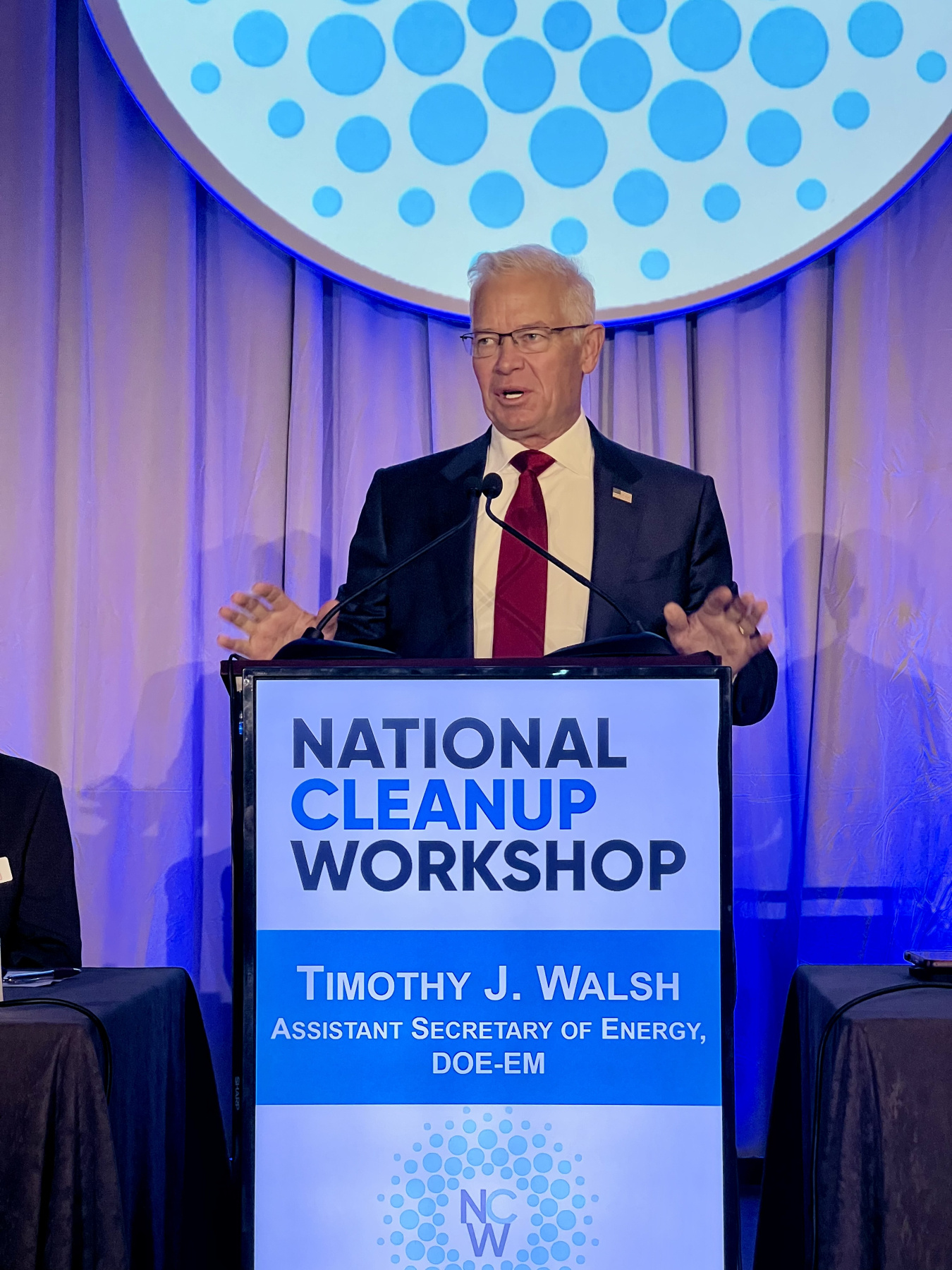
Assistant Secretary for Environmental Management kicks off the first full day of the 12th National Cleanup Workshop with his keynote address in front of an audience of 600 attendees.
ARLINGTON, Va. — As Assistant Secretary for Environmental Management Tim Walsh kicked off the 12th National Cleanup Workshop today, he emphasized that the soon-to-be-named Office of Nuclear Restoration & Revitalization is conducting restoration projects with a sense of urgency and redeveloping former cleanup sites to bring tremendous impact to the local communities and the nation.
Cleanup is paving the way for the new and exciting opportunities happening across the country.
“Under President Donald Trump and Secretary Chris Wright’s leadership, we are maximizing those opportunities more than ever by advancing cleanup in meaningful ways and re-evaluating land, buildings and materials that were previously considered excess or waste,” Walsh said in the keynote address to an audience of 600 attendees.
Case in point: Walsh pointed to the more than $650 billion private sector investments at or adjacent to cleanup sites for research, affordable energy production, computing power and innovation through the U.S. Department of Energy’s American Energy Hub initiative.
One of those investments involves a landmark $100 billion partnership with companies Brookfield and NextEra Energy to redevelop portions of the Paducah Site in Kentucky into a world-class high-performance compute campus powered by new affordable energy infrastructure. Aligned with Trump’s historic Ratepayer Protection Pledge, the project keeps power bills low for the people of Kentucky.
“This latest announcement is one of the largest investments in Kentucky’s history,” Walsh said. “It will lower electricity costs across the region, create thousands of high-paying jobs, provide a substantial new tax revenue base and strengthen national security.”
Another American Energy Hub is changing the trajectory of the region around the Portsmouth Site in Ohio, adding incredible amounts of energy and computational power.
Companies SoftBank and SB Energy announced an investment that is bringing 10 gigawatts of new power generation, the world’s most powerful computing campus and new utility infrastructure to Ohio. Over the next five years, a total of $500 billion will be invested in southern Ohio to build this historic innovation center.
“It’s a gamechanger that creates opportunities for a region that previously did not have a clear path back to prosperity,” Walsh said. “Now, there are thousands of new jobs being created, affordable energy being produced, and revitalized industry onsite that will attract more companies to relocate to the Piketon area and invest in that great community.”
Nuclear restoration and revitalization — like that at the Paducah, Portsmouth and other sites — reflects the program’s work more accurately, Walsh said, noting that the pending name change for the DOE Office of Environmental Management (EM) conveys "who we are to others, and equally important, it conveys who we are to our employees."
Walsh also cited big wins across the DOE complex, including:
- A historic milestone marking 2025 as the first time since the 1940s when the amount of tank waste at the Hanford Site in Washington state decreased. After the waste is run through a tank-side system to remove 99.9% of the radioactivity, it is fed to the Waste Treatment Plant, where it is solidified in glass. Implementing a dual glass-and-grout strategy has the potential to save taxpayers over $100 billion dollars, if not more, and shave decades off Hanford’s cleanup, he said.
- Treatment and disposal of more than 13 million gallons of tank waste at the Savannah River Site in South Carolina, an accomplishment supported by mature tank-waste capabilities and a strong relationship with regulators. Crews are processing legacy tank waste at unprecedented rates, accelerating cleanup timelines and reducing long-term risks and costs to taxpayers, Walsh said.
- Savannah River National Laboratory is projected to yield more than $150 billion in lifecycle cleanup savings as it invests in new technologies driving innovation. Its Advanced Manufacturing Collaborative is testing new materials for safer and stronger parts for the nuclear power and defense industries, advancing robotics to support hazardous tasks in the field and providing the computational backbone to advance artificial intelligence projects for DOE and EM’s Genesis Mission.
- Purposeful cleanup at Oak Ridge in Tennessee is leading to opportunities for private industry and important DOE missions as crews clear away aging infrastructure at the Y-12 National Security Complex and Oak Ridge National Laboratory (ORNL) to open space for crucial national security and research missions. Steady progress on the highest priority cleanup project at ORNL is eliminating the nation’s inventory of uranium-233 stored there and creating cancer-curing isotopes.
- The Idaho Cleanup Project is delivering cleanup enabling Idaho to lead the way in energy and medical research. Crews are accelerating demolitions for the Office of Naval Reactors at a considerable cost savings for American taxpayers, and workers have completed more than 40% of the tank-waste mission there.
- In New Mexico, infrastructure upgrades at the Waste Isolation Pilot Plant (WIPP) enhanced worker safety and ensured this unique national asset can support cleanup and security priorities for years to come. At the EM Los Alamos Field Office to date in fiscal year 2026, crews have completed 82 transuranic waste shipments to WIPP, a 91% increase over 43 shipments in the previous fiscal year. “We are moving in the right direction, and I am excited for further progress at WIPP and Los Alamos as New Mexico continues to be at the tip of the spear to build our nuclear deterrence capabilities,” he added.
To receive the latest news and updates about the Office of Environmental Management, submit your e-mail address.