



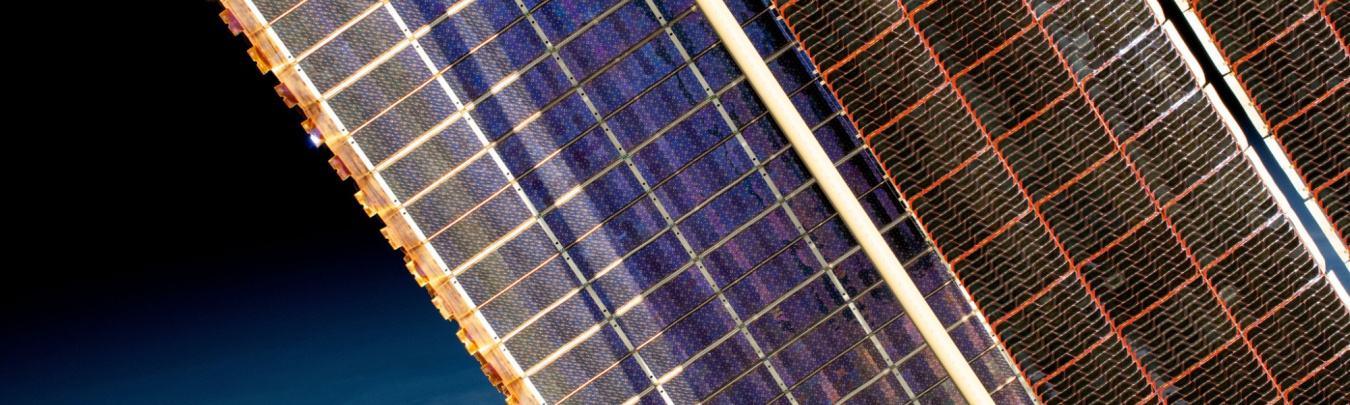
The Integrated Energy Systems Office (IESO) Space Photovoltaics (PV) Workshop convened 78 participants in Washington, D.C., on June 2, 2026: 37% from solar and space industries, 45% from federal agencies and national laboratories, and 18% from academia. Participants identified barriers to scaling the next generation of space PV and proposed research and development (R&D) targets and recommended actions for the community.
The targets and actions in this summary and the full report reflect recommendations of workshop participants and do not constitute commitments or the opinions of the U.S. Department of Energy (DOE).
Satellites, powered by PV cells, are fundamental to national defense, global communications, weather forecasting, navigation, and a growing on-orbit economy. Workshop participants expect demand for space power to grow faster than domestic production can scale and faster than qualification pathways can adapt. Proven III-V technologies (which use semiconductors combining chemical elements from Group III and Group V of the periodic table) offer high energy conversion efficiency and radiation tolerance but remain costly and dependent on specialized equipment and concentrated supplies of gallium (Ga), germanium (Ge), and other components. Lower-cost silicon (Si), perovskites, and other thin films offer potential advantages in cost, scale, and mass but require mission-relevant reliability data and qualification pathways. Participants therefore identified three main barriers: technology reliability, domestic manufacturing and supply-chain resilience, and appropriate testing and qualification.
To overcome these barriers, participants identified three core opportunities for R&D:
- Advance PV performance and reliability. Participants prioritized R&D to advance a portfolio of PV technologies and establish mission-relevant reliability. Participants proposed cross-cutting 2035 targets: PV arrays that simultaneously deliver at least 200 watts per kilogram (W/kg) of specific power, retain at least 70% of beginning-of-life power at end of life for a defined mission profile, and cost less than $10 per watt at a defined array boundary. Reaching these targets requires both steady improvement of existing Si and III-V-based cells and higher-risk research on thin-film and perovskite-based multi-junction cells, including predictive understanding of in-orbit degradation, recovery, and combined-stressor effects.
- Rebuild the U.S. supply chain and manufacturing base. Participants identified a clear need to reduce the material intensity of critical minerals such as Ga and Ge; strengthen their supply chains; expand U.S. manufacturing capacity for Si, III-V, and thin-film cells, substrates, and module components; and develop domestic manufacturing equipment capability. Participants noted continued terrestrial PV R&D and manufacturing as a key enabler in strengthening domestic manufacturing and supply chains for space PV.
- Modernize testing and qualification. Participants recommended mission- and technology-specific protocols, combined-stressor ground testing, regular low-cost flight opportunities, and shared data. Orbit-specific environmental profiles and market analysis would inform these activities.
A Phased Action Roadmap
A Phased Roadmap Consolidating the Actions Proposed by Workshop Participants
Timeframe | Key actions |
Immediate1–3 years |
|
Mid-term3–7 years |
|
Long-termby 2035 |
|
Sign up to receive the latest news, updates, and opportunities from the Integrated Energy Systems Office.