



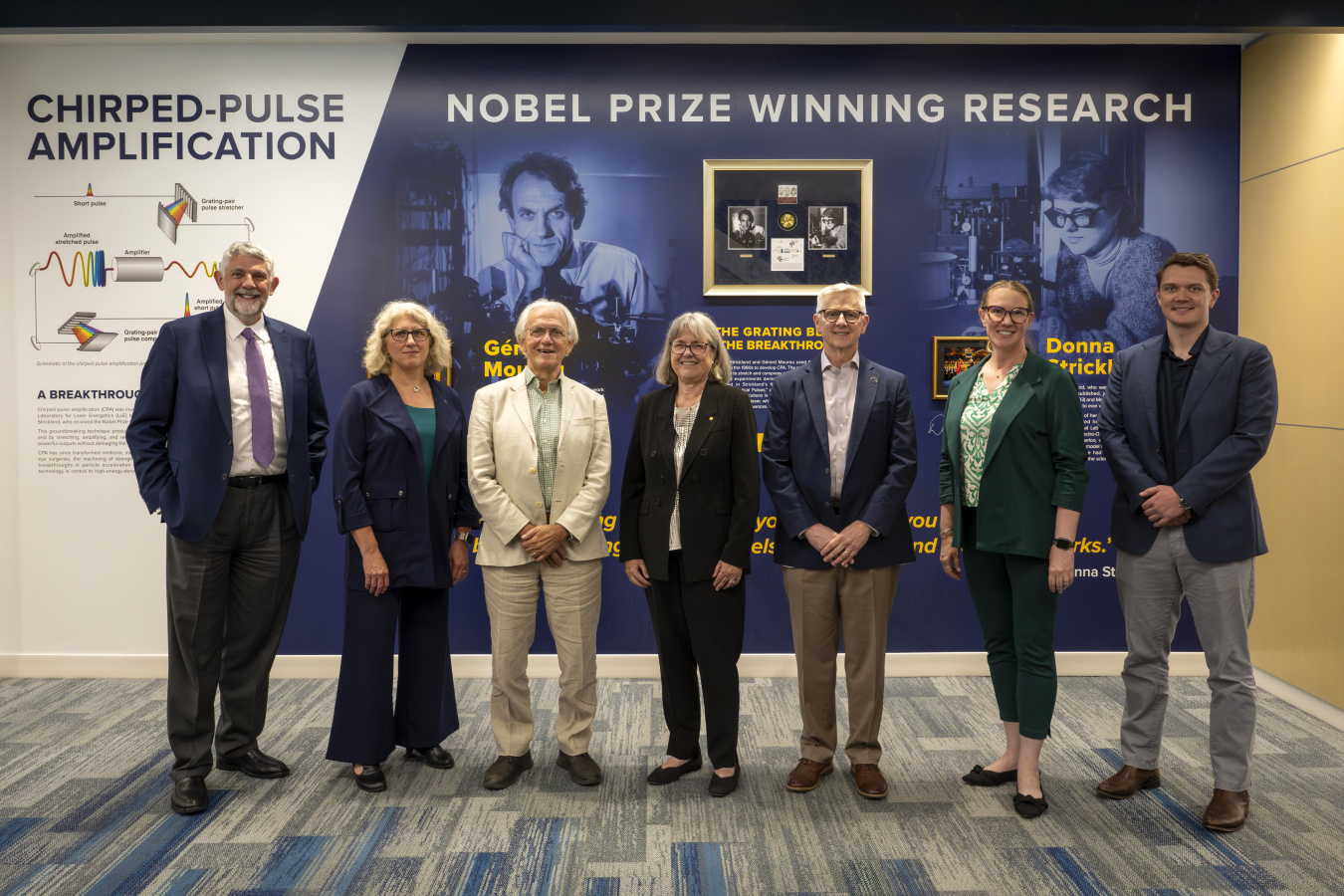
Leaders from NNSA’s Office of Research, Development, Test & Evaluation traveled to the University of Rochester in New York to celebrate the 50th anniversary of the Laboratory for Laser Energetics.
National Nuclear Security Administration
July 29, 2026 Estimated Read Time min
When scientists at the National Nuclear Security Administration’s (NNSA) National Ignition Facility achieved the breakthrough of fusion ignition in 2022, the implications of reproducing the power of the sun in a laboratory were celebrated around the world. In the first successful experiment of its kind, 192 laser beams concentrated two million joules of ultraviolet energy on a tiny capsule of deuterium and tritium, fusing the hydrogen isotopes and releasing more energy than the lasers delivered. Although the experiment featured cutting-edge technology, from 3D modeling and simulation to advanced diagnostics, the high-powered lasers that made the revolution possible had their roots in an innovation pioneered many decades earlier.
In July, leaders from NNSA’s Office of Research, Development, Test & Evaluation traveled to the University of Rochester in New York to celebrate the 50th anniversary of the Laboratory for Laser Energetics (LLE). The laboratory is the birthplace of a technological advancement—chirped-pulse amplification—that would fundamentally transform laser science and, in turn, inertial confinement fusion and high-energy-density (HED) physics, disciplines that are central to the modernization of the U.S. nuclear weapons stockpile.
Chirped-pulse Amplification
In 1985, Professor Gérard Mourou and his student Donna Strickland were wrestling with a straightforward but vexing challenge in their field: how to attain high levels of laser energy without destroying the very system that delivered it. Laser technology had been invented only a quarter-century earlier. Though progress was initially promising, with lasers steadily growing in strength, the technology was constrained by the tolerances of laser system optics, which could only withstand so much power before melting or disintegrating. Then one day while sitting on a ski chairlift, Mourou had a revelation.
Laser beams, he realized, could be manipulated to make them both more powerful and nondestructive at the same time. The technique Mourou conceived involved spacing out, or “chirping,” laser pulses, amplifying them, and then compressing the pulses again. Strickland was given the task of demonstrating the concept, making key experimental contributions. The three-page length of the pair’s resulting paper, “Compression of Amplified Chirped Optical Pulses,” belied its extraordinary significance; in 2018, Mourou and Strickland were honored with the Nobel Prize in Physics for their invention.
Today, chirped-pulse amplification is used in an astonishing range of commercial and health care applications, from industrial machining to medical imaging and cancer treatment. Anyone who has ever had laser eye surgery is a beneficiary of the technology (an application discovered as the result of an unfortunate but fortuitous laboratory accident).
The maturation of laser science at LLE coincided with an urgent national security need. Following the United States’ discontinuation of nuclear explosive testing in the early 1990s, scientists at NNSA’s weapons laboratories were challenged to ensure the reliability of the nation’s nuclear arsenal through exclusively scientific means. High-powered lasers thus became essentials tools of the stockpile stewardship mission. Consequently, NNSA has long funded research at LLE and collaborated with its scientists to advance stockpile-relevant technologies, particularly at LLE’s Omega Laser Facility, the largest academic laser facility in the world.
Crucial HED physics work is performed at Omega in support of the U.S. nuclear stockpile. Indeed, 80% of NNSA’s HED physics experiments are conducted at the facility. Scientists perform inertial confinement fusion experiments to replicate the physics of nuclear explosions, validating the models that NNSA’s weapons laboratories use to assess the reliability of America’s warheads. Omega scientists also study the behavior of nuclear materials under extreme conditions, providing important insights into the inner workings of nuclear weapons.
Roughly 2,000 target “shots” are conducted annually at the facility. Omega experiments are essential to maturing the platforms and diagnostics that make NNSA facilities more productive, including the National Ignition Facility at Lawrence Livermore National Laboratory and the Z Pulsed Power Facility at Sandia National Laboratories. Omega’s Laboratory Basic Science Program also offers shot time to scientists from inertial confinement fusion laboratories around the country, including Lawrence Livermore, Los Alamos, and Sandia, and several DOE Office of Science laboratories.
During remarks at the celebration, Dr. David LaGraffe, NNSA’s Principal Assistant Deputy Administrator for Research, Development, Test & Evaluation, reflected on the relationship between LLE and the nation’s weapons laboratories in supporting the nuclear stockpile. “Lab scientists focus on targeted weapons applications; LLE scientists pursue broader questions—and the two together are far stronger than either alone,” said LaGraffe. At LLE, the engineering, fusion and HED science, technical talent, and partnerships “converge on a single national purpose: bolstering the science that underpins the nuclear deterrent.”
LLE has long served as a talent pipeline to NNSA’s national security laboratories, training the next generation of HED physicists and laser engineers on world-class scientific facilities. Many of these students go on to careers at the NNSA labs, performing work directly related to the nuclear stockpile.
In Fiscal Year 2026, LLE received over $100 million in federal funding from NNSA. As a reflection of its importance to national security, the laboratory also receives funding from the Department of War and the Air Force Office of Scientific Research.