



Amendment 10 of ALRD DE-FOA-0002736 (IIJA – PREVENTING OUTAGES AND ENHANCING THE RESILIENCE OF THE ELECTRIC GRID FORMULA GRANTS TO STATES AND INDIAN TRIBES): The Grid Resilience State and Tribal Formula Grants amendment for FY25-FY26 Administrative and Legal Requirements Document (ALRD) was issued on October 20, 2026. The link to FY25-FY26 ALRD (Amendment 010) can be found on FedConnect here. The FY25-FY26 ALRD (Amendment 010) initiates the Fiscal Years 2025 and 2026 (FY25-FY26) Grid Resilience State and Tribal Formula Grants 120-day application period for existing grant recipients and new applicants. The FY25-FY26 application deadline will be February 17, 2027 at 11:59pm EST. The FY25-FY26 grant allocations for each state, Indian tribe, and territory can be viewed here.
Administered by OE with the support of the National Energy Technology Laboratory (NETL), the Grid Resilience State and Tribal Formula Grants program is designed to strengthen and modernize America’s power grid against wildfires, severe storms, and other natural disasters.
Program Information
The program will distribute funding to states, territories, and federally recognized Indian tribes, including Alaska Native Regional Corporations and Alaska Native Village Corporations, over five years based on a formula that includes factors such as population size, land area, probability and severity of disruptive events, and a locality’s historical expenditures on mitigation efforts. The states, territories, and tribes will then award these funds to a diverse set of projects, with priority given to efforts that generate the greatest community benefit providing affordable and reliable energy.
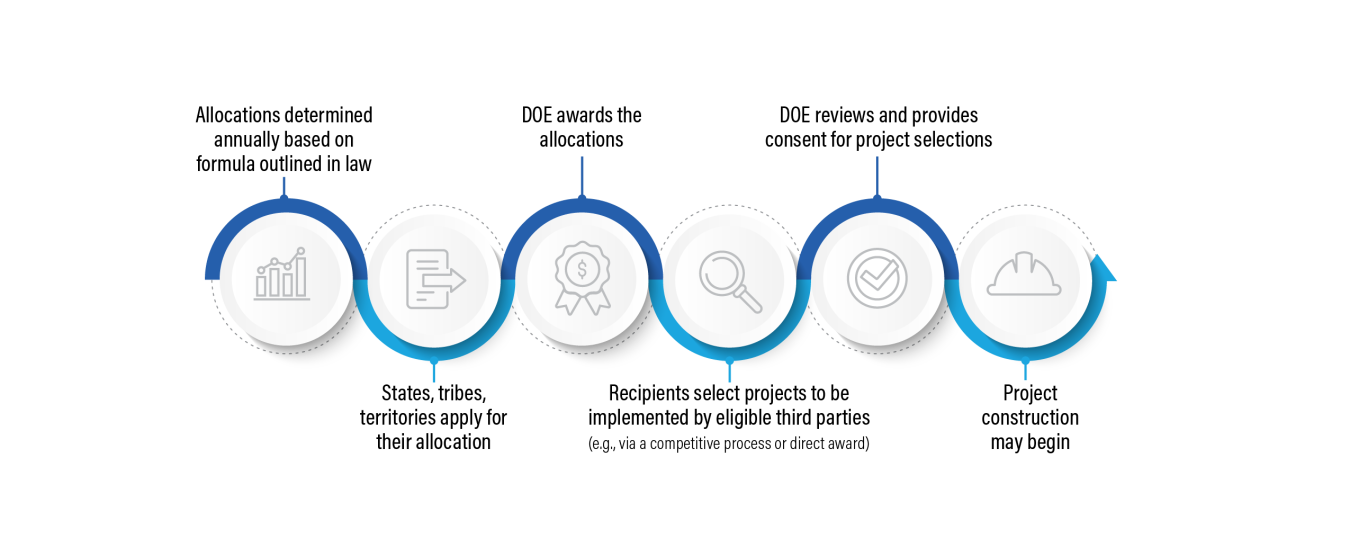
Formula Grant Awards
Find more information about the Grid Resilience State and Tribal formula grant awards and Tribal Consortiums.
Resources
This funding comes from the Grid Resilience State and Tribal Formula Grant allocation amounts from the Fiscal Year (FY) 2025 and FY 2026 appropriations and opens the FY 2025 and FY 2026 application and allocation request period. This is Years 4 and 5 out of the 5-year program.
- Application Submission Webpage
- Step-by-step Application Videos - These videos provide guidance on the Grid Resilience State and Tribal Formula Grant application process, including what you need to know before applying, registration and pre-application requirements, necessary forms, and steps after submission.
- NETL's Grid Resilience State and Tribal Formula Grant Webpage
Program Information
Case Studies - Grid Resilience Valuation and Investment Prioritization
- Increasing Manhattan’s Energy Resilience Through Storm Hardening
- Undergrounding to Reduce Florida Power System Vulnerability to Extreme Weather
Case Studies - Utility Resilience Planning Practices for Hazards
Grid Resilience Overview Documents
- Low-Cost Grid Resilience Projects
- Microgrid Overview
- Guide to Install Back-up Battery Power Systems on Tribal Facilities
U.S. Territories Energy Sector Risk Profiles
Webinar Materials
- Grid Resilience Exchange: Strengthening Tribal Communities Workshop
- Rural Alaska Grid Resilience Workshop
- Build America, Buy America (BABA) and Davis Bacon Act (DBA) Training for Tribes
To learn about technical and other assistance options that OE provides, please visit Request Grid Resilience Assistance.
The Formula Grant Explained
A formula grant is a non-competitive funding opportunity to a specific group of applicants, in this case to states and Indian tribes. A formula is used to allocate funds to the eligible applicants.How can my State, Indian Tribe, or Territory apply for FY 2025/26 funding?
The process for requesting a FY 2025/26 allocation depends on whether the applicant is an existing grant recipient or a new grant applicant:
Existing Grant Recipients that have already received grants for FY 2022–FY 2024 of the Program will have 120 days from the issuance of ALRD Amendment 000010 to request their FY 2025/26 allocation, in accordance with the Terms and Conditions of their current Grant award.
New Grant Applicants are eligible applicants (as defined in Administrative and Legal Requirements Document (ALRD) Amendment 000010) that did not submit a grant application for FY 2022–FY 2024 of the Program. New Grant Applicants will have 120 days from the issuance of ALRD Amendment 000010 to submit a grant application for a FY 2025/26 allocation.
Several one-time actions must be completed before an application can be submitted, including registration with the System for Award Management (SAM), obtaining a Unique Entity Identifier (UEI), and registering with FedConnect.net. These actions can be completed prior to the issuance of ALRD Amendment 000010. Prospective New Grant Applicants are encouraged to address these items as soon as possible, as some may take several weeks to complete. Additional instructions for New Grant Applicants will be provided in the ALRD Amendment 000010.
Why is my State, Indian Tribe, or Territory’s FY 2025/26 allocation different from its FY 2024 allocation?
Formula grant allocations may change year-to-year for several reasons. IIJA Section 40101(d) language requires that all data relating to the factors used in the allocation formula be updated annually, which means that each recipient’s annual allocation may be different for each year of the Grid Resilience Formula Grant Program. Changes to underlying data, such as updates to FEMA’s National Risk Index released in December 2025, may translate to changes in allocations. Additional reasons why allocations may have changed include improvements to the data sources and methodologies used to calculate each factor and addition of previous years’ unclaimed funds to the pool of available FY 2025/26 allocations.
Can my State, Indian Tribe, or Territory submit an application if we did not apply for previous rounds of funding?
Yes. States, Indian Tribes, and Territories that did not apply for FY 2022–FY 2024 funding by the relevant deadline may apply for the remaining years of grant funding. Grant funding is available to each eligible recipient on an annual basis regardless of previous application status.
How can I confirm that my application has been submitted/received?
Once an application has been submitted, FedConnect will display the date and time of the submission on a confirmation page. Submitted applications initially undergo a compliance and technical review. This process may take a few months based on the number of applications received. A Federal Project Officer (FPO) is then assigned to be the primary point of contact for the grant. The FPO will reach out to provide an update. If you have not received any correspondence regarding your application, you can reach out via FedConnect (https://www.fedconnect.net/fedconnect/?doc=DE-FOA-0002736&agency=DOE) or doeofficeofelectricity@hq.doe.gov for an update.
If I am an existing grant recipient, do I need to submit a new Program Narrative and conduct a new public hearing to receive FY 2025/26 funds?
States, Indian Tribes, and Territories must submit a Program Narrative to DOE that accounts for each year of funding in order to receive the annual funding allocation. Existing grant recipients do not need to submit a revised Program Narrative—and comply with associated public notice and hearing requirements—unless the recipient’s plans for implementing the award have changed or if the original Program Narrative did not account for or contemplate resilience projects beyond those implemented with FY 2022 – FY 2024 funding.
Some Applicants have difficulties with internet. Is there any way an applicant can submit a hard copy application?
A mail-in option is available for applicants with limited internet connectivity. The mail-in address is listed on the Administrative Legal Requirements Document (ALRD) and applications must be postmarked by the deadline. Applicants can reach out to OEGridResilience@doe.gov or OETribalAssistance@doe.gov if additional flexibilities are required.
Can multiple Tribes conduct a single public notice and hearing?
Yes, as long as the public notice and hearing are inclusive of all the Tribes in question.
How will my State, Territory, or Indian Tribe allocate its funds?
Each State, Territory, or Indian Tribe will determine its own process for allocation of funds to eligible entities by preparing a plan that will be adopted after notice and a public hearing and described in the Program Narrative, as described in section 40101(d)(2)(B). State or Indian Tribes shall give priority to projects that, in the determination of the State or Indian Tribe, will generate the greatest benefit (whether rural or urban) in reducing the likelihood and consequences of disruptive events.
Can you explain the new program feature to allow Emergency Backup Generation?
Funding toward projects that include new, combustion-based emergency backup generation is now an allowable activity under 42 U.S.C. 18711(e)(1)(H). This includes diesel, propane, and/or natural-gas-powered emergency backup generation used in settings that will reduce the likelihood and consequences of disruptive events. In addition to emergency backup generation, installing a Battery Energy Storage System (BESS), including mobile BESS, to continue to supply electricity where needed during disruptive events would be an allowable project.
Further Assistance
Once you have registered in FedConnect, you may submit questions to the administration team for this.If you have additional questions, please reach out to us at OEGridResilience@hq.doe.gov and we will get back to you as quickly as possible.
Explore Our Programs
Visit the Grid and Transmission Program Conductor to see which financing program is right for you. Check out the State and Tribal Resource Hub for more valuable information for communities.