



Continual dry weather conditions in northern New Mexico prompt the U.S. Department of Energy’s Environmental Management Los Alamos Field Office to conduct ongoing wildfire mitigation and preparedness measures in an area of Los Alamos National Laboratory. June 16, 2026
Office of Environmental Management
June 16, 2026 Estimated Read Time min
LOS ALAMOS, N.M. — Continual dry weather conditions in northern New Mexico prompt the U.S. Department of Energy’s (DOE) Environmental Management Los Alamos Field Office (EM-LA) to conduct ongoing wildfire mitigation and preparedness measures in an area of Los Alamos National Laboratory (LANL).
EM-LA and legacy cleanup contractor Newport News Nuclear BWXT-Los Alamos LLC (N3B) manage operations at Technical Area (TA) 54, Area G, where legacy radioactive and hazardous waste is safely stored.
“Ongoing wildfire mitigation preparation is paramount to protecting the containers holding radioactive and hazardous waste at Area G,” said Julie Wood, N3B director of fire protection engineering. “N3B works hand in hand with LANL to ensure we are on the same page and that protective safety measures are in place.”
Past large wildfires in the Los Alamos area, such as the Cerro Grande Fire in 2000 and the Los Conchas Fire in 2011, underscore the importance of mitigation.
All wildfire mitigation and preparedness efforts are integrated into LANL’s Emergency Management Program through its Wildland Fire and Forest Program. In accordance with that program’s standards, N3B manages vegetation at TA-54, Area G, collaborates with LANL to keep evacuation routes clear and implements safe shutdown protocols for facilities threatened by wildfire.
During periods of high fire risk, many activities — such as cutting and welding, and off-road vehicle use — are restricted because they could create ignition sources in wildland areas.
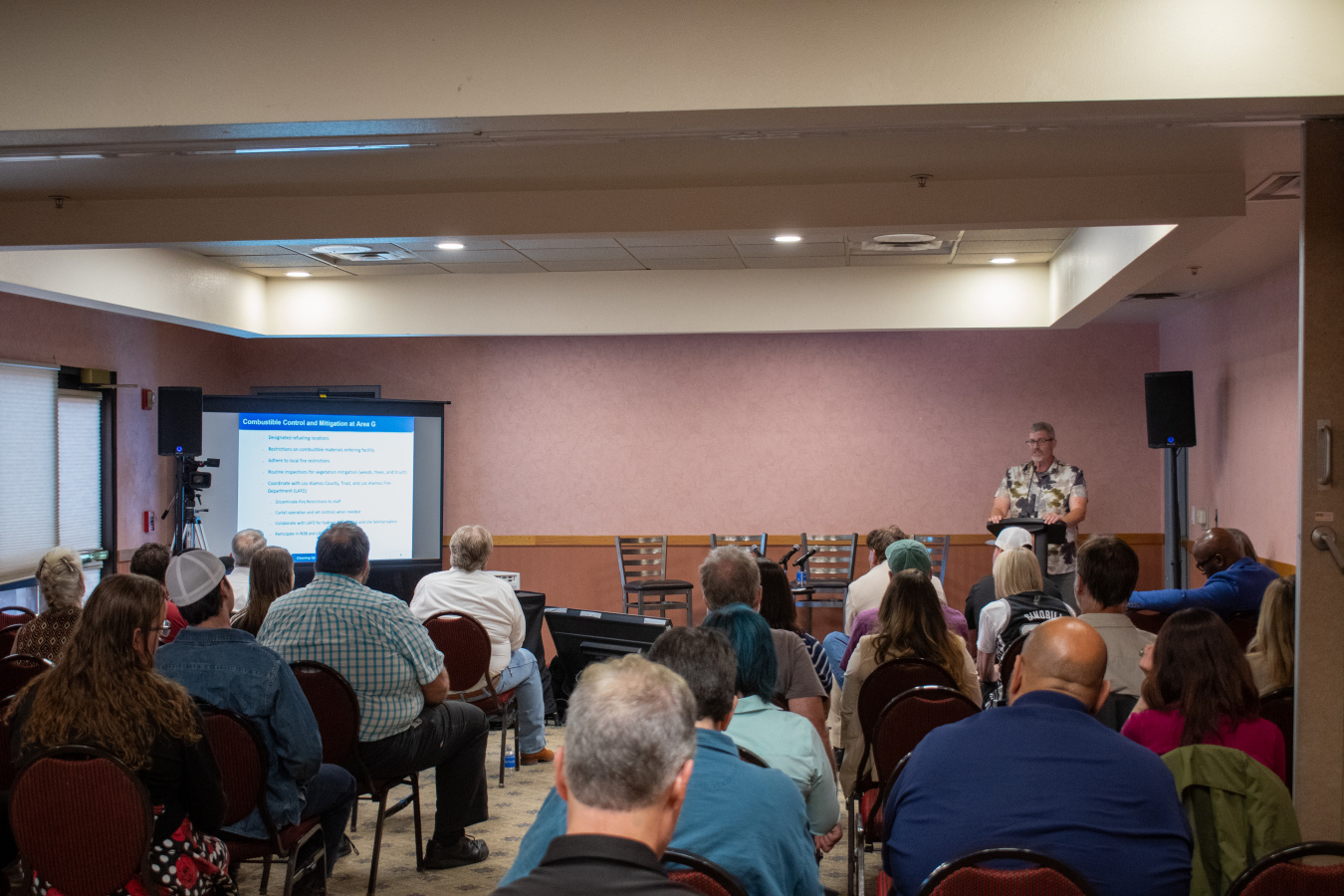
Brian Clayman, contact-handled transuranic waste program manager for Newport News Nuclear BWXT-Los Alamos LLC (N3B), presents on wildfire mitigation and preparedness measures for Technical Area 54, Area G, at Los Alamos National Laboratory, during the recent Environmental Management Cleanup Forum held by the Environmental Management Los Alamos Field Office and N3B.
Minimizing Wildfire Risk at TA-54, Area G
Waste containers are safely secured within structures with steel or aluminum frames, protected by fire-retardant fabric.
Removing legacy radioactive and hazardous waste reduces wildfire risk at TA-54, Area G. Over the past eight years, EM-LA and N3B have made significant progress in moving legacy waste off-site, including:
- Shipping more than 1,105 cubic meters, or 305 shipments, of transuranic waste to the DOE Office of Environmental Management’s Waste Isolation Pilot Plant for permanent disposal, enough to fill 138 large 15-foot-long moving trucks parked end-to-end
- Disposing of more than 21,000 cubic meters of low-level, mixed low-level and hazardous waste at facilities in Texas and Utah
Wildfire fuel mitigation efforts are continuously underway around TA-54, Area G. Tree thinning is done in the canyons adjacent to Area G. Vegetation on the Area G mesa primarily consists of small trees, shrubs and grasses. A perimeter is maintained around structures containing radioactive waste, where vegetation taller than 6 inches is cut and removed at least once a month during the growing season from April to October.
EM-LA and N3B’s year-round wildfire mitigation efforts are coordinated with several LANL Wildland Fire and Forest Program partners, including with the National Nuclear Security Administration Los Alamos Field Office; Los Alamos County; Four Accord Pueblos comprised of the Pueblo de Cochiti, Pueblo of Jemez, Pueblo de San Ildefonso and Santa Clara Pueblo; U.S. Forest Service; National Park Service; and Bureau of Land Management.
-Contributor: Donavan Mager
To receive the latest news and updates about the Office of Environmental Management, submit your e-mail address.