



A record amount of radioactivity has been reduced in Savannah River Site legacy radioactive tank waste over the past four years. February 25, 2026
Office of Environmental Management
February 25, 2026 Estimated Read Time min
Legacy radioactive waste totaling 33 million gallons is stored at Savannah River Site in two groupings of underground waste tanks known as tank farms, including the H Tank Farm, pictured.
AIKEN, S.C. — A record amount of radioactivity has been reduced in Savannah River Site (SRS) legacy radioactive tank waste over the past four years.
There are 46 million fewer curies in the tank waste since 2022, more than double the amount removed over the last eight years. A curie is a unit of measurement for radioactivity.
While some of the radioactivity in the tank waste decayed naturally, the vast majority of the curie reduction — 36 million — has been through the U.S. Department of Energy (DOE) Office of Environmental Management’s (EM) radioactive liquid waste processing facilities, such as the Salt Waste Processing Facility (SWPF) and Defense Waste Processing Facility (DWPF).
Curies are reduced from the waste by removing the highly radioactive sludge, where the majority of the curies are found in the high-activity radionuclides like cesium and strontium, from the tanks. The sludge is treated at DWPF, where it is vitrified and poured into stainless steel canisters safe for long term storage and disposal.
Increased production at SWPF has also accounted for the curie-reduction milestone. Since 2022, more than 10.6 million gallons of salt waste has been processed through SWPF, with a significant hike in production last fall after new cross flow filters were installed to handle higher capacity through the plant. More than 1.8 million gallons were processed from August to December 2025 alone.
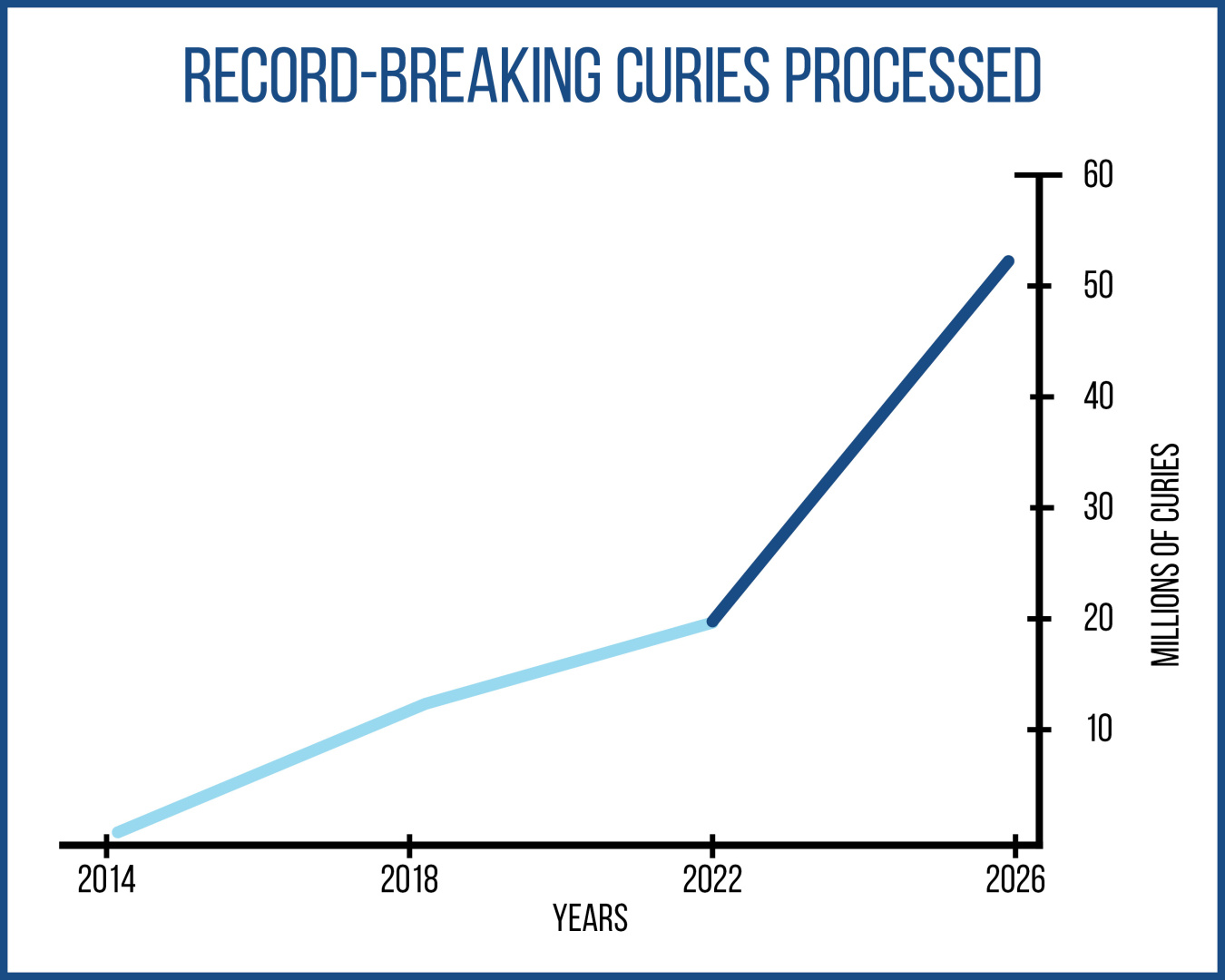
Since 2022, the U.S. Department of Energy's Office of Environmental Management and its liquid waste contractor at the Savannah River Site have processed more than 36 million curies from the underground tank waste at the Savannah River Site — a staggering increase over the lifespan of the site’s liquid waste mission.
Tony Robinson, DOE-Savannah River acting assistant manager for waste disposition, said EM continues to address the legacy waste of the past while safely meeting its cleanup responsibilities.
“The team at Savannah River is reducing the risk of the remaining waste and delivering on the Department’s commitment to accelerate cleanup,” Robinson said. “While this work is a substantial undertaking, we are making tremendous progress in remediating and safely reducing the legacy waste inventory at SRS.”
The waste at SRS is byproduct from processing nuclear materials for national defense, research, medical programs, and for NASA missions. The waste — totaling 33 million gallons — is stored at SRS in two groupings of underground waste tanks known as tank farms.
EM’s liquid waste contractor at SRS, Savannah River Mission Completion (SRMC), has been determined to operate with an end-state mindset, according to Thomas Burns Jr., SRMC president and program manager. The contractor is responsible for treating and disposing of the tank waste remaining at SRS, as well as closing the tanks.
“Our aggressive approach to going after curies early in the contract has proven to be the right strategy for risk reduction,” Burns said. “The decision to clear out the waste from multiple tanks before allocating resources to grout the tanks has exponentially enabled the rate of curie reduction from the tank waste.”
SRMC has prioritized accelerating preliminary cease waste removal milestones, the strategy that reduces real risk sooner and will streamline the process for operational tank closure when it’s time to grout tanks in bulk in the future.
Over the last year, SRMC has also accelerated the tank sampling schedule, bringing final tank closure even closer in sight. Some of the innovative factors contributing to this success include:
- Using drones for sampling and inspection of tanks, which saves four weeks and $700,000 per tank;
- Partnering with an offsite laboratory for tank sample analysis, which saves up to six months and $2 million per tank; and
- Developing a 3D-printed tool for tank sampling that uses a centrifuge, which saves up to six months in the tank closure schedule.
-Contributor: Colleen Hart
To receive the latest news and updates about the Office of Environmental Management, submit your e-mail address.