



The Transportation Technologies Office (TTO) supports research and development (R&D) to decrease the cost, volume, and weight of electric motors while maintaining or increasing performance and reliability and reducing or eliminating the need for rare earth elements.
Why Are Electric Motors Important?
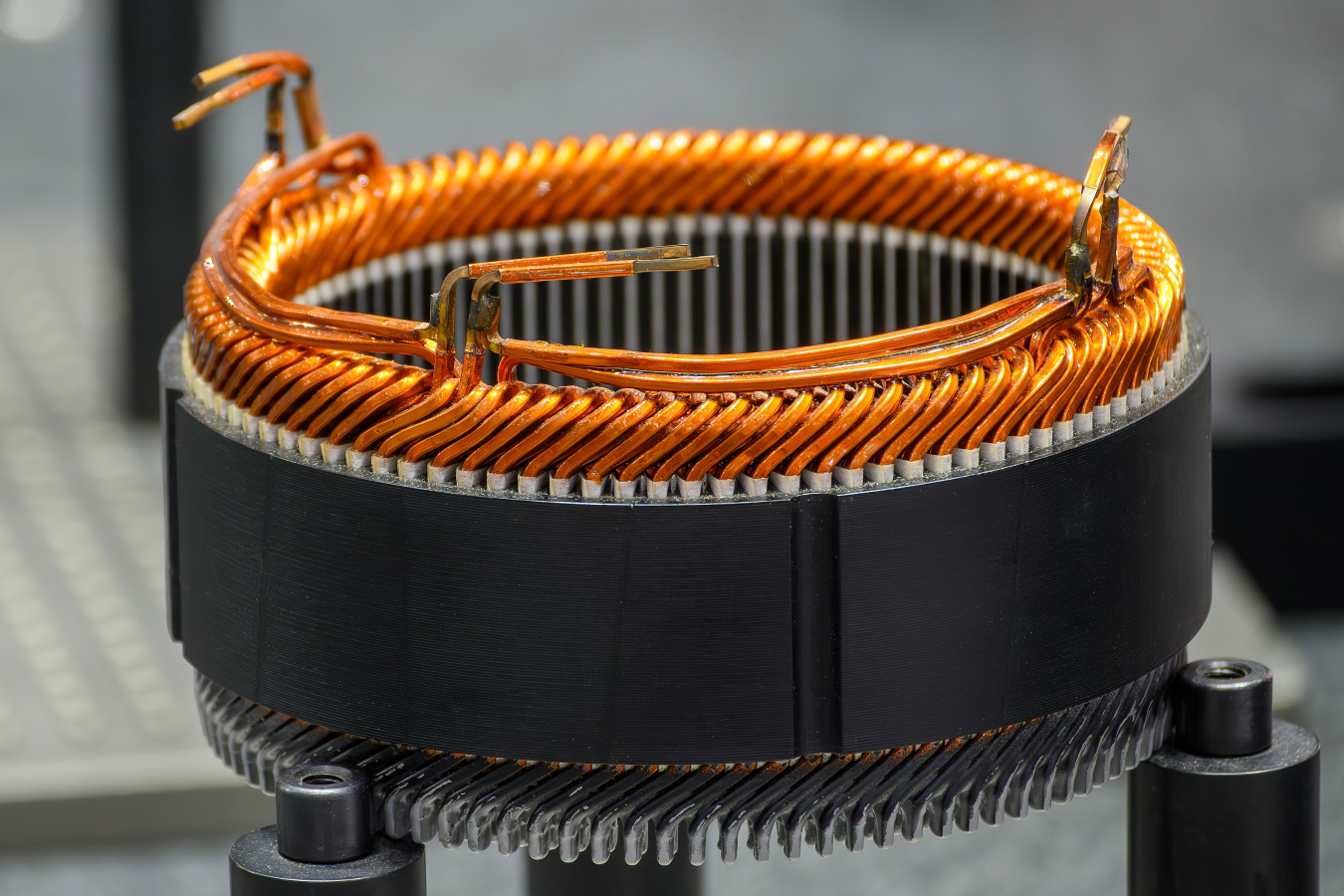
Electric motors convert electrical energy from a battery or generator to mechanical energy for transportation, industrial, buildings, and other applications. There are three main types of electric motors that vary in terms of the amount of power density, reliability, and overall performance they provide. Costs and use of rare earth elements and critical materials are also important variables.
Technologies
Internal permanent magnet (IPM) motors have high power density and maintain high performance over a high percentage of their operating range. However, currently available IPM motors require critical materials—specifically the rare earth elements neodymium, dysprosium and terbium—to achieve a high-power density and maintain thermal stability of the magnets. Permanent magnets that use rare earth elements are expensive and subject to supply chain vulnerabilities. This, along with the high cost of rotor fabrication, drives up the cost of IPM motors. Despite these challenges, automakers continue to favor IPM motors for plug-in and hybrid electric vehicles. Reducing the use of rare earth elements and other critical materials in IPM motors is a key priority for TTO R&D.
Induction motors have high starting torque and offer high reliability. However, their power density and overall performance are lower than that of IPM motors. They are widely available and common in various industries today, including some production vehicles. Although this motor technology is mature, innovations in materials, motor windings, thermal management, and advanced system design have the opportunity to increase the power density and performance to better compete or complement IPM motors on vehicles, reducing rare earth element dependence.
Switched reluctance motors offer a lower-cost option that can be easy to manufacture and have minimal need for critical materials. They also have a rugged structure that can tolerate high temperatures and speeds. However, they produce more noise and vibration than comparable motor designs, which is a major challenge for use in passenger vehicles. Also, switched reluctance motors use more fuel than other motor types. However, synchronous reluctance motors can be a good fit for some heavy-duty off-road applications, where these trade-offs are acceptable. Permanent-magnet-assisted reluctance (PMAR) motors are a type of switched reluctance motor that integrates the advantages of permanent-magnet and reluctance motors, utilizing less critical material while achieving better performance. PMARs are gaining interest from both researchers and manufacturers due to increased supply-chain-related issues for critical materials.
National Laboratory Partners
Ames Laboratory is investigating lower-cost permanent magnets and magnetic materials that reduce or eliminate reliance on rare earth elements. This effort is closely coordinated with the Critical Materials Innovation Hub, also led by Ames Laboratory.
Oak Ridge National Laboratory and industry projects are pursuing reduced rare earth magnet motors, non-permanent magnet motor designs, and innovative motor materials and designs.
The National Laboratory of the Rockies is focusing research on improving electric motor thermal management, performance, and reliability.
Argonne National Laboratory is focusing on a quantitative framework to evaluate electric machine technology pathways for hybrid, plug-in hybrid, and battery electric vehicle applications across light-, medium-, and heavy-duty vehicles.
Subscribe for monthly updates, success stories, funding opportunities, and more!
This was last updated .