



Step 6 of the site-level federal fleet ZEV Ready process includes identifying electric vehicle supply equipment (EVSE) opportunities.
Navigate the ZEV Ready Process
| Planning Phase Steps |
|---|
| 1. Identify and coordinate team |
| 2. Review training materials |
| 3. Review requirements and data |
| 4. Align headquarters strategy with site planning |
| 5. Identify ZEV opportunities (5 years) |
| 6. Identify EVSE opportunities (5 years) |
| 7. Coordinate site financial planning with headquarters |
Return to the ZEV Ready Center to see all 15 steps.
Primary Audiences
 | Agency Headquarters Fleet Managers |
 | Site ZEV Champions |
 | Site Location Fleet Managers |
 | Facility Infrastructure Managers |
The agency headquarters fleet managers, site ZEV champion, site location fleet managers, and the facility infrastructure manager are the primary audiences responsible for identifying the EVSE required to support zero-emission vehicle (ZEV) opportunities for the entire fleet at the facility or fleet location (discussed in Step 5: Identify ZEV Opportunities). These primary audiences are supported by other key stakeholders, as necessary.
Process To Assess the Suitability of EV Implementation at Each Location
This planning stage involves focusing on identifying the specific opportunities (over a 5-year time horizon) to transition vehicles at each fleet location to ZEVs and determine the EVSE needed to support those EV implementation opportunities.
The agency headquarters fleet managers coordinate with the site location fleet manager(s) and the site ZEV champion to identify opportunities to acquire ZEVs and deploy EVSE to support those vehicles at each fleet location. The process detailed in this section summarizes how agencies can assess the ZEV suitability for each vehicle at each fleet location. This process includes three steps:
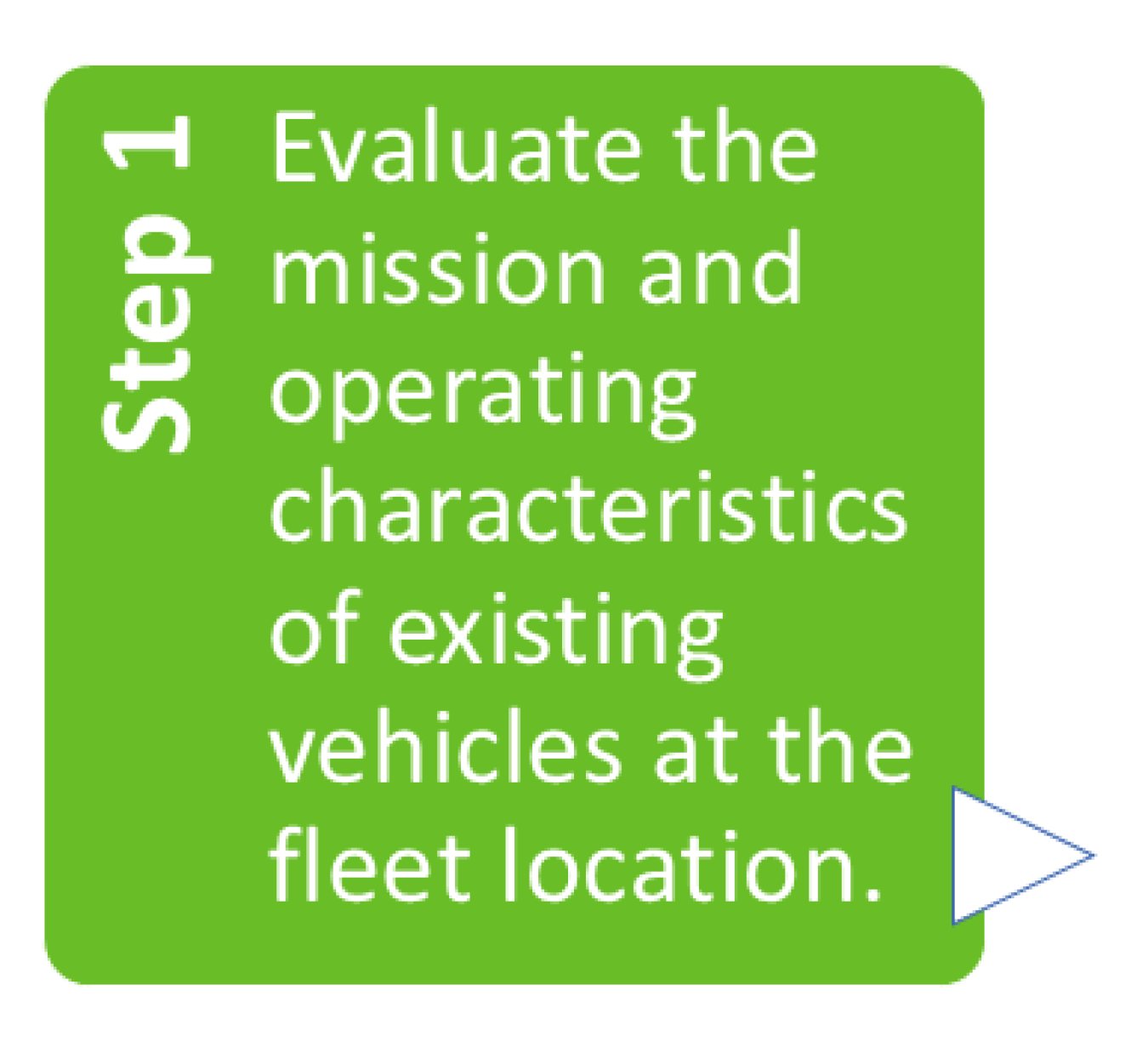
Step 1—Evaluate the mission and operating characteristics of existing vehicles at the fleet location.
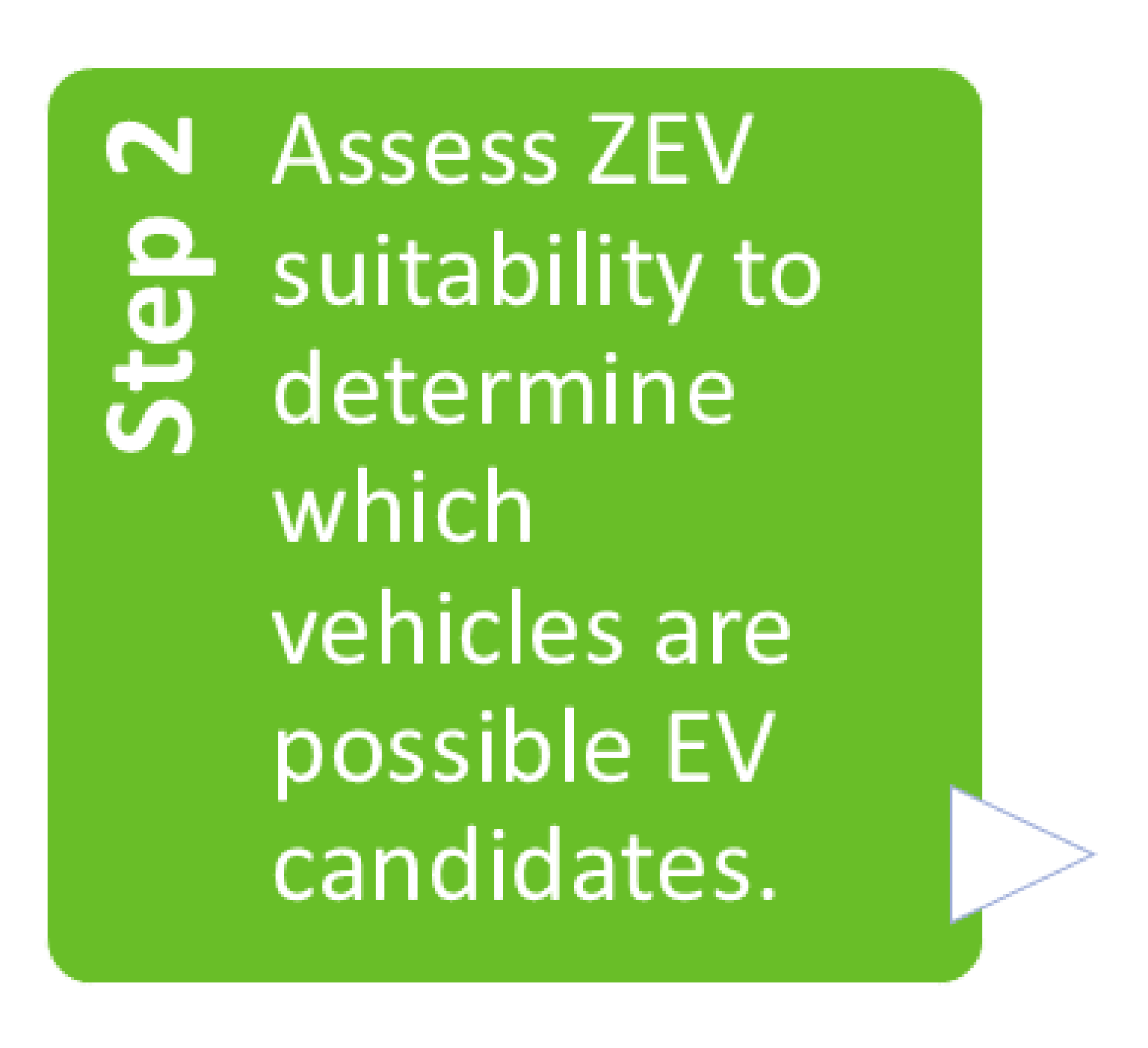
Step 2—Assess ZEV suitability to determine which vehicles are possible EV candidates.
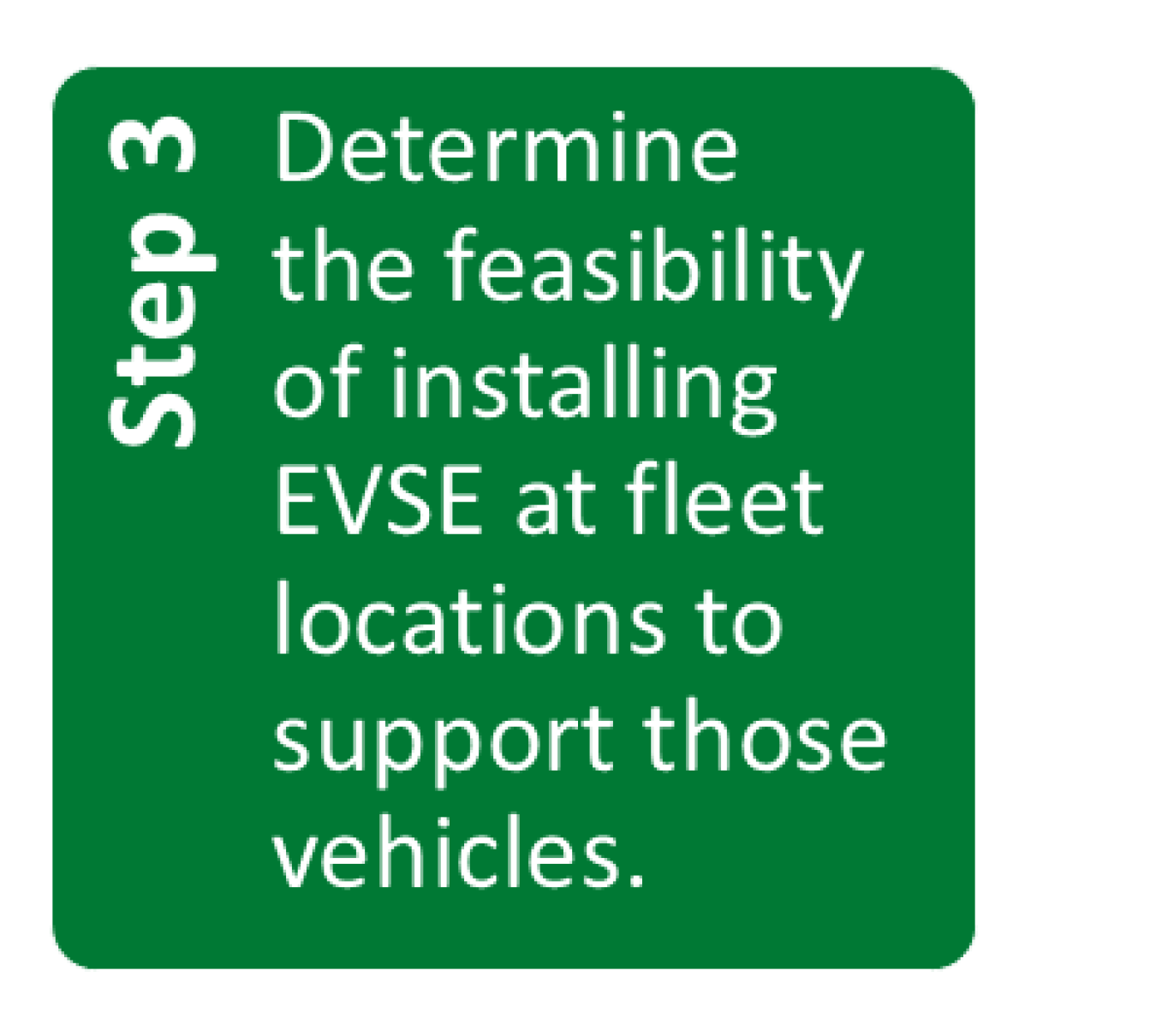
Step 3—Determine the feasibility of installing EVSE at fleet locations to support those vehicles.
Step 5: Identify ZEV Opportunities provides detail in evaluating and identifying suitable ZEV candidates at each fleet location, the first two steps of this process. This section, Step 6: Identify EVSE Opportunities, discusses the final step, determining the feasibility of installing EVSE to support those candidate ZEVs.
Fleet expertise and vehicle data should inform decisions on which vehicles to replace with ZEVs in future procurement cycles and the coordinated plan for deploying EVSE at fleet locations to support these vehicles. Agencies may use the optional ZPAC tool (recommended and described below) or another method to help access EV implementation opportunities at each fleet location.
ZEV Planning and Charging (ZPAC) Tool
FEMP developed the ZEV Planning and Charging (ZPAC) tool to assist agencies in planning for future ZEV acquisitions and deployment of EVSE at each fleet location.
ZPAC is an optional tool that supports detailed analysis of the ZEV suitability for each existing vehicle in an agency’s inventory, using current estimates of future ZEV model availability, modeling of battery electric vehicle (BEV) range concerns, and the potential impact on emissions.
The tool allows agencies to assign specific fleet locations to their vehicles and then uses the projected ZEV acquisitions at those locations to identify EVSE needs. Using the ZPAC tool also ensures that replacement options will serve the vehicle mission and charging requirements and do not cause undue burden on fleet operations. More detail on using the ZPAC tool is provided in the sections below.
Using the ZPAC Tool
FEMP and NLR created the ZPAC tool to support and guide fleet managers in determining which individual vehicles should be replaced with ZEVs and the number of EVSE required to support the ZEV fleet.
Determine the Feasibility of Installing EVSE at Fleet Locations To Support ZEVs
After evaluating and identifying suitable ZEV candidates at each fleet location, agencies next complete a high-level assessment of the feasibility of installing EVSE to support charging of those vehicles.
After identifying current and future ZEV candidates at each fleet location, the site location fleet manager, in coordination with the agency headquarters fleet managers and facility infrastructure managers, should next inventory available EVSE to support those vehicles at the fleet locations and determine the additional number, type, and power requirements of EVSE to support EV implementation. At some fleet locations, planning for installing charging infrastructure may not be feasible. Potential reasons may include the utility service or available infrastructure, design, or ownership of locations where fleet vehicles are parked, or limitations on using charging infrastructure associated with some transportation missions.
Agencies should prioritize deployment of EVSE at locations that will help maximize fleet EV implementation given the agency’s limited resources, including budget and staff. This may include locations with the highest number of current and/or future ZEV candidates or the easiest installation given site design and utility service. After identifying priority EVSE sites, the site location fleet manager, in coordination with the agency headquarters fleet managers, should then prioritize matching ZEV acquisitions at those locations with existing or planned charging infrastructure.
Agencies should focus on matching budget planning cycles with ZEV and EVSE acquisition, which is typically over the next 2 fiscal years. Agencies are also recommended to identify longer-term EVSE acquisition plans (approximately 5 years into the future). Installing enough EVSE to support longer-term EVSE needs helps save costs by minimizing the number of installation projects and avoiding duplicative costs in EVSE installation.
EVSE Planning Best Practices
Fleet managers should ensure that charging infrastructure will be available to support battery electric vehicles (BEVs) at the fleet location once delivered. In the long term, at most larger locations, a single EVSE port can support more than just a single EV. More information on recommended ratios of EVSE to EVs is available under Determine Number of EVSE Ports in Step 10.
Once vehicle evaluation is complete in the ZPAC tool, the “EVSE Needs & Prioritization” tab is automatically populated with the ZEV candidates grouped by site location, using the information entered on the “ZEV Selection” tab. The agency headquarters fleet managers, in coordination with the site location fleet manager, complete the ZPAC tool by determining EVSE needs, evaluating existing charging infrastructure, and estimating the Level 1 and Level 2 EVSE required to support projected EV implementation at each site. Note that the tool does not limit the acquisition of EVSE based on budget; agencies should assess budget decisions after evaluating potential ZEV acquisition and EVSE deployment opportunities, as discussed in Step 7: Coordinate Site Financial Planning with Headquarters.
Agencies are strongly encouraged to offer federal employees' privately owned vehicles (POVs) access to EVSE deployed primarily to serve fleet vehicles. With the increasing adoption of EVs in the U.S. market and limitations that many have on home charging, offering workplace charging for POVs may be important in helping some employees transition to EVs. Consider plans for workplace POV charging using the FEMP Workplace Charging Program Guide.
More information on providing access to POVs in charging station design is available in Step 10 under Determine Access to EVSE.
Becoming ZEV Ready

As part of the Charging Ready component of the ZEV Ready certification, the agency headquarters fleet managers, site location fleet managers, the site ZEV champion, and identified key EV stakeholders should work together to evaluate the potential for EVSE opportunities at the fleet location to support the ZEV opportunities (over the next 5 years) identified in the Vehicle Ready step.
| PHASE | ZEV READY | STEP | ACTIONS |
|---|---|---|---|
| PLANNING |
| 6. Identify EVSE Opportunities (next 5 years) | ✔ The agency headquarters fleet managers, site ZEV champion, site location fleet manager, and identified key EV stakeholders should identify the EVSE opportunities at the facility or fleet location to support the potential ZEV candidates over the next five vehicle replacement ordering cycles by using the ZPAC tool or similar planning tool. |

Previous Step
Go back to Step 5: Identify ZEV Opportunities.