The Threat Profile Guide provides a practical methodology to transform fragmented threat updates into actionable insights.
Office of Cybersecurity, Energy Security, and Emergency Response
July 28, 2026 Estimated Read Time min
Today’s cybersecurity practitioners face a challenging question: “How do I make sense of the constant flow of alerts and advisories I receive from vendors and government?” Cybersecurity threat information may arrive in fragments, lack context, change over time, and vary in fit, form, and function. This complicates one of the most critical activities performed by cybersecurity teams—quickly gauging the applicability and priority of new threat information.
In response to this challenge, the U.S. Department of Energy’s (DOE) Office of Cybersecurity, Energy Security, and Emergency Response (CESER) and critical infrastructure operators collaborated to develop the Cybersecurity Threat Profile Development Guide. The guide provides a practical methodology to transform fragmented threat updates into actionable insights aligned to organizational mission and risk priorities.
Why develop a Cybersecurity Threat Profile?
Understanding the cybersecurity threats that could impact day-to-day operations is fundamental to several key cybersecurity activities, including:
- Guiding cybersecurity program strategy
- Patching and mitigating vulnerabilities
- Managing and securing end points
- Planning and prioritizing threat hunting efforts
- Detecting and responding to incidents
- Designing a cybersecurity architecture
- Tailoring training and awareness activities
- Informing leadership about program needs and accomplishments
- Understanding how cybersecurity threats contribute to enterprise risk
What is a Cybersecurity Threat Profile?
A cybersecurity threat profile enables organizations to analyze and prioritize the threats most relevant to their operations. Organizations build a threat profile by exploring how specific cyberattack scenarios—such as ransomware, supply chain compromise, or insider threats—might unfold, what vulnerabilities may be exploited, and what consequences could result. This creates a better understanding of the potential for cybersecurity threats to disrupt key assets, critical operations, and local communities.
The Cybersecurity Threat Profile Development Guide provides a roadmap for implementing this process efficiently, including starter questions to help kickstart analysis. Examples include:
- Which assets may be targeted or leveraged for an attack?
- What impacts could result from a cyberattack?
- How would those impacts affect my organization’s mission, goals, and my community?
- What are cyberattack tactics, techniques, and procedures (TTPs) of highest concern for an organization?
- What potential vulnerabilities may be leveraged by threat actors?
- What controls or mitigations might help stop an attack?
- Which threat actors may be motivated to target my organization?
By answering questions like these, organizational leaders can develop a more accurate picture of their organization’s level of cybersecurity risk and its contribution to overall enterprise risk. The relationship between threat profiles, cybersecurity risk, and enterprise risk management is shown in the following diagram.
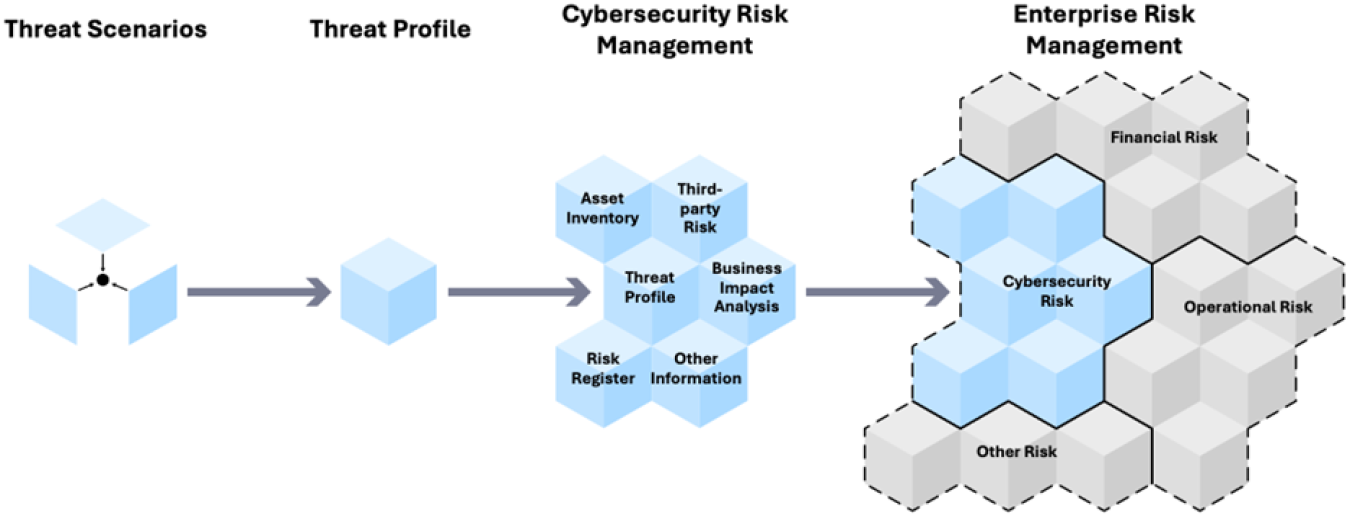
Where to Start
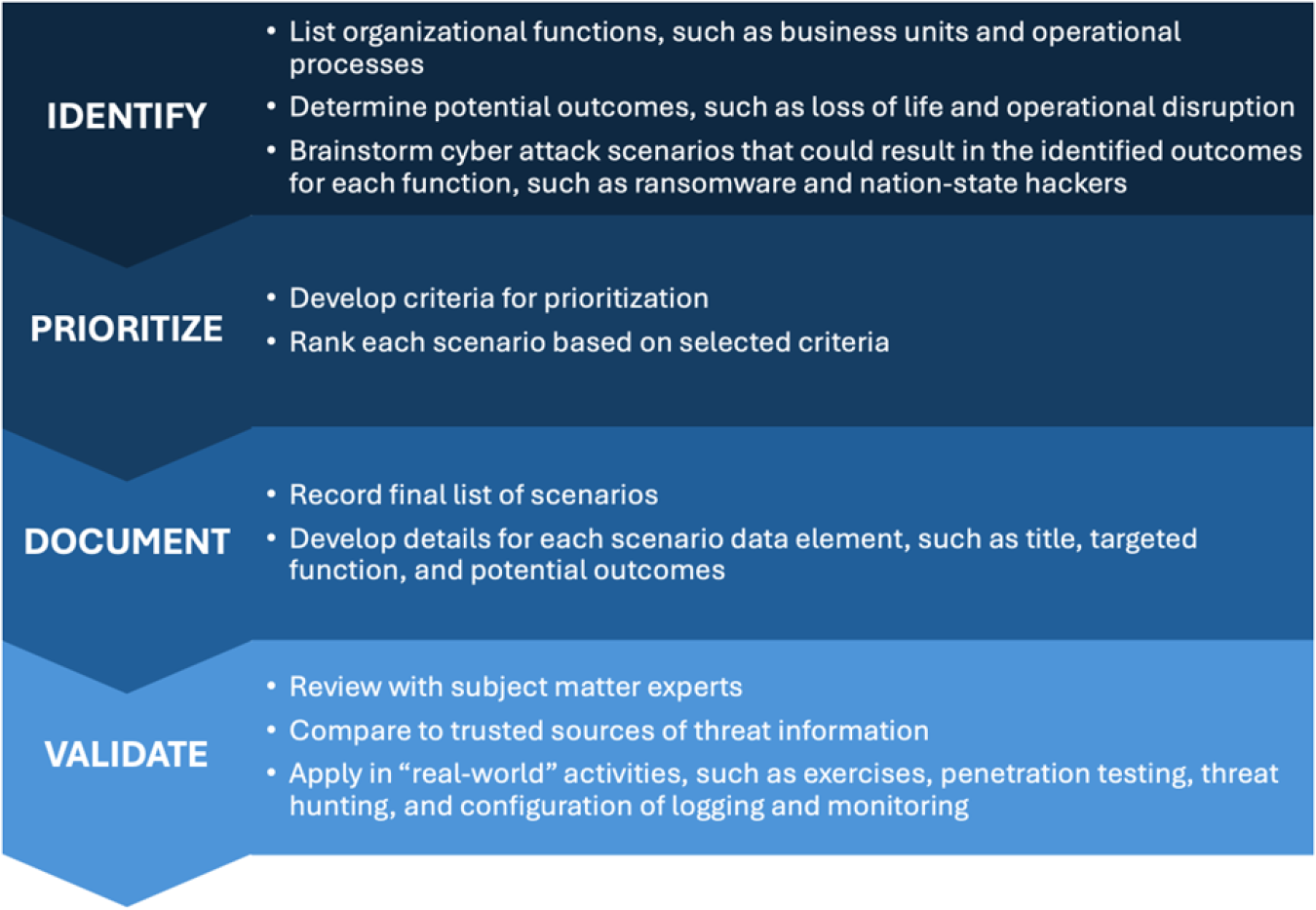
The process for developing a threat profile will vary across organizations but generally includes four steps: identify, prioritize, document, and validate. Together, these steps help organizations move from raw threat information to a documented, validated threat profile that can inform operational decisions and strategic risk management. Each step in the development process is detailed in the following figure.
Check Out the Full Guide
For tips, templates, and examples for building and using a cybersecurity threat profile, check out the Cybersecurity Threat Profile Development Guide. This document is part of the Cybersecurity Capability Maturity Model (C2M2) suite of guidance and tools, which help measure and strengthen cybersecurity programs.
DOE facilitates voluntary, no-cost self-evaluations for C2M2 and National Institute of Standards and Technology (NIST) Cybersecurity Framework (CSF) as well as threat profile development workshops for U.S. electricity, oil, and natural gas organizations upon request. Email C2M2@hq.doe.gov for more information.