



Sales of the Quantum Instrumentation Control Kit (QICK) have grown quickly after Energy I-Corps
Office of Technology Commercialization
November 3, 2026 Estimated Read Time min
Its purpose is to help detect unknown matter of the universe, but its users see something more down to earth.
The Quantum Instrumentation Control Kit, or QICK (pronounced “kick”), box is a versatile development platform for running quantum information experiments. The QICK box is reaching new markets, thanks in part to the U.S. Department of Energy’s (DOE) Energy I-Corps program, which supports the commercialization of National Lab innovations through technology transfer.
The QICK box now has hundreds of users who value its open-source design, competitive price, and simple setup. In a market poised for growth, Energy I-Corps helped the QICK development team engage with its users and better understand their needs.
“Energy I-Corps made us realize that we could really grow our solution,” said Sara Sussman, principal investigator of QICK at Fermilab.

Sussman worked with Fermilab Entrepreneurial Lead Daiane Colombo to scope the commercial direction of the QICK box. Fermilab exclusively designs and manages the product but allows other vendors, such as Qblox, to market and sell it. Qblox also partnered with Fermilab in during the Energy I-Corps cohort.
“Daiane is an amazing business strategist; we were a really good team,” Sussman said. “In I-Corps we conducted over 70 interviews and developed value propositions and market proposals to come up with a commercialization strategy. It was very exciting.”
QICK originated at Fermilab in 2021 for precision control and readout of superconducting qubits. Fermilab physicists use the qubits because they are delicate enough to detect dark matter. QICK translates between an experiment’s quantum information and classical control systems, which is a capability of growing importance in computing, sensing, robotics, materials, and more.
The team simplified their original design, managing to shrink QICK down to a briefcase-sized box, which is far smaller than systems currently used by industry. This quantum lab-in-a-box was the innovation that the U.S. Department of Energy’s Office of Technology Commercialization selected to participate in Energy I-Corps’ Cohort 18.
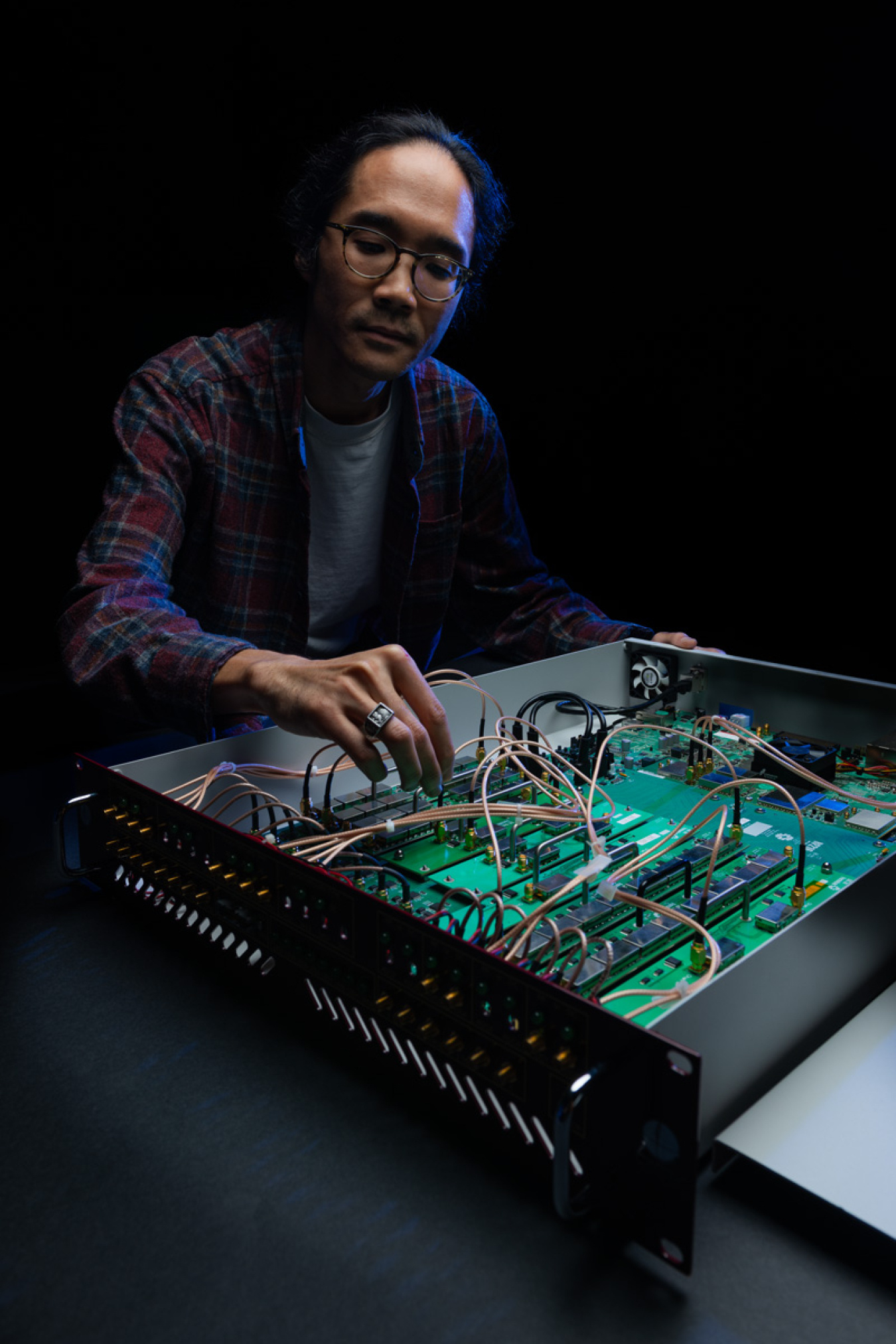
“The Energy I-Corps program provided a unique and intense two-month learning and hands-on experience,” Colombo said. “The conversations we conducted with quantum professionals generated valuable insights: users expressed strong appreciation for the open-source QICK software, reinforcing our commitment to keeping it open source, and several interviewees indicated there would be market demand for a commercialized QICK hardware solution. Energy I-Corps participation was valuable in that it confirmed our initial goals were the right ones and reinforced the need for QICK's continued development.”
Through customer discovery interviews with potential industry partners, the Fermilab team better appreciated the value of open source to users. The interviews also provided an opportunity to explore QICK’s broad range of applications. Since its release, the QICK box has expanded from superconducting systems to nine different quantum system types, including spin, neutral atom, and molecular qubits. Well-known companies and laboratories have also built off QICK with their own open-source toolkits named sideQICK and QICKdawg, among others.
“We’ve achieved our goal of versatility across different quantum platforms. Now we’re focused on modernizing the system to utilize automated tune-up and neural networks to analyze data fast on the chip,” Sussman said.
Commercializing QICK and building a high-quality product remain top priorities for the team. The QICK box costs about one-tenth as much as competing systems, and multiple units can be stacked to accomodate a wide range of experimental setups.
“This is all for the benefit of the people using it,” said Sussman. “We’re trying to deliver the highest quality open-source quantum information control kit. That’s the mission for me.”