



New statistical methods improve spectrophotometric analysis for nuclear and industrial applications.
Isotope R&D and Production (DOE IP)
August 25, 2026 Estimated Read Time min
The Science
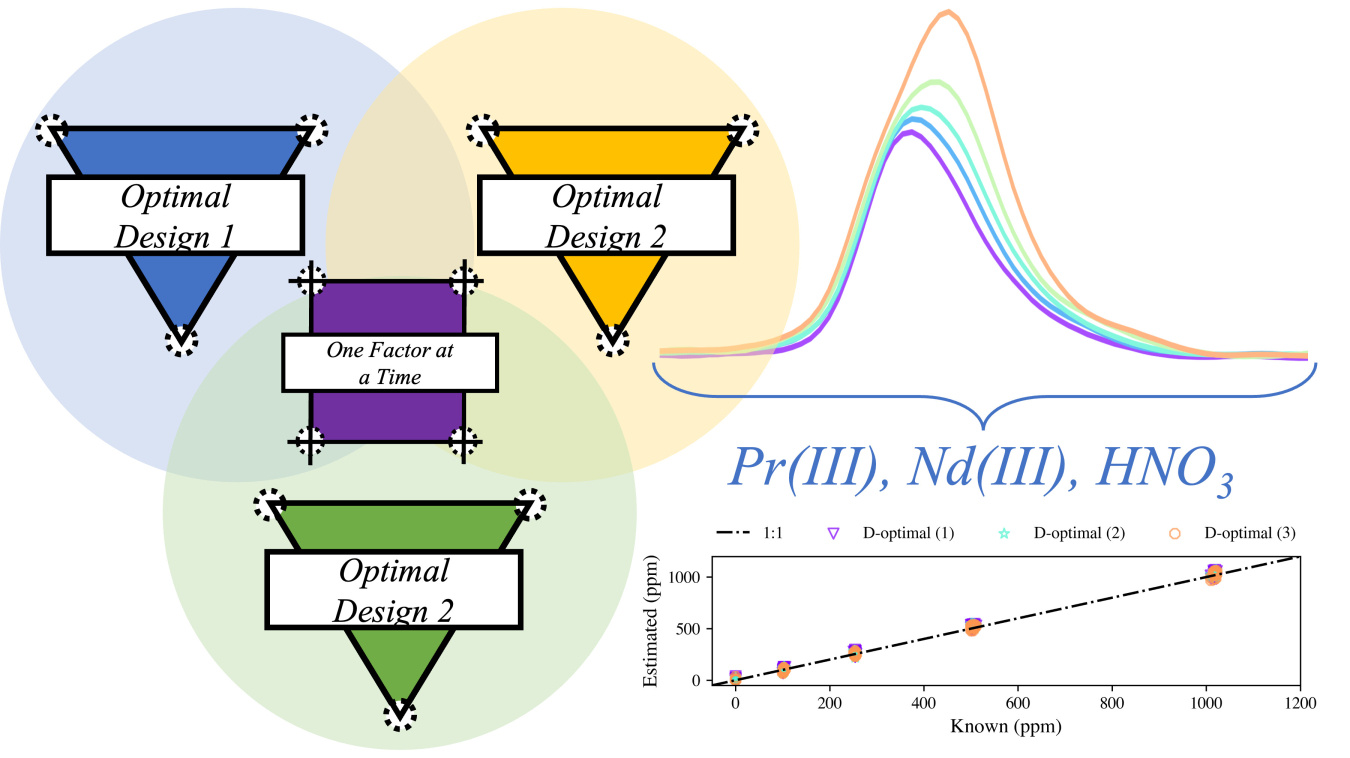
It’s challenging for scientists to monitor chemical processes at nuclear facilities in real time. In this study, scientists developed new techniques to analyze chemical solutions in complex environments. The research team developed an approach to improve predictive machine learning models. These models draw information about chemical systems from real-life data. The researchers used spectroscopy to collect this data. Spectroscopy is a powerful technique for identifying and measuring chemicals based on how they absorb light. The team’s efforts to develop this training data reduced the number of samples they needed to take to build accurate models. The results also improved real-time chemical monitoring. In addition, the method precisely measured several test solutions that contained isotopes of rare earth minerals.
The Impact
This research helps make chemical analysis faster, cheaper, and more efficient. Needing fewer samples to train predictive models helps scientists improve real-time monitoring of hazardous materials. This will improve chemical handling in multiple areas, including nuclear materials processing, environmental monitoring, and industrial chemical production. These results also support efforts to develop automated, remote-sensing technologies. These technologies can improve safety and efficiency in complex chemical environments.
Summary
To improve the accuracy of spectroscopy, researchers used statistical design techniques to create efficient training sets for chemometric models. Chemometric models use data to extract information from chemical systems. The scientists used D-optical designs, which adjust the position of the object so that the image is formed at the least distance of distinct vision. As a result, the researchers minimized the number of samples they needed. At the same time, they still maintained high prediction accuracy for concentrations of isotopes of the rare earth minerals praseodymium and neodymium in solutions of nitric acid. The best models achieved error rates as low as 1.2 percent. The study also examined how different numbers of validation samples affect the reliability of models. This information helped researchers determine the optimal number of samples needed for robust analysis. The results of the study advance the field of chemometrics and support real-time chemical modeling in nuclear and industrial settings.
Contact
Luke Sadergaski
Oak Ridge National Laboratory
sadergaskilr@ornl.gov
Hunter Andrews
Oak Ridge National Laboratory
andrewshb@ornl.gov
Funding
Funding was provided by the Office of Isotope R&D and Production in the DOE Office of Science.
Publications
Sadergaski, L.R.; Andrews, H.B.; Rai, D.; Anagnostopoulous, V.A. “Comparing designed training sets to optimize multivariate regression models for Pr, Nd and nitric acid using spectrophotometry.” Applied Spectroscopy Practica. 2024; 2(1). [DOI: 10.1177/27551857241243083]