



Our research on nuclear and high energy physics is inspired by some of the biggest questions about matter, energy, space, time, and the universe:
- What is the universe made of?
- What forces and symmetries govern it?
- How did the universe evolve from its earliest moments into the cosmos we observe today?
- How do fundamental particles combine to form protons, neutrons, atomic nuclei, and the elements?
The High Energy and Nuclear Physics (HENP) program within the U.S. Department of Energy’s Office of Science supports the people, scientific tools, and facilities needed to pursue these questions. Finding the answers to these questions requires some of the biggest scientific collaborations using some of the largest, most powerful scientific machines in the world.
High Energy Physics explores what the universe is made of and how it works at the smallest and largest scales. High energy physicists seek new discoveries from the tiniest particles (particle physics) to the outer reaches of space (astrophysics).
Nuclear Physics works to discover, explore, and understand all forms of nuclear matter. Nuclear physicists seek to understand both the familiar forms of matter we see around us as well as exotic forms. These exotic forms range from those that existed in the first moments after the Big Bang to those that exist today inside neutron stars.
This research requires long-term support for both theoretical and experimental efforts. Comparing experimental observations and theoretical predictions tests the limits of our understanding and suggests new directions for research. The program runs world-class Office of Science User Facilities and develops tools to open the door to future discoveries.
HENP also supports today’s scientists at universities and DOE National Laboratories as well as potential future scientists. We provide support for U.S. participation in international collaborations and provide more than 90 percent of the nuclear science research funding in the United States.
The knowledge, technologies, and skilled workforce this research produces contributes to advances in medicine, computing, industry, and national security.
Areas of Focus
HENP Science Highlights
-
 Collisions of lead with smaller nuclei allow taking images of the fluctuating nuclear shape
-
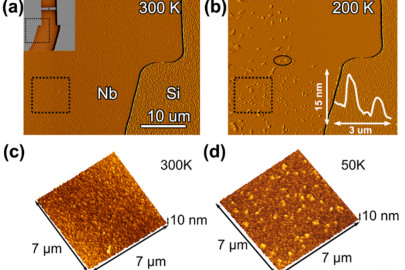 Microscopes, x-rays, and spectroscopy tools join forces to identify defects that interfere with delicate superconducting qubit properties.
-
 Collisions of oxygen and neon nuclei show how nuclear shapes can influence collective particle flow in small systems.
-
 A potential tool could use Bose Einstein condensates to produce intense beams of neutrinos.
-
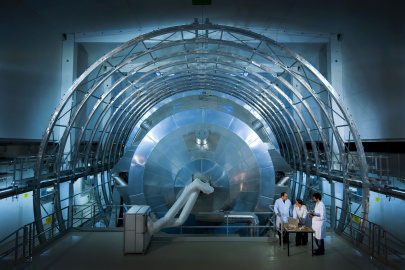 A direct search shows that neutrinos are at least a million times lighter than electrons.
-
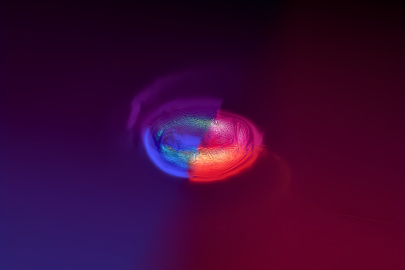 Scientists have developed a simulation of the merger of two neutron stars that includes the oscillation of different neutrino flavors into one another.
-
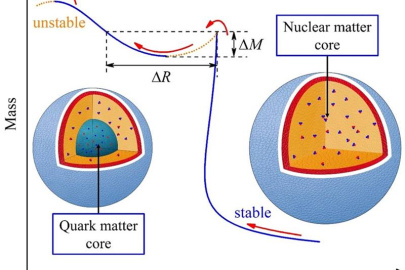 Scientists have new insights into factors that determine how twin neutron stars—stars with the same mass but different sizes and compositions—can coexist.
-
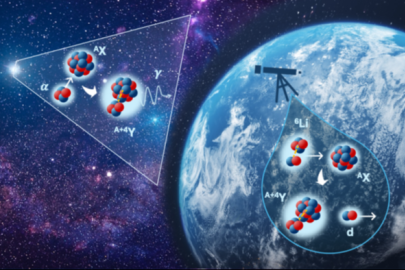 Theoretical calculations enable more accurate determination of reaction rates for modelling primordial lithium-6 abundance and massive stars’ lifecycle.
-
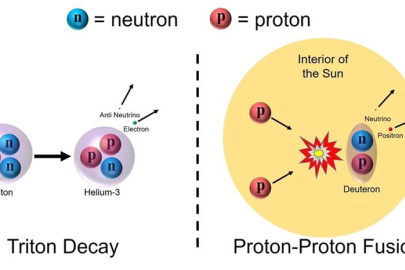 Remarkably, the rate of proton-proton fusion in the sun is not precisely understood, but it can be better predicted using the process of triton decay.
-
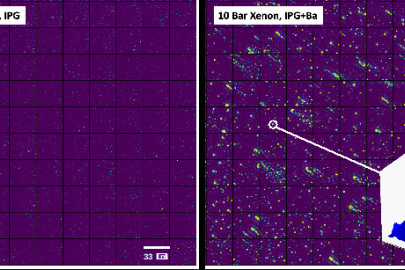 Researchers imaged individual barium ions in dense xenon gas, offering a new path toward ultra-low-background searches for neutrinoless double beta decay.
Contact Information
High Energy and Nuclear Physics
U.S. Department of Energy
Germantown Building
1000 Independence Ave., SW
Washington, DC 20585
E: sc.hep@science.doe.gov