



Critical materials are substances that the United States' government deems essential to economic and national security, energy technologies, and the manufacture of key products. It is in the national interest to defend the supply chains for these materials from disruptions, such as sudden increase in demand, natural disasters, and the restriction of exports by foreign governments.
The U.S. Department of Energy (DOE) has identified 20 critical energy materials that are important for the future of the energy sector.
Many critical materials have unique properties that make them indispensable components of advanced technologies. For example, some are used to create very strong, compact magnets. Others speed up chemical reactions, and a few efficiently convert electricity into light.
The critical materials identified by DOE include natural elements—those found in the Earth— as well as engineered materials created in laboratories. Many of these elements come from stars and supernovas. Only tiny amounts are created through radioactive decay and other means.
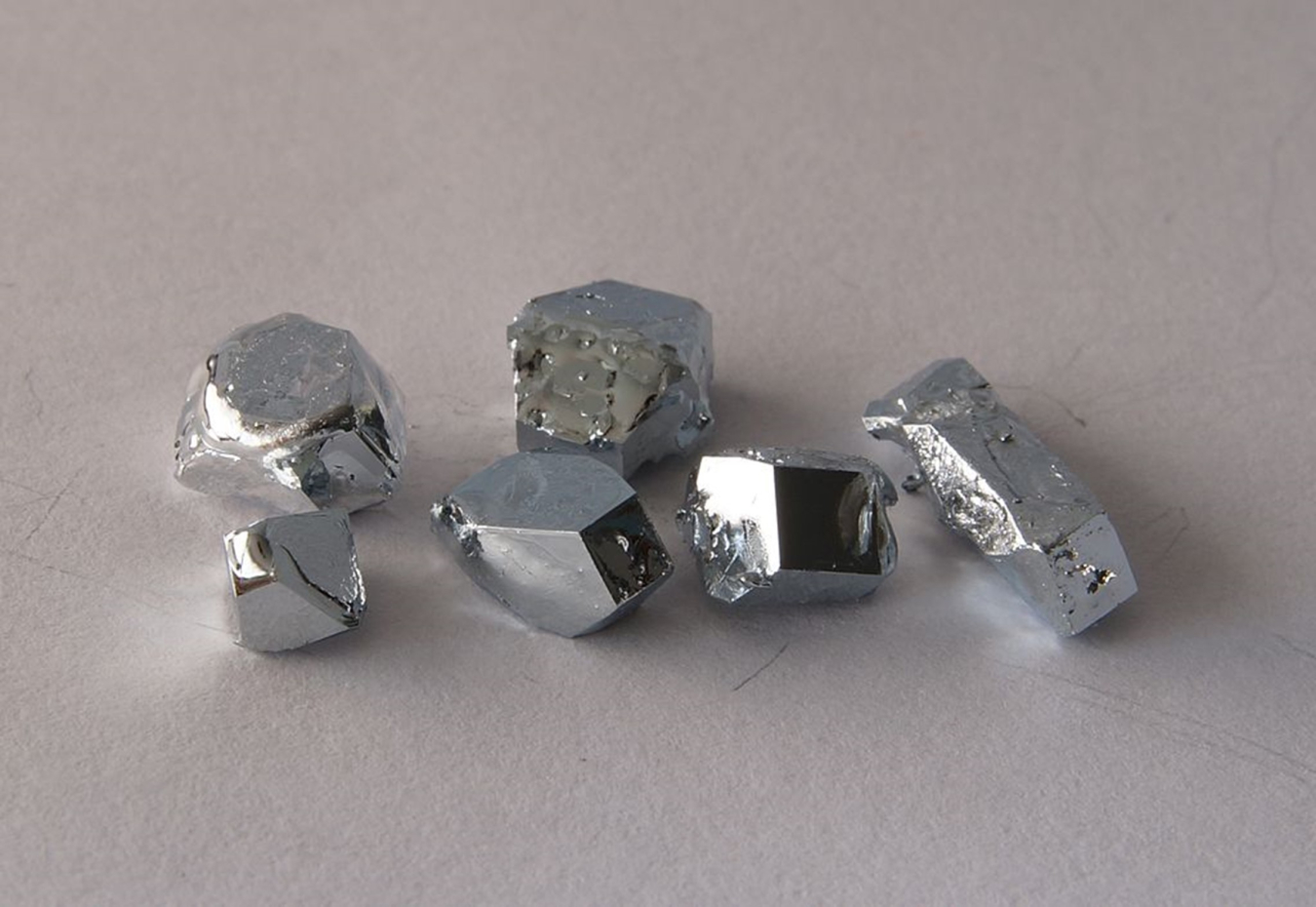
Gallium, pictured above, is one of these critical materials. Manufacturers use gallium to make a range of electronic devices. It is commonly used in LED light bulbs, smartphone communications chips, and high-efficiency power supplies. Because of its rarity, gallium is typically not mined directly. Instead, mining companies produce it as a byproduct of aluminum manufacturing.
DOE Contributions to Critical Materials Research
Critical materials are essential to energy technology, such as batteries. Therefore, DOE oversees several key programs to address critical material concerns.
Office of Critical Minerals and Energy Innovation
DOE's Office of Critical Minerals and Energy Innovation (CMEI) strengthens and protects America's critical minerals supply chains. Under CMEI, the Advanced Mining and Mineral Production Technologies Office (AMMPT) promotes the production and processing of rare earth elements and other critical materials from mining, industrial wastes, and other unconventional sources. CMEI's Advanced Materials and Manufacturing Technologies Office (AMMTO) runs the Critical Minerals and Materials Accelerator Program, which supports industry-led partnerships that prototype and pilot innovative processing technologies. CMEI's Manufacturing Deployment Office (MDO) is leading work in two funding areas: Battery Manufacturing and Recycling Grants and Battery Materials Processing Grants. MDO and AMMPT are also co-managing the Rare Earth Elements Demonstration Facility.
Office of Science
DOE’s Office of Science supports the fundamental science in chemistry, materials sciences, biology, and physics that underlies critical materials research. Scientists study critical materials to better understand their characteristics and properties. They examine how these materials behave at a variety of scales, from the level of electrons, atoms, and molecules, through to applications. They are also using bio-design and biotechnology to develop microbes and plants that could be used to extract and refine critical materials. These tools and foundational knowledge help engineers design technologies that need fewer of these materials. It also makes it easier to search for substitute materials. Basic research in chemistry and physics also enables improvements to separation technologies. In addition, many of the Office of Science’s User Facilities support applied research on critical materials, including X-ray light sources, neutron sources, high-performance supercomputers, and others.
DOE also supports the Critical Materials Innovation (CMI) Hub. The Hub is led by DOE's Ames National Laboratory and managed by AMMTO. The CMI Hub conducts applied research to advance technologies that can unlock new sources of critical materials, substitutes for these materials, and ways to make better use of existing materials through reuse and recycling.
Fast Facts
- Learn more about critical materials—and all the elements—with the Periodic Table of Elements on the Critical Minerals & Materials website.
- Critical materials include all but one of the 17 rare earth metals. These silvery metals are chemically similar.
- The Critical Materials Innovation Hub has developed a new way to extract rare earth elements from high-powered magnets in electric waste. A company has signed a license agreement for the technology.
Resources
- Explore the DOE Critical Minerals & Materials Program, including the program’s definition of these materials.
- See the DOE Office of Science Basic Energy Sciences program, the foundation of much of DOE's work on critical materials.
- Learn more about the Critical Materials Innovation Hub.
Scientific terms can be confusing. DOE Explains offers straightforward explanations of key words and concepts in fundamental science. It also describes how these concepts apply to the work that the Department of Energy’s Office of Science conducts as it helps the United States excel in research across the scientific spectrum.