


The U.S.-Japan Nuclear Security Working Group convened at Argonne National Laboratory to address evolving global nuclear and radiological security progress and challenges.
National Nuclear Security Administration
November 23, 2026 Estimated Read Time min
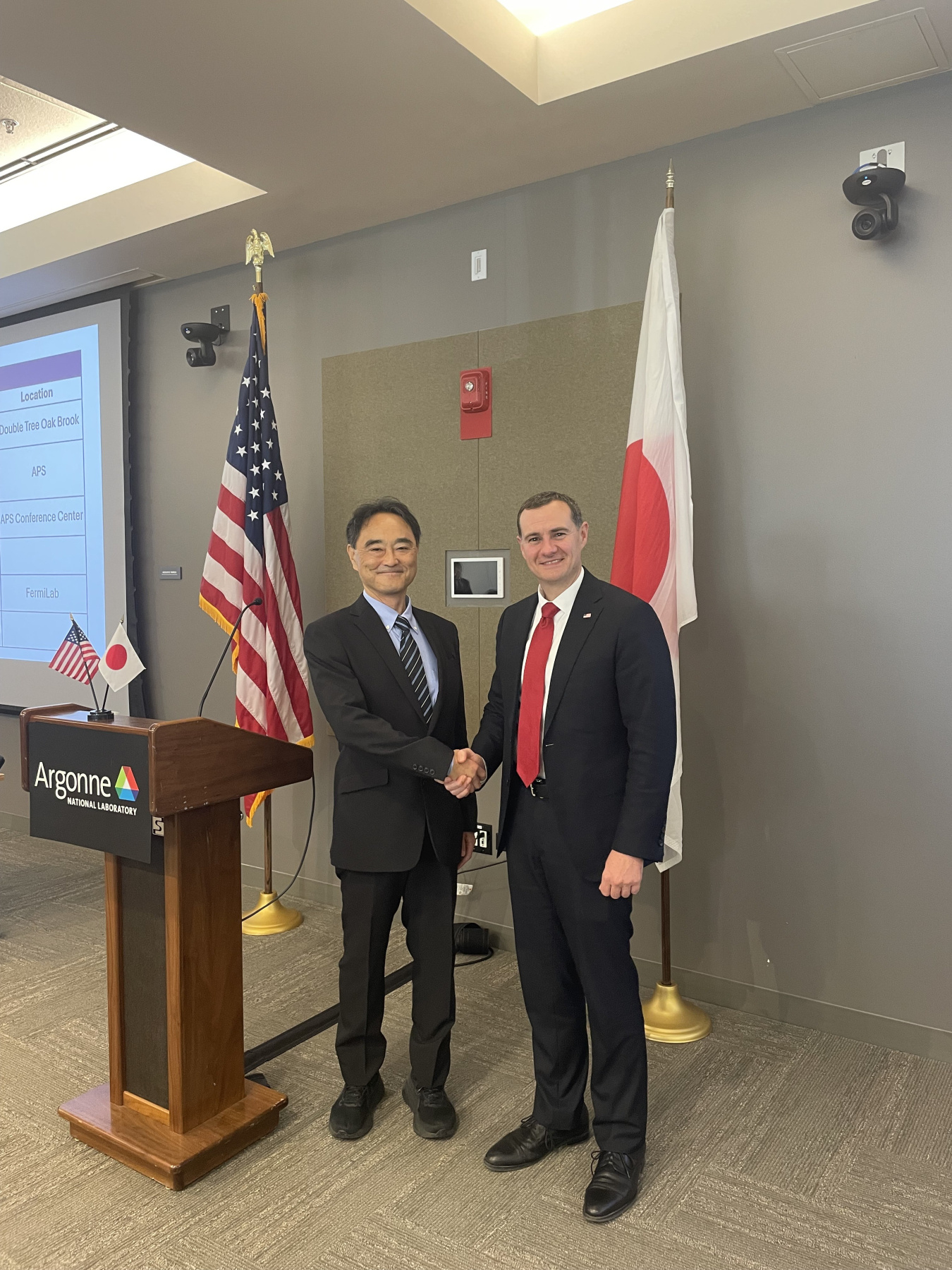
The 14th U.S.-Japan Nuclear Security Working Group (NSWG) meeting convened at Argonne National Laboratory in October, reaffirming the two nations’ enduring commitment to strengthening nuclear and radiological security.
Following a security summit in 2010, the United States and Japan established the NSWG to foster bilateral collaboration and joint leadership on the world's nuclear security challenges. Since the NSWG’s first official meeting in 2011, the United States and Japan have worked across a variety of key topics, from transport security to managing plutonium to nuclear safeguards.
Dr. Matthew Napoli, the National Nuclear Security Administration’s (NNSA) Deputy Administrator for Defense Nuclear Nonproliferation and Ambassador Makoto Igusa, Deputy Director-General of the Disarmament, Non-Proliferation and Science Department, Ministry of Foreign Affairs of Japan led the October meeting. Fifty participants from NNSA’s Defense Nuclear Nonproliferation offices, the Federal Bureau of Investigation, U.S. State Department, and Japanese ministries focused on regulation, law enforcement, training, and science and technology.
The delegation discussed critical issues related to nuclear and radiological security, making progress on shared challenges and goals. For example, the United States and Japan highlighted ongoing cooperation to support the conversion of the Kindai University Teaching and Research Reactor (UTR-KINKI) from highly enriched uranium to low-enriched uranium (LEU), minimizing risk, as LEU is less likely to be used in a nuclear weapon.
“As we advance peaceful nuclear energy and strengthen our respective energy security postures, we must maintain an absolute standard: growth cannot outpace security,” said Matthew Napoli. “The NSWG exists to ensure that our layered defenses—denying adversary access to materials, detecting threats early, and defeating proliferation risks—remain uncompromised.”
The NSWG developed a Living Roadmap in 2011, an evolving framework that outlines tangible goals and guides joint efforts to strengthen global security for the United States, Japan, and beyond. As of the 14th meeting, three goals have been formally completed, while work across the remaining priorities continues to advance.
“There’s an increasing need for authorities responsible for nuclear security to collaborate seamlessly across organizational boundaries,” said Ambassador Igusa. “This necessity arises from a combination of factors: advancements in nuclear technology, such as the development of next-generation reactors, including Small Modular Reactors, and other scientific and technological developments involving Superintelligence, drones, and significant shifts in the security landscape. Given these circumstances, the importance of a forum for such comprehensive discussion is self-evident, and it is recognized that relevant authorities in Japan and the United States must further strengthen their bilateral cooperation.”
Building on over a decade of progress, the NSWG remains an important pillar of the U.S.-Japan partnership and a vital forum for capturing cooperation between the two nations. Through the NSWG, the United States and Japan work together to confront an evolving nuclear and radiological threat landscape, supporting an enduring alliance while advancing U.S. and global security.