When exploring how to break down waste plastic, researchers at DOE’s Oak Ridge National Laboratory created a material with a surprising application.
August 5, 2026 Estimated Read Time min
Shannon Brescher Shea

Shannon Brescher Shea (shannon.shea@science.doe.gov) is the social media manager and senior writer/editor in the Office of Science’s Office of Communications and Public Affairs. She writes and curates content for the Office of Science’s Twitter and LinkedIn accounts as well as contributes to the Department of Energy’s overall social media accounts. In addition, she writes and edits feature stories covering the Office of Science’s discovery research and manages the Science Public Outreach Community (SPOC). Previously, she was a communications specialist in the Vehicle Technologies Office in the Office of Energy Efficiency and Renewable Energy. She began at the Energy Department in 2008 as a Presidential Management Fellow. In her free time, she enjoys bicycling, gardening, writing, volunteering, and parenting two awesome kids.
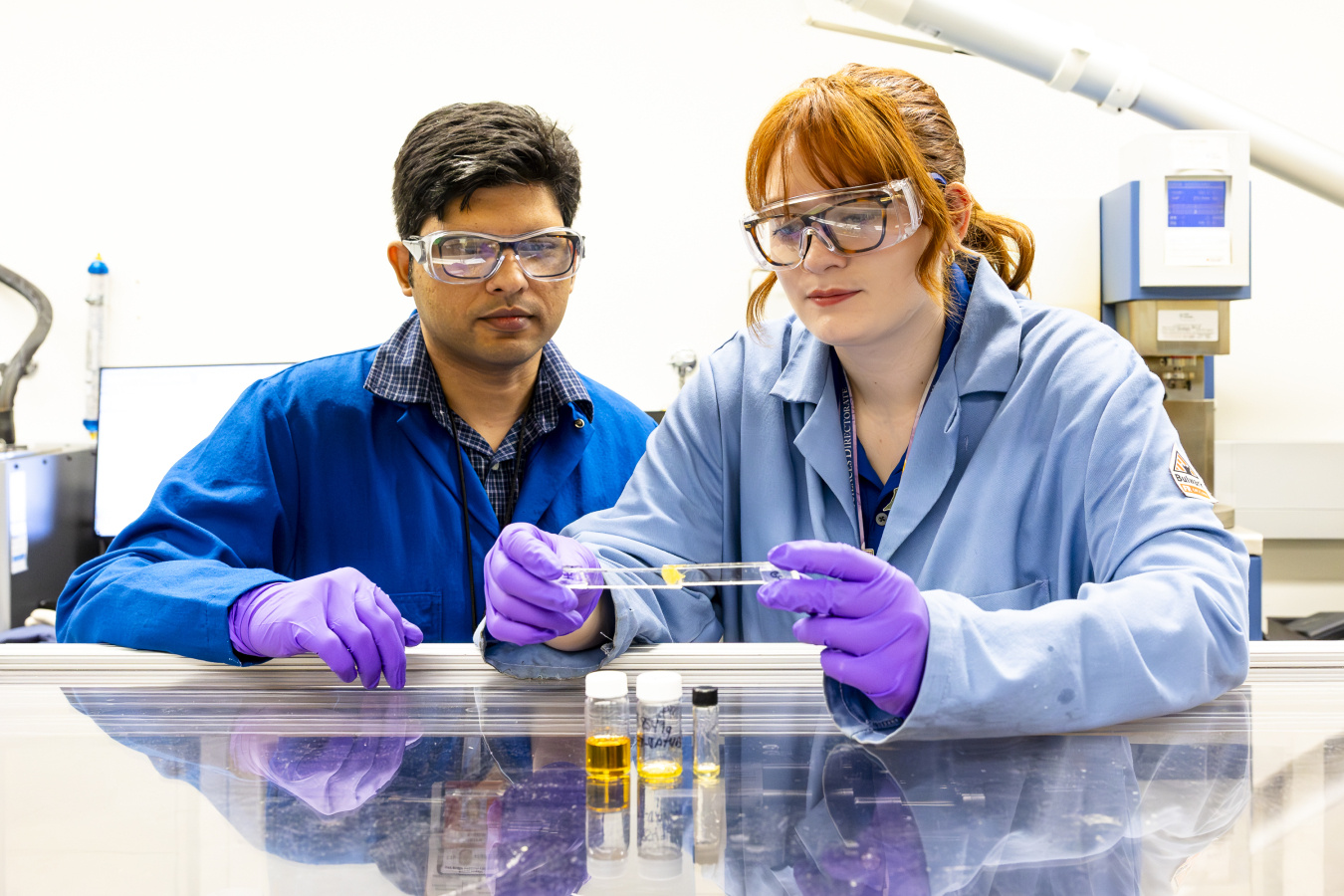
The Stories Behind the Science series looks at the process and drama of the research behind a selection of studies supported by the Department of Energy's Office of Science.
Mary Danielson was stuck. Literally.
Doing her post-graduate research at the Department of Energy’s (DOE) Oak Ridge National Laboratory (ORNL), she was aiming to break down plastic waste. The resulting chemical could then serve as a starter for a more valuable material. She had succeeded in breaking it down into a yellow, viscous liquid. Next up was characterizing its properties.
But she couldn’t pull it off the characterization equipment, no matter what she did.
When she brought the problem to her mentor, Anisur Rahman, he suggested figuring out what was causing the stickiness. As she recalled, they realized, “It’s sticking to everything. What if that was a feature, not a bug?”
That realization led to them developing a technology that has the potential to change the multi-billion dollar market for adhesives. Although they started by conducting foundational research supported by the DOE’s Office of Science, their work unexpectedly led to developing a remarkable adhesive.
Tackling plastic waste
Plastic waste is everywhere and is only expected to increase in the future. By 2050, production of plastics is expected to double.
Unfortunately, plastics can’t be recycled the way that glass and paper can. Each time plastics are mechanically recycled, their value decreases. As a result, a vast majority of plastic waste is never recycled.
“We were basically trying to find a way to recover value that was outside of traditional mechanical recycling processes,” said Rahman.
As a chemist focused on polymer chemistry and materials science, Danielson was interested in addressing these issues.
“I didn’t want to be a perpetuator of the problem. I wanted to be someone who could help fix it,” she said.
Polyethylene Terephthalate (PET) plastic is a particularly good candidate for new forms of recycling. There are already 25 billion tons of PET in the world and 70 million more tons are produced each year. It makes up about 12 percent of global plastic waste with only 20 percent being recycled.
Breaking down polymers
Reducing the amount of plastic and making recycling economically efficient requires transforming waste into higher value items.
The first step is figuring out how to break down plastic waste effectively. Plastics are made of polymers, long chains of chemical units of a single type. This relatively simple structure enables a huge diversity of uses. Unfortunately, it also makes it difficult to recycle. Over time, mechanical recycling physically breaks apart polymers in a way that they can’t be put back together.
Instead, the research team tapped into complex knowledge of materials science and chemistry.
“Our project was intended to understand the fundamentals of polymer deconstruction,” said Rahman. If they could chemically break down plastic and turn it into a new polymer, they could create building blocks for a new material.
One approach is incorporating dynamic covalent bonds into polymers. In covalent bonds, atoms share electrons to create molecules. For example, covalent bonds hold together hydrogen atoms in water and carbon atoms in the chains that make up plastics.
Dynamic covalent bonds can break and reform in response to stimuli, like heat or light. As a result, scientists can break apart and reform polymers with these bonds like Lego bricks.
Using this process, scientists have developed a type of plastic called vitrimers. While these plastics have a lot of potential, there are major barriers to commercializing them. They must be as good as or better than the original material. The production must be energy and cost-efficient. The bonds must be stable but able to break apart for recycling.
Rahman, Danielson, and their team sought to create vitrimers from plastic waste with better performance than the original.
Getting stuck on the process
“We started with a fairly well-known process,” said Danielson. They avoided using expensive catalysts and instead added amines, chemical groups that contain nitrogen. She said, “If you change the amine, you get wildly different chemical properties.” As they used a commercially-available chemical, their process was particularly cost-efficient.
After the scientists added the amine to a plastic egg carton and heated it to 180 C (365 F), the plastic broke down in about seven hours. Once they distilled and purified it, they ended up with the incredibly sticky liquid. To measure how the chemical’s properties change with temperature, Danielson heated the liquid, attempted to pull it apart, and realized the extent of its stickiness.
Once Danielson and Rahman realized how useful that property could be, it was time to fulfill that potential. To make it into an adhesive, they developed a cross-linker that sets liquid so it can dry.
One of the standard tests for adhesives requires sticking two pieces of metal together. An instrument then grabs on to each side and pulls.
“It pulled apart so hard that you could hear the metal sing,” said Danielson, recalling the measurement. Sticking her head in Rahman’s office down the hall, she said, “Hey, I have this data, I don’t know what I’m looking at. Can you see if it’s good?”
Coming into the lab and examining the data, he responded, “Oh, that’s really good. That’s very, very good.”
Next up was investigating the conditions it could be used in. Rahman suggested testing it underwater. Most adhesives can’t be used underwater, making repairs to boat hulls, pipelines, and underwater telecommunications cables difficult.
Danielson recalled her thinking. “We’re already precipitating it with water, so why don’t we see if it will work? It won’t kill us. It’s just one experiment.” Much to their surprise, it was another unparalleled success. She said, “That’s when we got really excited about it.”
Answers from nature
It was clear that the team had created a highly effective adhesive. But why was it so effective?
Danielson was excited to find out. She said, “I love experimental science. Going into a lab and not knowing what’s going to come out of it.”
As the team studied it, they realized that they ended up with a chemical with an unusual structure. The major clue was its ability to work underwater.
The yellow liquid’s chemical structure had a core that was hydrophobic (pushing away water) and chemical “arms” that are hydrophilic (attracting water). The cross-linker also had parts that were hydrophobic and others that were hydrophilic.
By mixing the two, they created a network that both pushes away and attracts water in different areas. This combination bonds the surfaces together while keeping water from seeping into the seals.
But the specific forces were still a mystery. Natural systems provided some insight.
“We thought, ‘Maybe mussels also work this way’,” said Rahman. The feet of those marine organisms stick remarkably well to rocks. They’re also able to remove and reattach themselves. While scientists have tried to replicate this process, they hadn’t done so effectively – until now. The team affirmed their suspicions about the forces using the tools at the Center for Nanophase Materials Sciences, a DOE Office of Science User Facility.
Looking ahead to future inventions
The team had developed a versatile, tough adhesive that could be applied and reapplied. It works in both dry and wet environments on a variety of materials, including wood, glass, metal, and paper. Being able to remove and reattach it makes it easier to fix mistakes and reduce waste.
Of course, it’s also made of cheap PET waste. Unlike conventional recycling that can only handle clear, clean PET, the team used a mix of PET types, including egg cartons, fabric, and water bottles.
By fine-tuning the ratios of the liquid and cross-linker, the team found that they could also adjust the adhesive’s performance in different environments. It works in a variety of situations, including freshwater, seawater, high-pressure and even on structural applications. The adhesive even outperformed several commercial epoxies.
“If you want to get the best performance, you just need to tweak it a little bit,” said Rahman.
The scientists realized that they could also use their process to develop an effective, stable vitrimer plastic. Compared to the parent plastic, it had better tensile strength and toughness. They could even mix it with materials like carbon fiber and recover them in the recycling process. A preliminary analysis showed that this vitrimer plastic has the potential to be economically viable.
Since then, the team has published two papers, with more on the way. They have also applied for a patent.
While Danielson has moved on from ORNL to be an assistant research professor at nearby University of Tennessee Knoxville, she is still working on this process with Rahman. They are studying how they could use it to create weaker, temporary bonds like those on removable labels and bandages. Rahman’s team is still working to apply this adhesive for joining dissimilar materials, which is a great challenge in automotive industries.
“It was a very productive field of research that we were really excited to work on,” said Danielson. “Like most good science, it was a mix of luck, attention to the serendipity of the moment, and also the fundamentals.”