



A University of Georgia Savannah River Ecology Laboratory study at the Savannah River Site provides new insight into how relatively simple changes to vehicle lighting may improve safety for both people and wildlife on roadways. July 28, 2026
Office of Environmental Management
July 28, 2026 Estimated Read Time min
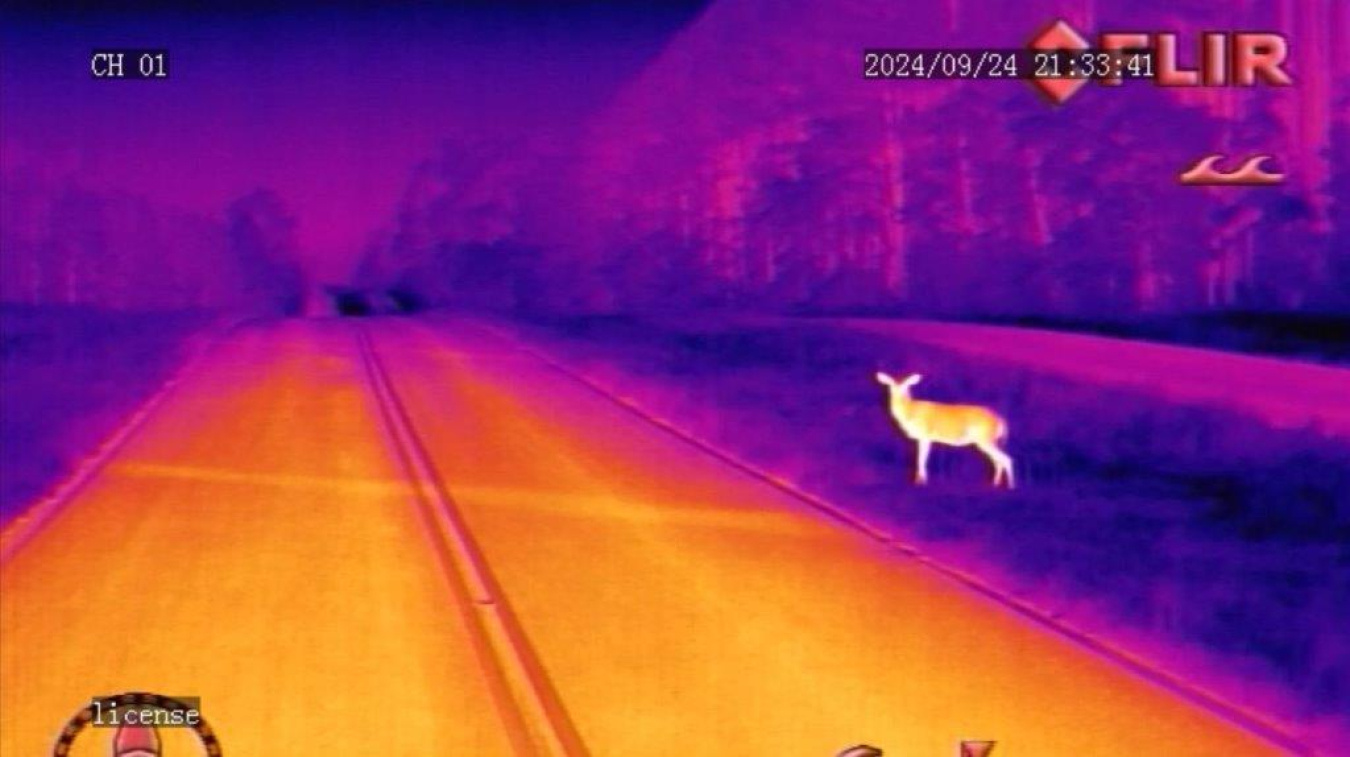
A buck stands roadside after an encounter with the study vehicle. (Photo courtesy of Carson Pakula)
AIKEN, S.C. — A University of Georgia (UGA) Savannah River Ecology Laboratory (SREL) study at the Savannah River Site (SRS) provides new insight into how relatively simple changes to vehicle lighting may improve safety for both people and wildlife on roadways.
Led by Carson Pakula, who conducted the research as a doctoral student, the team studied white-tailed deer and wild pigs at SRS, where an average of 95 deer collisions and 40 wild pig collisions occur each year. The researchers compared traditional halogen headlights with modern LED headlights while also testing a rear-facing lightbar that increased frontal illumination and made more of a vehicle visible to animals at night.
"Vehicle lighting is an interesting area to investigate because most damaging collisions occur at night," Pakula said. "During this time, vehicle lighting is the main source of light on the roadways, which may influence how wildlife respond to approaching vehicles."
As a UGA research unit located on the SRS, SREL operates under a cooperative agreement with DOE to provide independent evaluation of the environmental impacts of nuclear activities to both the agency and the public, supporting DOE Office of Environmental Management cleanup efforts.
The study found that deer and wild pigs responded differently. For white-tailed deer, headlight type had little effect on when animals initiated flight. However, the additional illumination provided by the lightbar reduced the tendency for deer to remain stationary, or "freeze," as vehicle speed increased, preventing an increase in dangerous encounters between deer and vehicles at higher speeds.
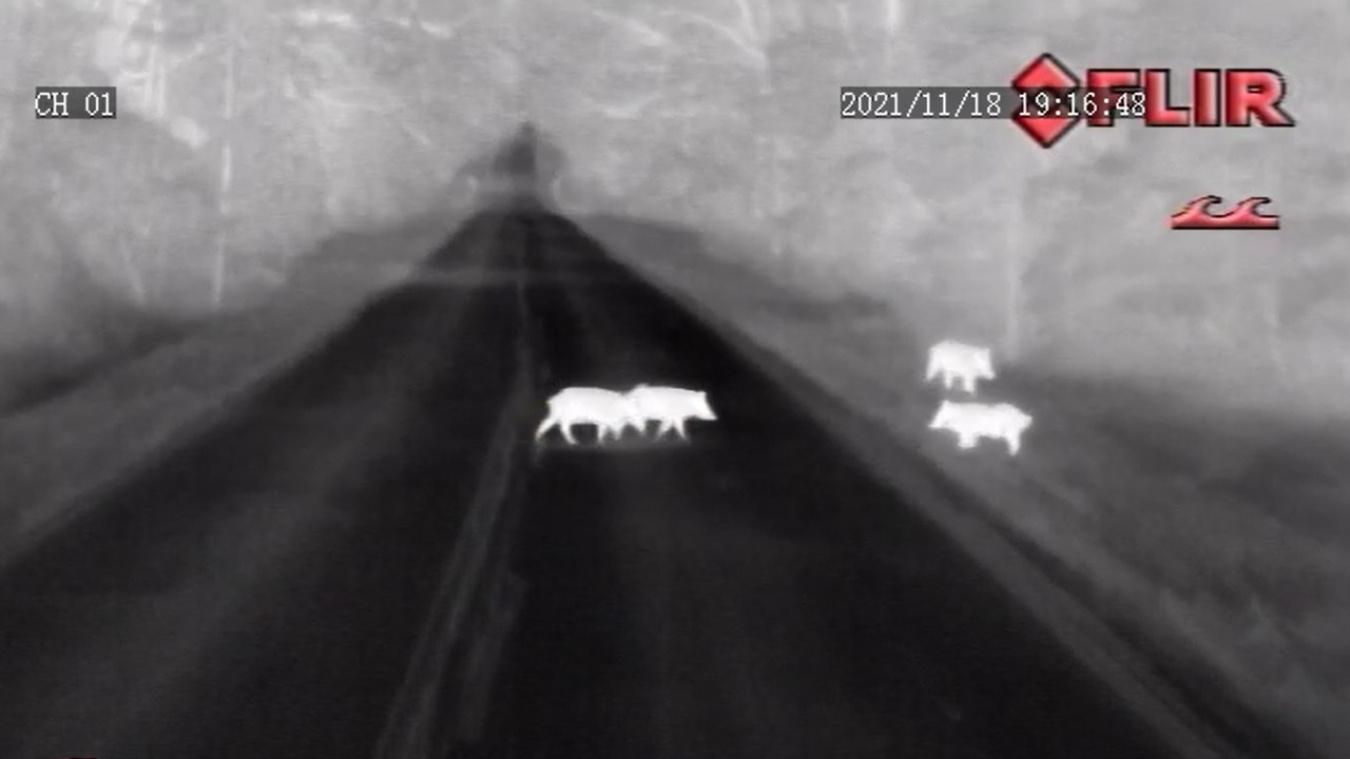
A group of wild pigs are seen crossing the road during an encounter with the study vehicle. Videos and images were taken using an infrared camera, allowing researchers to observe animals under low-light conditions.
(Photo courtesy of Carson Pakula)
However, wild pigs responded differently. Pigs exposed to LED headlights initiated flight substantially earlier than those exposed to halogen headlights, while the lightbar encouraged them to flee at greater distances as vehicle speed increased, potentially providing more time for animals and drivers to avoid a collision.
"These results present exciting opportunities for further research on how exactly lighting affects animal behavior and how vehicle lighting can be tailored to encourage more beneficial wildlife responses," Pakula said.
Over a two-year period, researchers conducted 95 nighttime driving surveys and documented 612 encounters with white-tailed deer and 176 encounters with wild pigs. Using infrared cameras and multiple lighting configurations, the team measured when animals moved, how far away they were when they responded and whether those responses occurred early enough to provide adequate stopping distance.
Wildlife-vehicle collisions remain a persistent challenge for both public safety and wildlife conservation, causing billions of dollars in damage each year while injuring drivers and harming animals. Although wildlife crossings, roadside fencing and warning systems can reduce collisions in some locations, these approaches are often expensive or limited to specific stretches of roadway. As a result, the researchers explored modified vehicle lighting as a practical, widely applicable way to encourage wildlife to respond sooner to approaching vehicles, with the goal of reducing collisions and improving safety for both animals and drivers.
-Contributor: Tyjaha Steele
To receive the latest news and updates about the Office of Environmental Management, submit your e-mail address.