



What cleanup has been done in Area IV at the Santa Susana Field Laboratory? That was one of the main questions the U.S. Department of Energy tackled at its recent Community Outreach, Neighbor Notifications, Engagement, Collaboration and Training Series community update. June 9, 2026
Office of Environmental Management
June 9, 2026 Estimated Read Time min

Josh Mengers, the U.S. Department of Energy’s federal project director at the Santa Susana Field Laboratory, answers questions from attendees during the Community Outreach, Neighbor Notifications, Engagement, Collaboration and Training Series community update.
SIMI VALLEY, Calif. — What cleanup has been done in Area IV at the Santa Susana Field Laboratory (SSFL)?
That was one of the main questions the U.S. Department of Energy (DOE) tackled at its recent Community Outreach, Neighbor Notifications, Engagement, Collaboration and Training (CONNECT) Series community update.
Josh Mengers, DOE’s federal project director at SSFL, said much of the remediation has already been done in Area IV, where the department previously conducted liquid metals and nuclear energy research at the former Energy Technology Engineering Center (ETEC).
“We’ve been remediating Area IV for decades, even before . . . 1998 (when) we finished all of our research at the site, (ending all operations) and we’ve been focused just on the remediation ever since,” Mengers said during the meeting.
One example of completed cleanup is the Sodium Reactor Experiment, which operated from 1957 to 1964 and was a pioneering nuclear power plant that is more well known for a July 1959 incident when 13 of its 34 fuel rods partially melted. It was successfully decontaminated and decommissioned from 1974 to 1983.
Another example is the Former Sodium Disposal Facility, or sodium burn pit, that operated from 1956 to 1978 and was used to clean sodium from components before disposal. Interim soil remediation was conducted between 2000 and 2002 that removed all soil down to bedrock. Clean soil was then brought in and the area was revegetated.
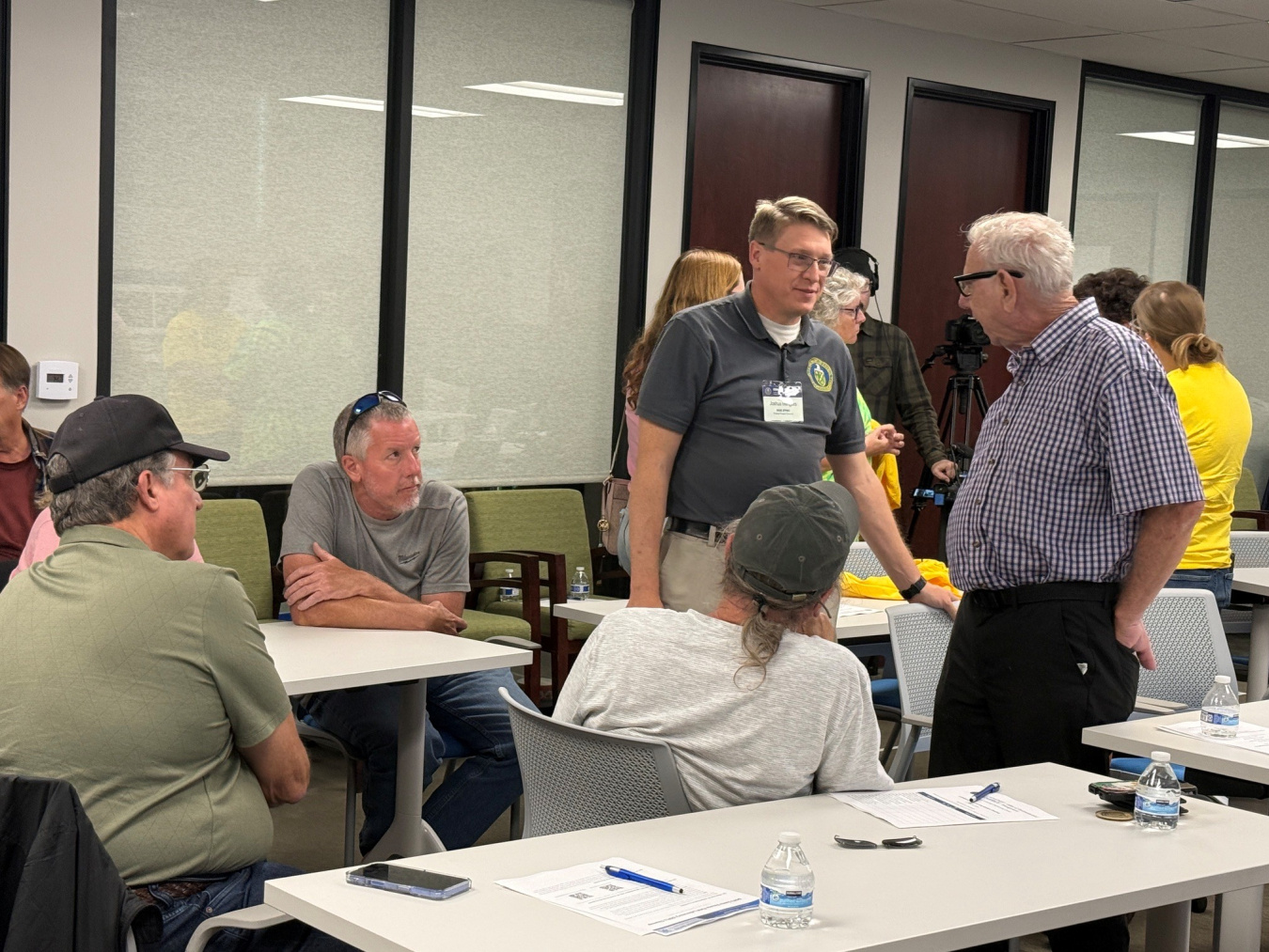
Josh Mengers, the U.S. Department of Energy’s federal project director at the Santa Susana Field Laboratory, interacts with the public during the Community Outreach, Neighbor Notifications, Engagement, Collaboration and Training Series community update.
Numerous comprehensive studies have been conducted over the years.
In 2012, the U.S. Environmental Protection Agency published results from its radiological surveys of Area IV that identified the extent of contaminants remaining in soil, Mengers said. The results from these studies show that the previous remediations were successful.
“We’re continuing our ongoing environmental monitoring (since) much of that (other remediation) work has already been completed and we’re looking to . . . finish the job,” Mengers said.
Ongoing work includes groundwater and air monitoring, a soils study to understand how to best revegetate the area after cleanup is done, and a groundwater treatment pilot study.
A recording of the May 13 presentation and slides are available on the CONNECT Series page.
Join the ETEC team for the next CONNECT tentatively scheduled for Aug. 12 to learn more about the Sandy Fire that recently burned near SSFL. Topics will include air monitoring data collected, response, safety protocols and lessons learned from the Woolsey Fire that burned across a majority of SSFL in 2018.
Check the CONNECT Series page for upcoming sessions or topics. To suggest future topics or provide feedback, fill out the CONNECT feedback form.
-Contributor: Melissa Simon
To receive the latest news and updates about the Office of Environmental Management, submit your e-mail address.