



Crews taking down the largest former uranium enrichment facility in the heart of the U.S. Department of Energy’s Portsmouth Site recently removed the last of its nearly 15,000 panels containing asbestos, a marker of progress toward the aging structure’s demolition. June 9, 2026
Office of Environmental Management
June 9, 2026 Estimated Read Time min

EMTV: This video tells the story of crews removing nearly 15,000 transite panels from the Portsmouth Site's largest former uranium enrichment structure, the X-333 Process Building. They cleared the panels from the aging facility in just over 12 months as part of demolition activities. In this photo, transite removal technicians Blake Stiltner, left, and Brady Lykins use an aerial lift to bring the final X-333 panel to the ground for stacking, wrapping and disposal.
PIKETON, Ohio — Crews taking down the largest former uranium enrichment facility in the heart of the U.S. Department of Energy’s Portsmouth Site recently removed the last of its nearly 15,000 panels containing asbestos, a marker of progress toward the aging structure’s demolition.
Transite, the outer panels armoring the building, is a known asbestos-containing material that must be cautiously removed to meet environmental regulatory requirements. Workers spent just over 12 months clearing the panels from the X-333 Process Building after removing the first one in April last year. They completed the work without a recordable or lost-time accident.
“Transite removal is the first significant milestone during the demolition phase, so it’s important to set the right tone for this multiyear building demolition,” Federal Project Director Christy Brown said. “The meticulous removal of transite panels successfully set a precedence for safety and teamwork, while still meeting project deadlines.”

Two transite removal technicians lower the X-333 Process Building’s final panel to the ground with an aerial lift. The panel was then handed off to workers on the ground so that it could be stacked and prepared for transport to the On-Site Waste Disposal Facility.
The accomplishment comes as the Portsmouth Site is decontaminating and demolishing legacy buildings to create space for future industry, such as artificial intelligence infrastructure and nuclear energy opportunities, helping to create generational jobs and build long-term economic vitality in the local community.
Team members sprayed the X-333 panels, each weighing between 75 and 150 pounds, with fixative. Next, they carefully detached the panels from the building before stacking and wrapping them. The process required two workers in an aerial lift, several workers on the ground using tools, clear communication, feedback and thorough planning.
“Removing the panels represents nearly 15,000 repetitions of labor-intensive work, which spanned through all types of weather conditions,” Southern Ohio Cleanup Company (SOCCo) Demolition Project Manager John Collins said. “Without a single lost-time accident, the safety culture and success benchmark of this crew will be the standard for the rest of the project.”
SOCCo is the deactivation and demolition contractor at the Portsmouth Site.
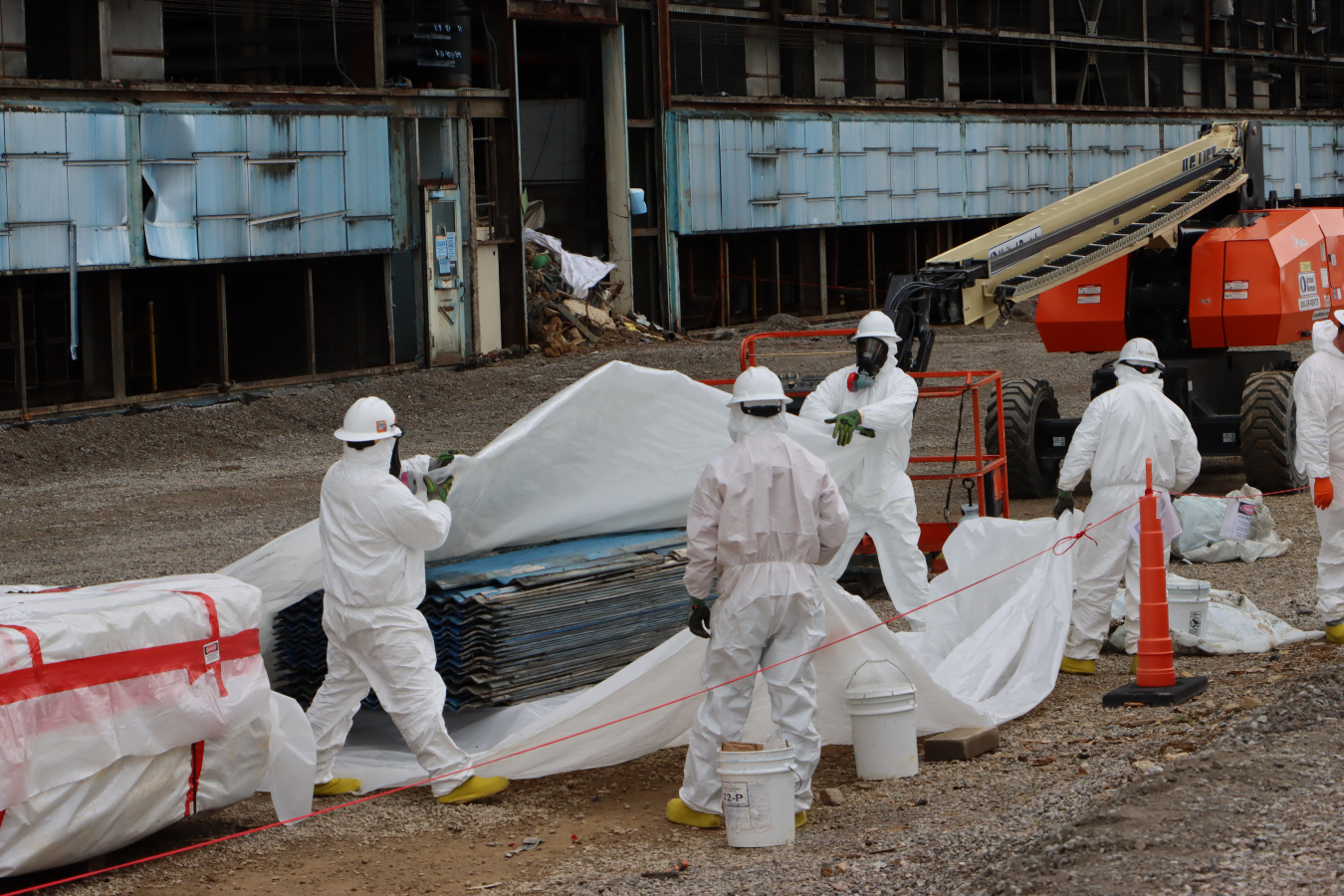
Transite removal technicians wrap a bundle of panels together to prepare it for transport to the On-Site Waste Disposal Facility. The panels ranged in weight from 75 to 150 pounds.
Crews expect to finish transporting the panels to the On-Site Waste Disposal Facility for disposal this summer.
They will continue demolishing X-333, with completion scheduled in 2031. The facility has 66 acres of floor space under roof.
-Contributor: Michelle Teeters
To receive the latest news and updates about the Office of Environmental Management, submit your e-mail address.