



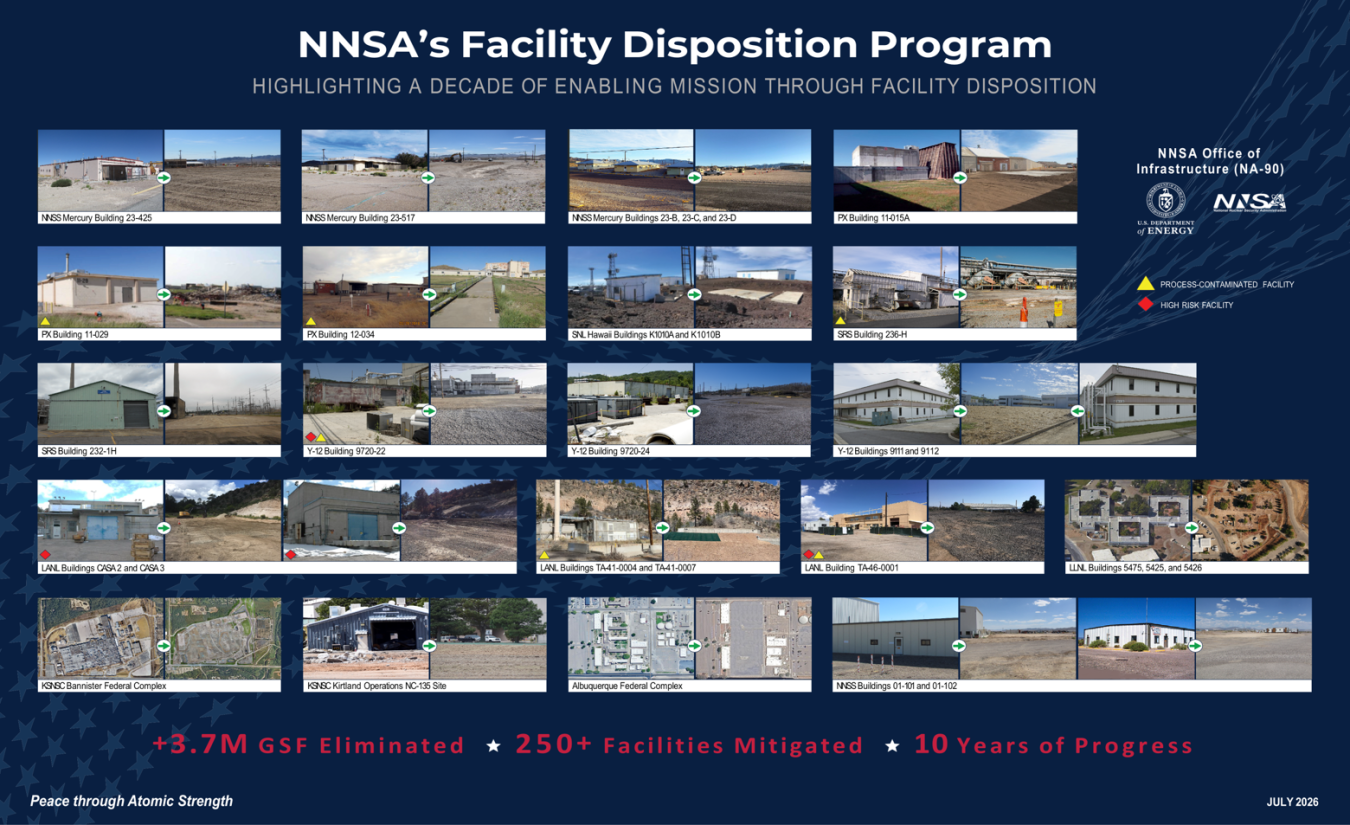
Since 2016, its Facility Disposition Program has demolished more than 250 facilities and cleared approximately 3.7 million square feet of degraded infrastructure—roughly the equivalent of 64 football fields.
National Nuclear Security Administration
October 22, 2026 Estimated Read Time min
NNSA’s Facility Disposition Program Marks Ten Years of Progress
Ten years ago, hundreds of aging and obsolete facilities were taking up valuable space across the Nuclear Security Enterprise—facilities that no longer supported the mission but still required resources to maintain. The National Nuclear Security Administration (NNSA) set out to change that. Since 2016, its Facility Disposition Program has demolished more than 250 facilities and cleared approximately 3.7 million square feet of degraded infrastructure—roughly the equivalent of 64 football fields.
In the process, NNSA has reduced the share of excess facilities across its sites from 13 percent to 8 percent, reduced risks associated with deteriorating infrastructure and made room for the modern facilities needed to carry out the national security mission for decades to come.
But the impact goes well beyond the number of buildings demolished.
Removing deteriorating facilities reduces risks to workers, eliminates the cost and burden of maintaining infrastructure that no longer serves a mission, and—critically—creates spaces for new capabilities.
Across NNSA sites, cleared areas are being put to a new use to support modernization and emerging mission needs.
Based on the 2015 findings of Department of Energy (DOE) Inspector General (IG) and General Accounting Office (GAO), the NNSA developed an enterprise-wide, stand-alone program focusing on facility disposition needs. NNSA then collaborated with DOE Office of Environmental Management (EM) to develop a plan to address the highly contaminated facilities. Since then, EM has demolished over 10 heavily contaminated facilities across the Nuclear Security Enterprise. NNSA continues to collaborate with EM to plan the demolitions needed over the next 10+ years.
The NNSA program has reduced risks for workers and the public by demolishing more than 60 process-contaminated facilities—facilities containing contamination from previous mission operations. These efforts have cleared space for new, mission-critical, specialized infrastructure and created opportunities to repurpose existing sites. Examples include modernization of the Mercury area at Nevada National Security Site and several infrastructure modernization projects at Y-12 National Security Complex including a new Uranium Processing Facility storage shed, utility rerouting that enabled the West End Protected Area Reduction (WEPAR) project, and preparations for construction of a new substation in 2027. In addition to reducing risks and supporting infrastructure modernization, these efforts improve operational efficiency and create safer, more productive work environments.
NNSA’s ability to carry out its missions depends on the facilities and systems that support them. The infrastructure established during the Manhattan Project era can no longer sustain the advancements of today. The Disposition Program has an important role in prioritizing mission needs and risk reduction to demolish excessed infrastructure, clearing the path for a modern and resilient nuclear enterprise to support the deterrent. This program is essential for the modernization of the Nuclear Security Enterprise to ensure NNSA can meet national security needs for decades to come.