



Savannah River National Laboratory will lead projects supporting critical national security and environmental stewardship goals for the U.S. Department of Energy’s Office of Environmental Management and National Nuclear Security Administration, as part of the first projects recently announced for the Genesis Mission. August 4, 2026
Office of Environmental Management
August 4, 2026 Estimated Read Time min
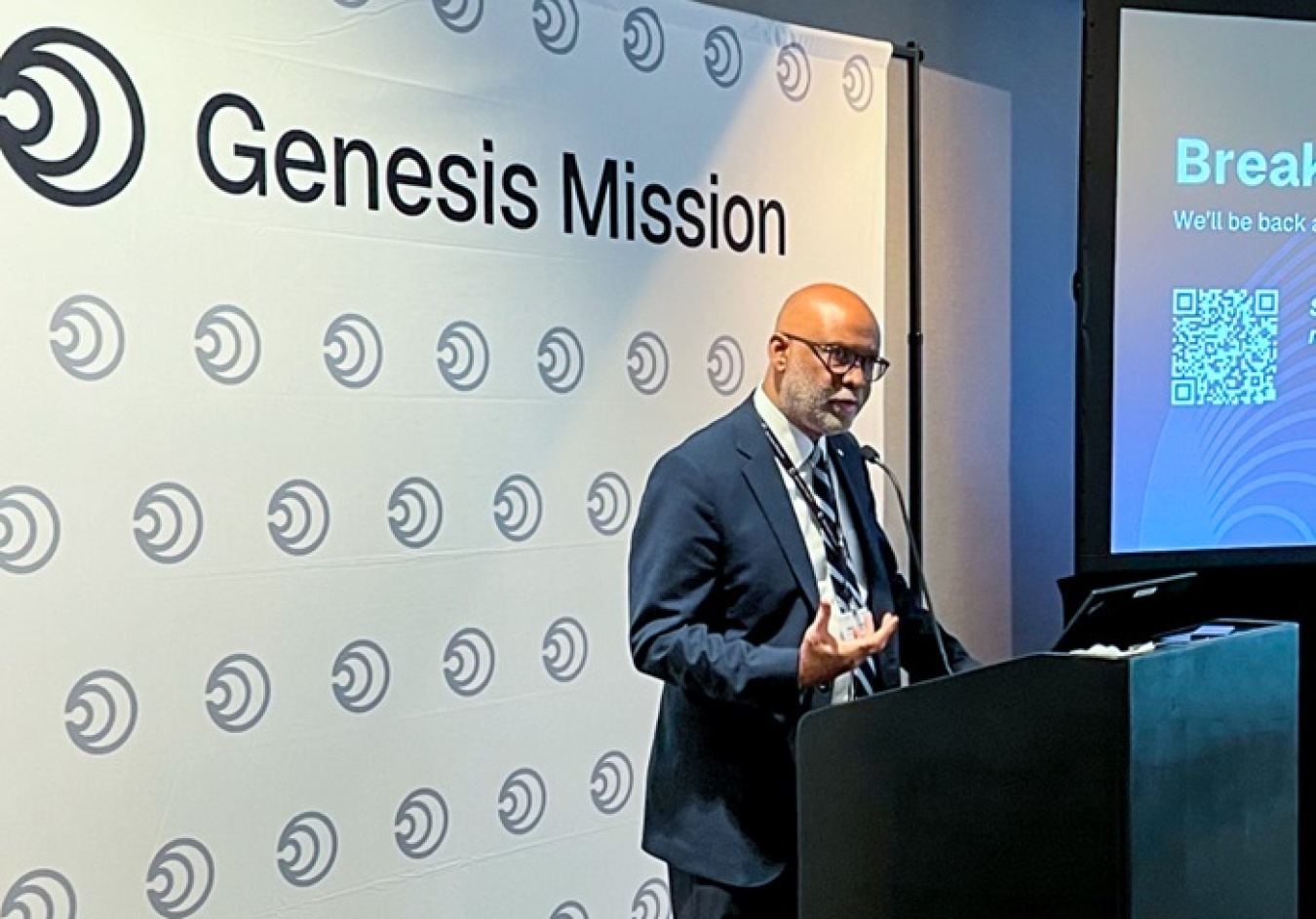
Savannah River National Laboratory Director Johney Green speaks to reporters during a Q&A session at the recent Genesis Mission Annual Summit.
AIKEN, S.C. — Savannah River National Laboratory (SRNL) will lead projects supporting critical national security and environmental stewardship goals for the U.S. Department of Energy’s (DOE) Office of Environmental Management (EM) and National Nuclear Security Administration, as part of the first projects recently announced for the Genesis Mission.
“SRNL has built decades of expertise tackling complex environmental cleanup and nuclear materials challenges,” said SRNL Director Johney Green. “As we embark on the Genesis Mission, we are eager to harness this depth of expertise in collaboration with our partners across national laboratories, industry and academic institutions. By integrating our longstanding scientific knowledge with emerging AI capabilities, we are accelerating discovery in ways that will strengthen our national security, environmental, and energy missions.”
Nearly 300 projects selected from a historic request for applications response span all 50 states. The national portfolio of research teams will help develop and demonstrate AI-enabled scientific workflows designed to accelerate breakthroughs in energy, discovery science and national security.
Designed to double America’s scientific productivity, President Donald Trump’s historic Genesis Mission brings together DOE’s world-class scientific capabilities, advanced artificial intelligence, high-performance computing, and the nation’s leading researchers to transform how scientific discovery is conducted and strengthen American leadership in science and technology.
SRNL is developing first-of-its-kind AI models designed to solve complex challenges in environmental remediation, waste management and infrastructure resilience — ultimately safeguarding national security assets while yielding over $150 billion in lifecycle cleanup savings.
SRNL will lead the following environmental projects:
- The VITA-SCALE project leverages physics-based AI to accurately predict how nuclear waste behaves during vitrification at full scale. Vitrification, the process of converting waste materials into glass, is used by EM for long-term storage. VITA-SCALE overcomes the limitations of small-lab analyses and steady-state models, and accelerates EM cleanup, reduces costs and improves safety with plans to open-source its models for broader innovation.
- The SCOPE project uses AI, chemistry and physics-based modeling to more accurately predict the behavior of radioactive liquid waste during treatment. This improved understanding can help prevent costly process disruptions, such as unexpected solids formation, reducing operational risk while improving process efficiency.
SRNL will also partner on an environmental project led by Pacific Northwest National Laboratory and a fusion project led by Vanderbilt University.
Learn more about the DOE Genesis Mission initiative here and the Genesis Mission at SRNL here.
To receive the latest news and updates about the Office of Environmental Management, submit your e-mail address.