



The Hanford Waste Treatment and Immobilization Plant’s High-Level Waste Facility Research and Technology team completed an important test two months ahead of the milestone schedule at The Catholic University of America’s Vitreous State Laboratory in Washington, D.C. July 21, 2026
Office of Environmental Management
July 21, 2026 Estimated Read Time min
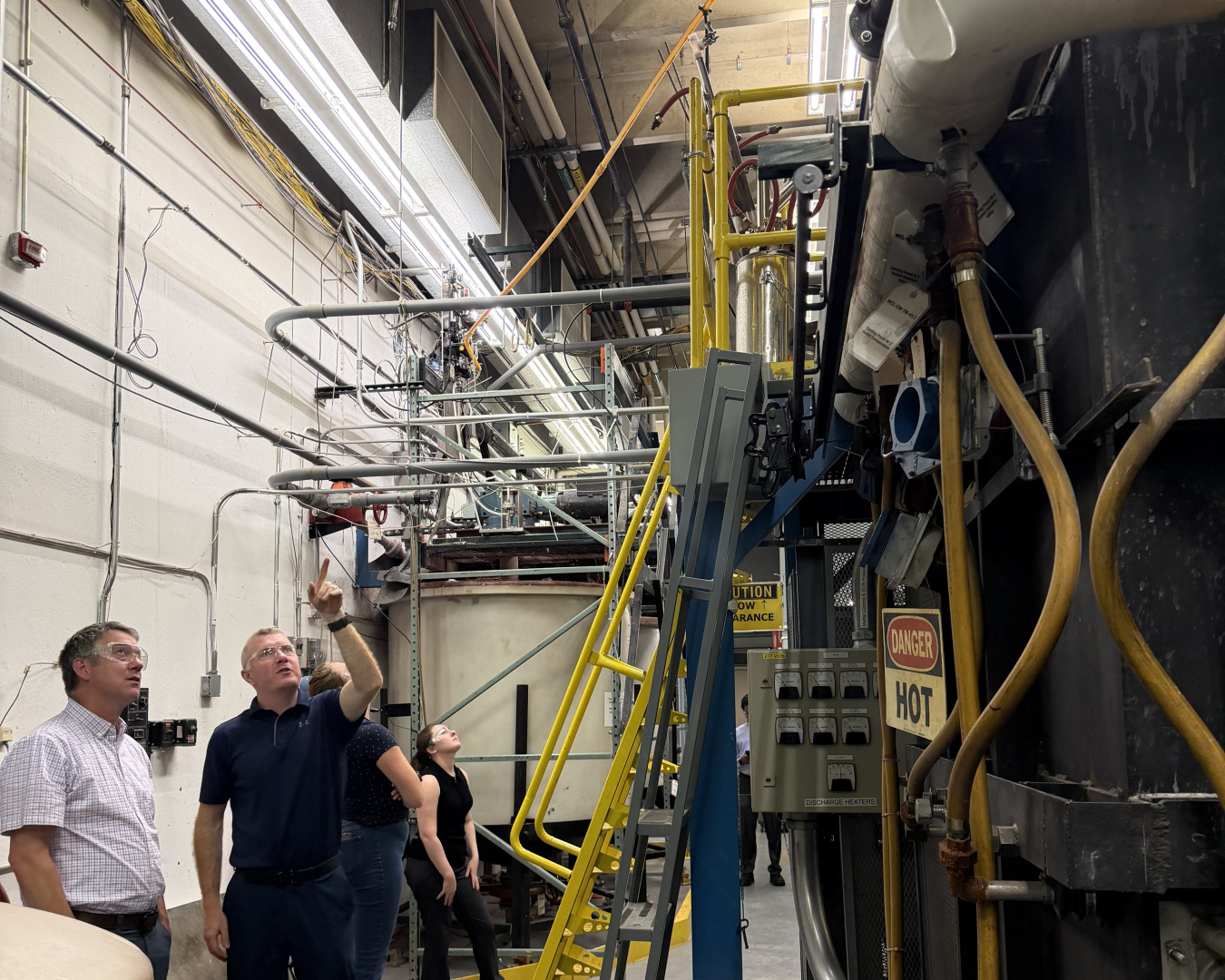
Team members from the Hanford Site’s High-Level Waste Facility are pictured at the Vitreous State Laboratory, where they observe a one-third scale melter like the High-Level Waste Facility will use at Hanford.
WASHINGTON, D.C. — The Hanford Waste Treatment and Immobilization Plant’s (WTP) High-Level Waste (HLW) Facility Research and Technology team completed an important test two months ahead of the milestone schedule at The Catholic University of America’s Vitreous State Laboratory (VSL) in Washington, D.C.
The test brought together teams from the U.S. Department of Energy (DOE) Office of Environmental Management’s Hanford Field Office, WTP prime contractor Bechtel National Inc., AtkinsRéalis, and VSL to assess melter and emissions treatment system challenges and provide insights for ongoing HLW Facility engineering design.
“This test highlights how strategic partnerships are shaping the future of the Hanford cleanup mission,” said Mat Irwin, Hanford’s assistant manager for the WTP. “By partnering with technical and industry experts, we are able to accelerate progress, identify potential challenges and ensure that the HLW Facility is ready to safely and efficiently treat high-level waste when operations begin.”
The team performed the test over five days at VSL, which operates the largest collection of waste glass melters in the United States, including a one-third scale of the melter and emissions treatment system like what the HLW Facility will use. It was the second of six tests to be performed to validate melter and emissions treatment system design.
“Partnerships strengthen our ability to deliver safe and reliable operations for DOE, the environment and the surrounding communities depending on this cleanup,” said Mark Johnson, HLW Facility project manager for Bechtel. “They have been invaluable to WTP, both for the Low-Activity Waste Facility and HLW.”
Bechtel is advancing the design for direct-feed high-level waste to 90% complete while enclosing the HLW Facility.
Like Hanford’s Low-Activity Waste Facility, the HLW Facility will mix tank waste with glass-forming materials in two large melters operating at 2,100 degrees Fahrenheit. The mixture will be poured into stainless steel containers for interim safe storage prior to disposal.
To receive the latest news and updates about the Office of Environmental Management, submit your e-mail address.