



A drone and advanced laser scanning technology known as lidar are providing highly accurate 3D maps of the interior of bin sets containing radioactive waste, an important step to prepare the Idaho Cleanup Project to safely access the structures and eventually retrieve the material for disposal. August 11, 2026
Office of Environmental Management
August 11, 2026 Estimated Read Time min
IDAHO FALLS, Idaho — A drone and advanced laser scanning technology known as lidar are providing highly accurate 3D maps of the interior of bin sets containing radioactive waste, an important step to prepare the Idaho Cleanup Project (ICP) to safely access the structures and eventually retrieve the material for disposal.
ICP contractor Idaho Environmental Coalition (IEC) collected hundreds of millions of measurement points to capture detailed geometry inside concrete vaults at the Idaho Nuclear Technology and Engineering Center at the Idaho National Laboratory Site. The vaults contain stainless steel bins holding 4,400 cubic meters of calcine, a granular waste similar in consistency to sand, generated during historic nuclear fuel reprocessing activities.
An IEC team is working to characterize and prepare the bin sets for waste treatment and disposition, a critical effort in reducing environmental risks and meeting the commitments outlined in an agreement with the state of Idaho.
Stationary scanning technology yielded exceptionally high-resolution data but left some shadowed areas — gaps successfully filled by the drone, which was able to scan along its full flight path and reveal obstructions and structural features from top to bottom. Together, these complementary scans produced a complete and highly accurate representation of a bin set’s interiors while avoiding the need for personnel to enter hazardous environments.
“This accomplishment reflects the outstanding work of the entire team,” said Val Kimbro, IEC’s project manager for the Calcine Disposition Project. “Their meticulous preparation, detailed mock-ups, thorough dry runs, and deep knowledge of the facility enabled these scans to be completed safely and efficiently.”
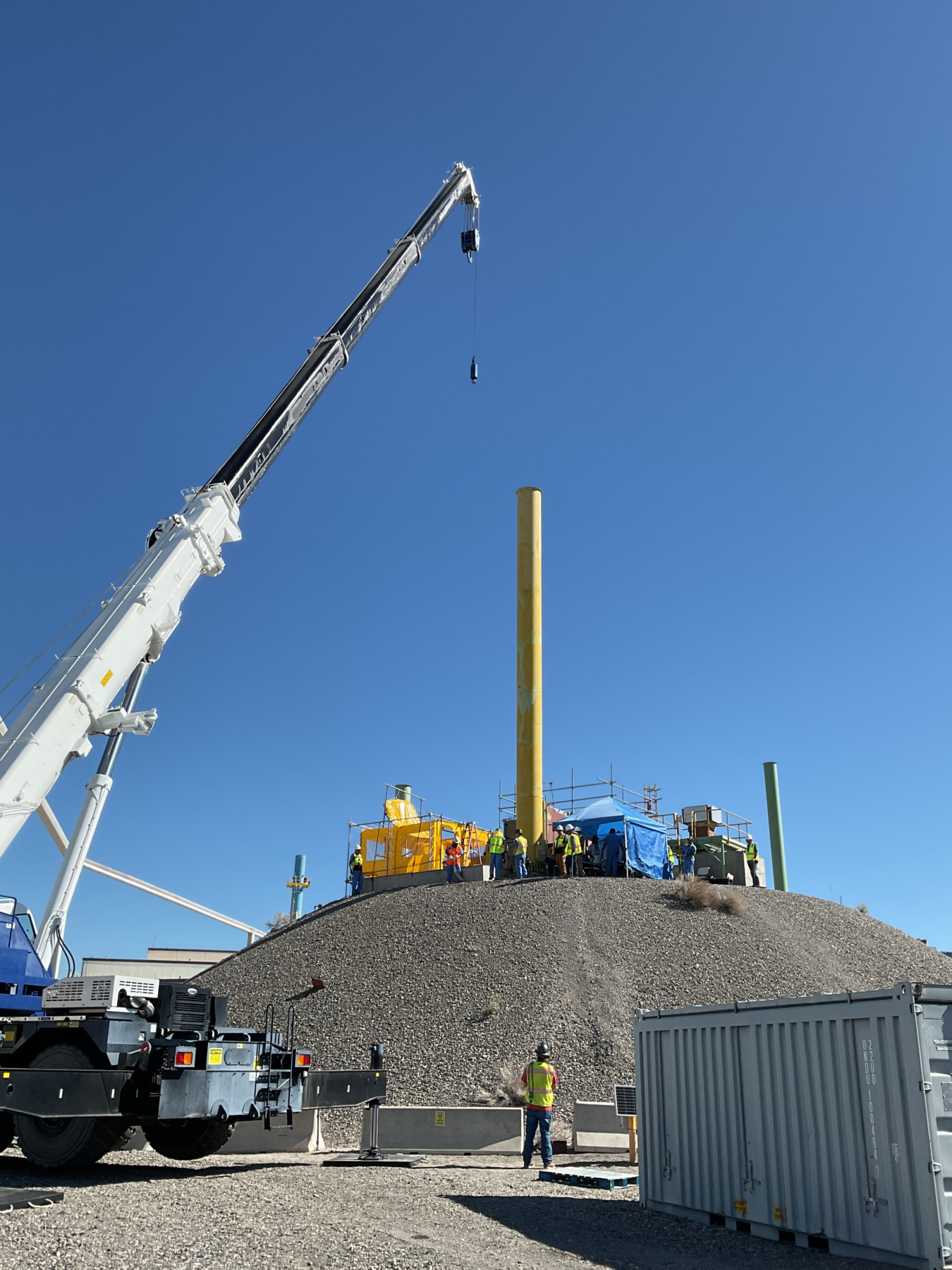
Crews lift the top hatch of a calcine bin set to enable access for interior mapping work, supporting Idaho Cleanup Project efforts to safely validate storage conditions ahead of future waste retrieval.
The effort built upon earlier testing conducted in a full-scale mock-up, where IEC demonstrated the drone’s ability to navigate confined spaces and carry the scanning equipment. The innovative pairing of drones and advanced light detection and ranging mapping supports the U.S. Department of Energy Office of Environmental Management’s broader vision of leveraging cutting-edge technologies to address complex environmental cleanup challenges.
Data from the scanning equipment supports IEC engineers as they develop a robotic welding system. The robot welder will require precise understanding of bin geometries, weld locations and clearance for automated movement. The high-fidelity scans provide engineers with the exact dimensional data needed to design weld paths, fabricate custom fixtures using additive manufacturing and validate robotic operations prior to deployment.
Due to the design of one of the six bin sets, crews must install a nearly 20-foot-long, 8-inch diameter pipe, or access riser, to retrieve the waste. The robot was designed to weld the access riser pipe to the bins in that bin set. Once the weld is complete, the same robot is fitted with equipment to cut a hole into the bins at the welded point of the pipe.
-Contributor: Ryan Christensen
To receive the latest news and updates about the Office of Environmental Management, submit your e-mail address.