



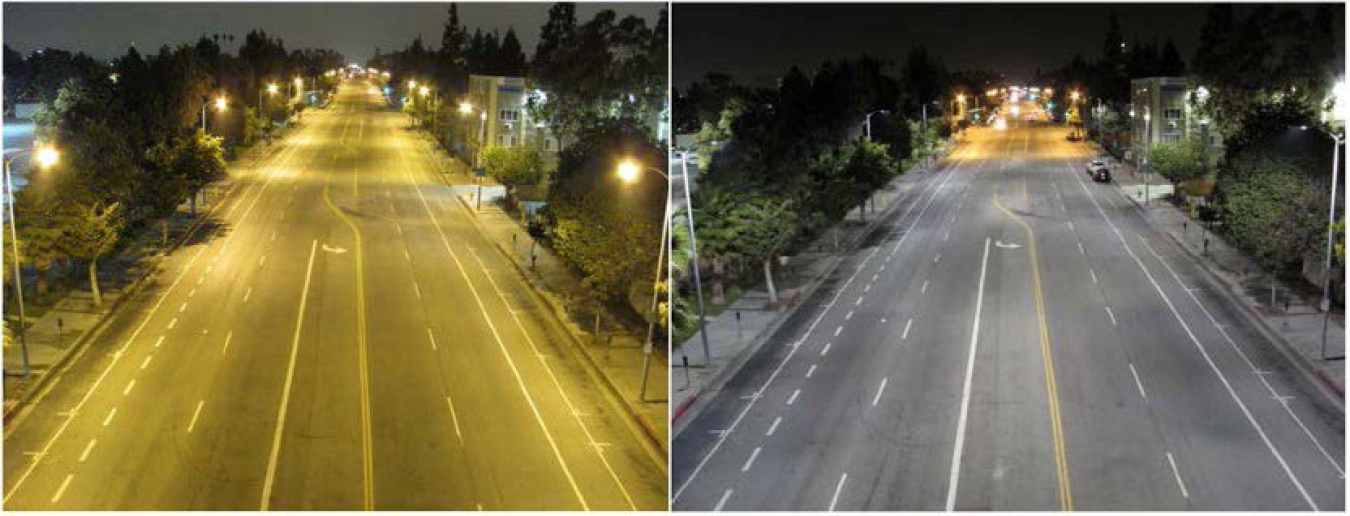
DOE roadway lighting research seeks to better understand the effects of LED roadway lighting on energy use, as well as its potential impact on health and safety. LED technology has already demonstrated that roadway light levels can be achieved with less than half of the total generated light compared to previous technologies due to improved optical controllability. LED roadway lighting also does not (or should not) emit any light upward. LED lighting has been used with controls to dim full-on light levels to target minimums and to enable time of night dimming, where light levels are further reduced late at night. Taken together, it is feasible to reduce the amount of light at night by 80-90% without adversely affecting the intended function of the light.
ROADWAY RESEARCH
Measuring the Impact of Adaptive Outdoor Lighting
Researchers at Virginia Tech Transportation Institute (VTTI) studied the effects of adaptive LED outdoor lighting systems, seeking to develop metrics that maximize energy savings through better understanding of application needs such as visibility, safety, comfort, and security. To begin, the team analyzed the effect of light levels on crash and crime incidents in cities with and without adaptive lighting. The results then informed an evaluation of light levels on perceptions of safety, comfort, and visibility at VTTI’s Smart Road facility. Final findings will inform the development of guidelines and specifications for the application of adaptive lighting in street and residential areas.
Outdoor Lighting Health Impacts
Researchers at VTTI partnered with Thomas Jefferson University to study the effects of outdoor lighting on melatonin levels in realistic roadway environments. Researchers measured the physiological effects of lighting on drivers, pedestrians, and occupants of a roadside cabin at VTTI’s Smart Road facility. The results of the study will help enable improved guidance as to the optimum light spectra for roadway use. The results will also inform the public on the health impacts of outdoor lighting – not just on drivers, but also on pedestrians and individuals with bedrooms exposed to street lighting.
- Impact of Solid-State Roadway Lighting on Melatonin in Humans (Journal article, November 2022)
ADDITIONAL DOE RESOURCES
- Article: Next Steps: Five Principles for Responsible Outdoor Lighting
- Article: Rewriting the Rulebooks for Outdoor Lighting
- Article: Another Sky-Glow Culprit: The Trouble with Tilted Outdoor Lighting
- Article: Can LED Lighting Improve Roadway Safety?
- Article: Home Nighttime Light Exposures
- Table: Selected Blue Light Characteristics of Various Outdoor Lighting Sources at Equivalent Lumen Output