



Discovery proves the existence of the mysterious Wigner crystal — an unusual kind of matter made entirely of electrons.
December 5, 2025 Estimated Read Time min
The Science
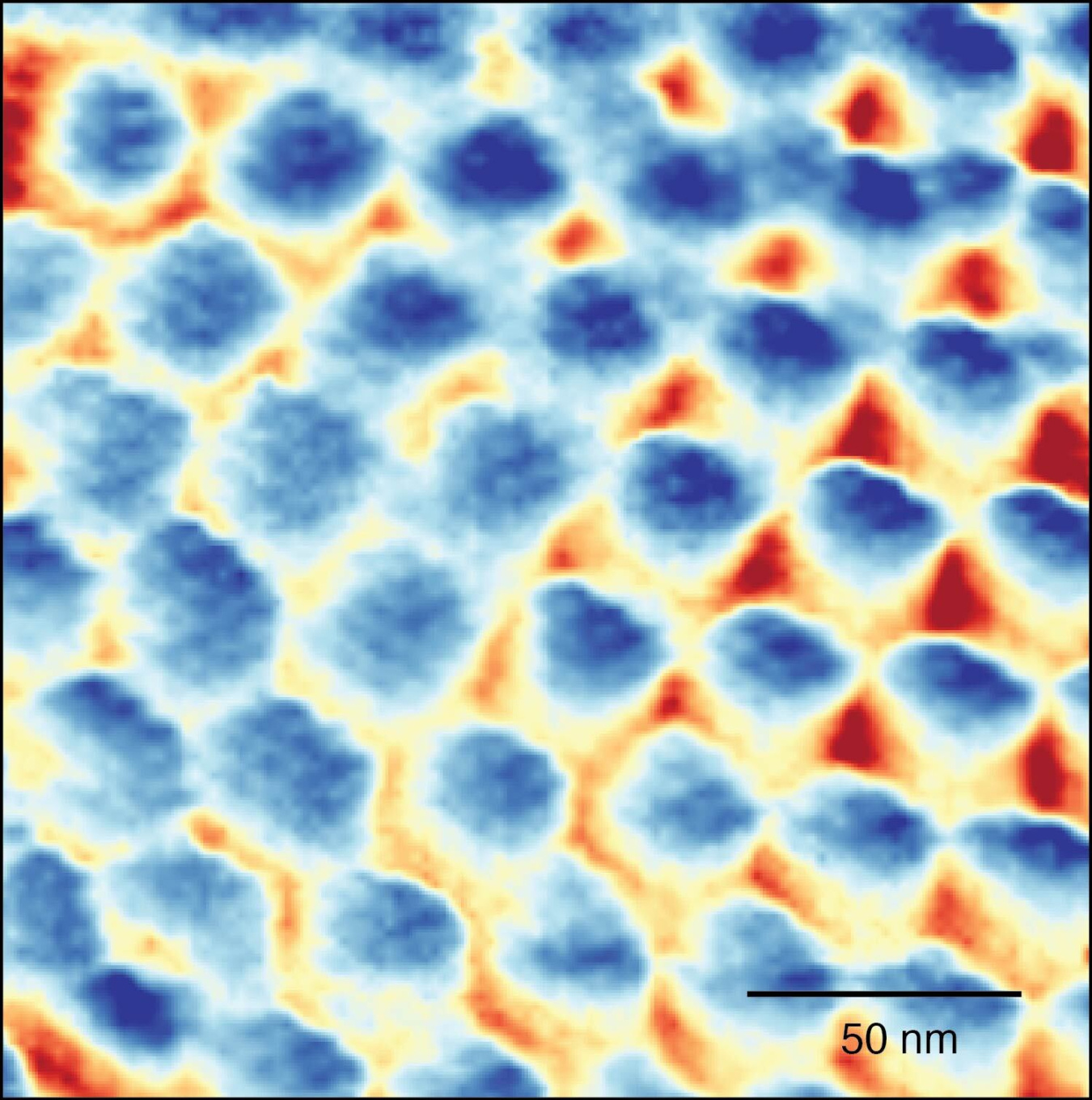
Crystals are a phase of matter with a periodic structure of atoms. Materials with a periodic structure have repeated groups of atoms or other particles with regular gaps between each group. The bonds that form between the atoms provide attractive forces between them and stabilize the crystalline phase. In 1934, Eugene Wigner predicted the existence of a type of crystal that is made of only electrons. In these crystals, the structure would be made possible by the forces of repulsion between the electrons. Experimentalists have since found many indications of the existence of such crystals, but no direct evidence. This research directly imaged a magnetic-field-induced electron Wigner crystal in a material made of two atom-thick layers of graphene. The research also used high-resolution scanning tunnelling microscopy to examine how the crystal’s structural properties related to its electron density, magnetic field, and temperature.
The Impact
This research not only confirms a 90-year-old theory, but it also demonstrates a technique for examining exotic and fragile phases of electrons. This technique allows researchers to visualize electrons at extremely small length scales of less than a billionth of a meter. At these scales, quantum mechanics dictate the electrons’ behavior. This ability opens the door to studying and verifying phases of matter in which electrons can organize themselves spontaneously.
Summary
In 1934, the physicist Eugene Wigner predicted the existence of a crystal made of only electrons, where the forces are repulsive. Using a scanning tunneling microscope, researchers have revealed the first images of the Wigner crystal on a graphene bilayer under a strong, perpendicular magnetic field. Graphene provided a clean environment and enhanced the interaction between the electrons within. The magnetic field slowed down the electrons, so that their movements were dominated by the interaction energy instead of the kinetic energy. This immobilized the electrons, with any movement creating a large energy penalty.
Studying the frozen electrons, researchers found that the stable structure of the crystal is a triangular lattice, and the lattice parameter can be tuned continuously as the number of electrons increases. This also demonstrated that electrons can provide tunable potential with different periodicities. Closer inspection of a single cell of the crystal revealed that the localized electron possesses zero-point motion, a phenomenon that exists only in the quantum world. The researchers also studied quantum phase transitions. Decreasing the strength of the magnetic field surprisingly led to emergence of a stripe phase, where electrons are organized into periodic, one-dimensional stripes. The direct observation of a quantum crystal opens the door to visualizing other, more exotic phases of interacting electrons.
Contact
Ali Yazdani
Princeton University
yazdani@princeton.edu
Funding
This work was primarily supported by the Department of Energy Office of Science, Basic Energy Sciences program and by the Gordon and Betty Moore Foundation’s Emergent Phenomena in Quantum Systems Initiative.
Publications
Tsui, Y.C., et al., Direct observation of a magnetic-field-induced Wigner crystal. Nature 628, 287–292 (2024). [DOI: 10.1038/s41586-024-07212-7]
Related Links
A quantum solid made of electrons: observing the elusive Wigner crystal, Nature Research Briefing
Quantum crystal of frozen electrons—the Wigner crystal—is visualized for the first time, Princeton University Office of the Dean for Research News
Physicists finally capture mysterious Wigner crystal after 90 years, Science Alert