The SciDAC program has long supported research teams that are using the DOE’s cutting-edge computers to solve urgent problems in science.
January 28, 2026 Estimated Read Time min
Shannon Brescher Shea

Shannon Brescher Shea (shannon.shea@science.doe.gov) is the social media manager and senior writer/editor in the Office of Science’s Office of Communications and Public Affairs. She writes and curates content for the Office of Science’s Twitter and LinkedIn accounts as well as contributes to the Department of Energy’s overall social media accounts. In addition, she writes and edits feature stories covering the Office of Science’s discovery research and manages the Science Public Outreach Community (SPOC). Previously, she was a communications specialist in the Vehicle Technologies Office in the Office of Energy Efficiency and Renewable Energy. She began at the Energy Department in 2008 as a Presidential Management Fellow. In her free time, she enjoys bicycling, gardening, writing, volunteering, and parenting two awesome kids.
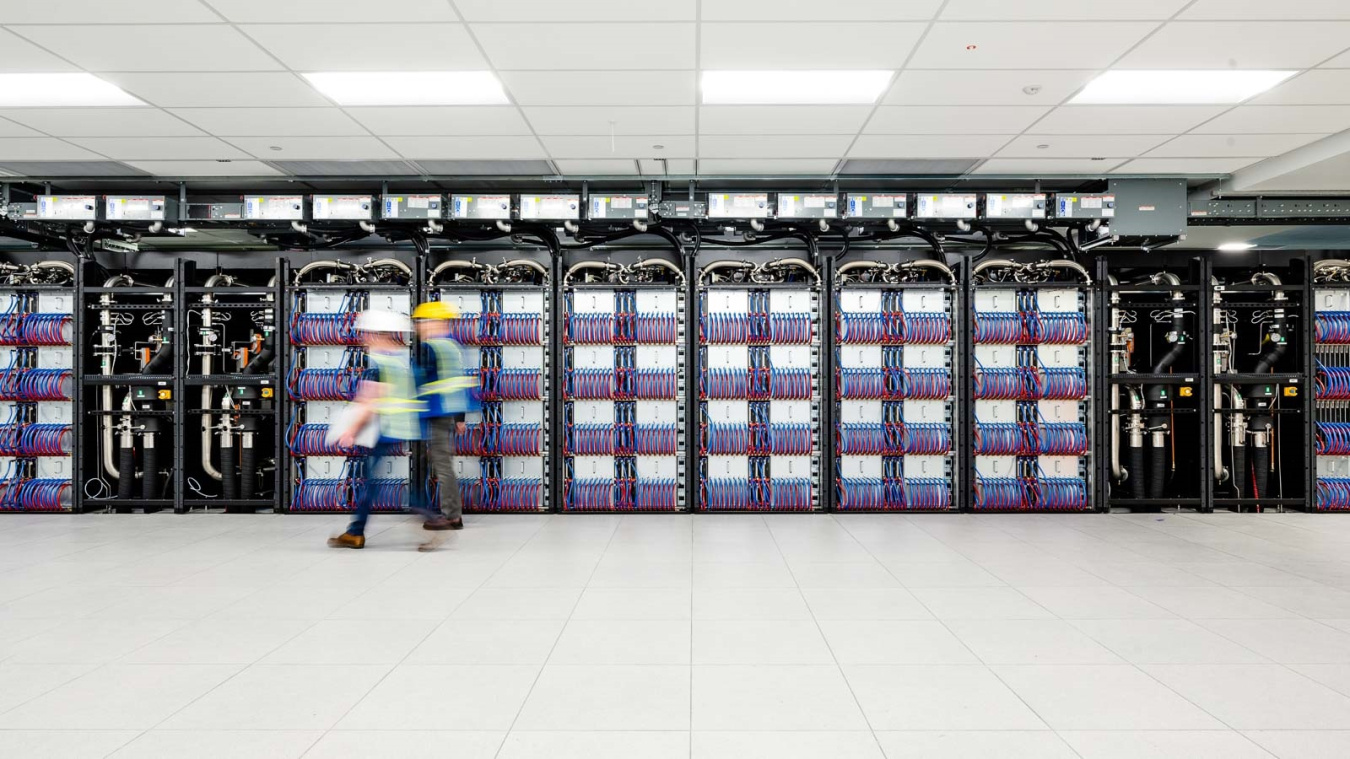
Rows and rows of computer banks stretch into the distance, filling a huge warehouse-like room. Cooling systems hum, creating a constant background buzz. Colorful murals unfurl across the cabinets, portraying scientific symbols and figures. The computers’ names even evoke greatness: Frontier, Aurora, Perlmutter.
Ever since computers came on the scientific scene in the 1950s, computing has been essential to research. The agencies that served as predecessors to the Department of Energy (DOE) played a key role in establishing networks used around the world today. Researchers and engineers who work on the supercomputers at DOE’s National Laboratories now continue that tradition.
While the computers are a tremendous accomplishment, their real value lies in the science they support. For over two decades, the DOE Office of Science’s Scientific Discovery Through Advanced Computing (SciDAC) program has brought together diverse experts to tackle scientific challenges for the DOE mission. These challenges span the full Office of Science portfolio as well as the DOE Office of Nuclear Energy. Participating experts include physical scientists, mathematicians, computer scientists, and computational scientists.
Together, they develop the necessary software, algorithms, and infrastructure to use supercomputing architectures for groundbreaking research. Leveraging the DOE’s world-leading, high-performance computing capabilities, the SciDAC program has enabled discoveries that would otherwise be impossible.
What is supercomputing?
Supercomputing – also known as high-performance computing – uses incredibly powerful digital computer systems. The systems are made up of multiple computers working in parallel at the same time. They use specialized hardware and software that is designed to handle large amounts of complex data.
An exascale computer is an exceptional supercomputer that can perform 1 exaFLOP (floating point operation), or a billion billion calculations per second. It would take every person in the world completing a math problem each second over the course of five years to do what an exascale computer can do in one second.
Supercomputers allow scientists to do research that they wouldn’t be able to do otherwise. These computers can run simulations of phenomena that are too big, small, dangerous, or fast to observe. They can process tremendous amounts of data beyond other computers’ capabilities. Researchers are using supercomputers networked to other instruments like X-ray light sources to receive and analyze data from those instruments in real time.
Leveraging advanced computing
As of November 2025, the DOE currently manages the three most powerful computers in the world, according to the Top500 list. All three are exascale computers. These are El Capitan at Lawrence Livermore National Laboratory, Frontier at the Oak Ridge Leadership Computing Facility (OLCF), and Aurora at the Argonne Leadership Computing Facility (ALCF). (OLCF and ALCF are both DOE Office of Science User Facilities.) Along with OLCF and ALCF, SciDAC also partners with the National Energy Research Scientific Computing Center (NERSC) at DOE’s Lawrence Berkeley National Laboratory.
With the power of these and previous DOE supercomputers, the SciDAC program has led to transformative scientific discoveries. The program began in 2001 to develop the software and hardware needed for research in the Office of Science’s focus areas. Later, the program expanded to include projects from the Office of Nuclear Energy and Office of Electricity. Now, SciDAC is an international leader in supercomputing for scientific research.
Past SciDAC projects have spanned a huge number of areas. Cosmologists have run simulations of the universe to investigate dark matter and dark energy. Physicists have studied the way the ions in plasma in fusion move. This work will help them develop better fusion devices. By studying the nuclei in atoms, nuclear physicists have advanced our understanding of the building blocks of matter. In addition to providing answers to domain-specific questions, these projects have also advanced fundamental knowledge in mathematics and computer science.
These accomplishments are only possible because SciDAC brings together scientists across disciplines. Teams collaborate to solve interdisciplinary problems that a single group wouldn’t be able to tackle alone.
The future of discovery
SciDAC is continuing this long history with two new funding selections.
DOE’s Office of Science is providing $78.8 million to establish three SciDAC institutes. Large multi-disciplinary and multi-institutional teams will run them to support the SciDAC partnership across the Office of Science programs and beyond. They have the goal of addressing problems related to DOE’s mission. Each institute is headed by a DOE National Laboratory.
The second selection provides $47.6 million for five projects that will improve advanced computing for basic energy sciences. The teams on these projects will develop high performance algorithms and software. These projects will support discoveries in fields relevant to energy research, including chemical and materials sciences.
In addition to these new selections, other SciDAC partnership projects are ongoing. They will go through re-competition in future funding cycles.
Harnessing the immense power of supercomputing, we've already unlocked incredible scientific discoveries. Now, these SciDAC institutes and partnership projects are poised to enable the next wave of innovation and breakthroughs.