Over the past year, DOE’s Office of Science has made major advances in a variety of scientific areas.
December 18, 2025 Estimated Read Time min
Shannon Brescher Shea

Shannon Brescher Shea (shannon.shea@science.doe.gov) is the social media manager and senior writer/editor in the Office of Science’s Office of Communications and Public Affairs. She writes and curates content for the Office of Science’s Twitter and LinkedIn accounts as well as contributes to the Department of Energy’s overall social media accounts. In addition, she writes and edits feature stories covering the Office of Science’s discovery research and manages the Science Public Outreach Community (SPOC). Previously, she was a communications specialist in the Vehicle Technologies Office in the Office of Energy Efficiency and Renewable Energy. She began at the Energy Department in 2008 as a Presidential Management Fellow. In her free time, she enjoys bicycling, gardening, writing, volunteering, and parenting two awesome kids.
For the Department of Energy’s (DOE) Office of Science, 2025 was a year of unveiling scientific instruments and developing plans for future discoveries. From quantum to fusion, researchers supported by the DOE Office of Science made major advances across discovery science.
Pursuing artificial intelligence for research
While artificial intelligence (AI) has influenced research for quite a while, 2025 was its biggest year yet.
DOE kicked off the surge with the “1,000 Scientist AI Jam.” This was a collaboration hosted by nine of DOE’s National Laboratories with OpenAI. More than 1,500 participants explored how AI can make their research more effective and efficient. Not long after, the National Laboratory directors got in on the action. They explored new tools and expanded their understanding of AI’s potential impact.
But the biggest news of 2025 in AI was the announcement of the Genesis Mission. Launched by a Presidential Executive Order, the Genesis Mission will connect AI, DOE’s supercomputers, massive data sets, and DOE’s User Facilities in a platform for science. Its goal is to double the productivity and impact of science and engineering in America over the next decade. To do so, it will focus on challenges in three areas: energy, discovery science, and national security.
Building better supercomputers
AI relies on computing power. Fortunately, DOE brought that in droves.
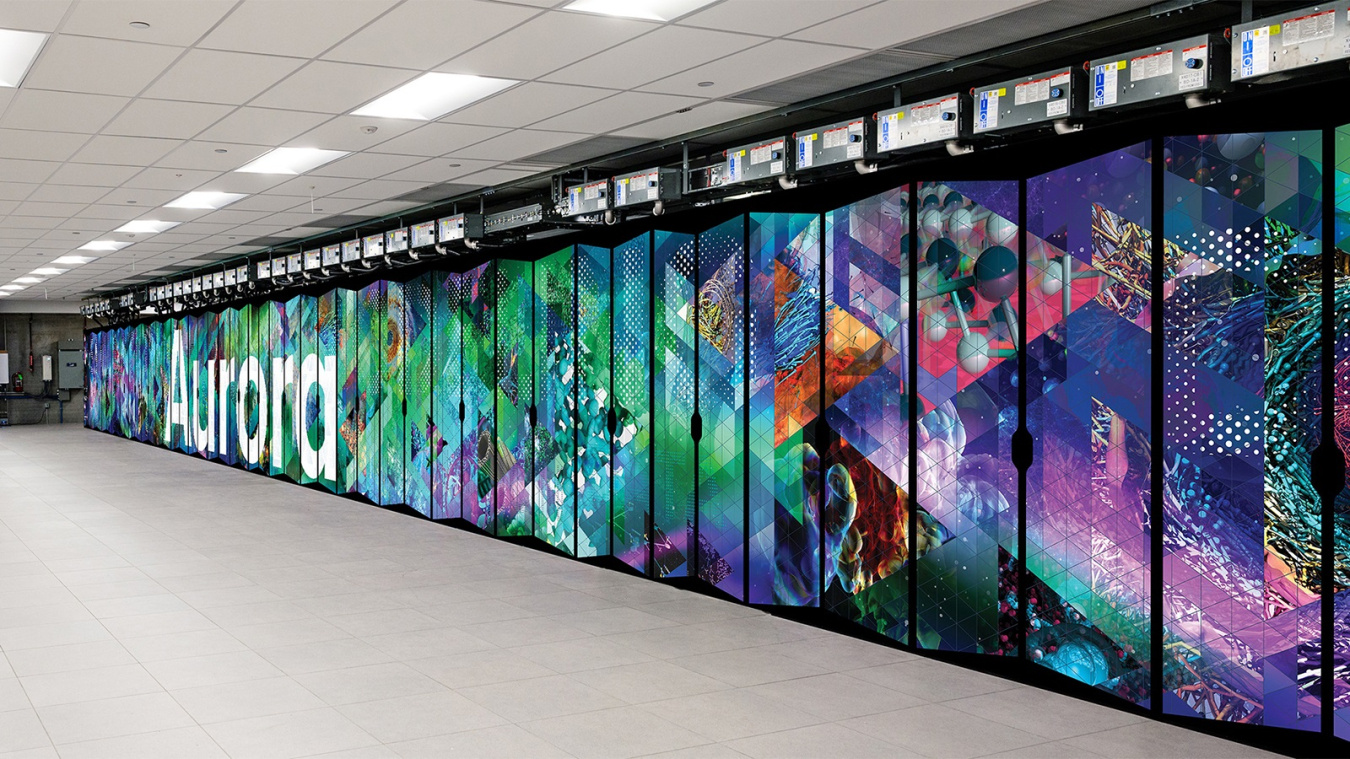
At the beginning of 2025, DOE debuted its newest computer – Aurora at the Argonne Leadership Computing Facility (ALCF, an Office of Science User Facility). This computer became available to the scientific community, giving scientists around the world the opportunity to use it. As an exascale computer, Aurora can conduct more than a billion billion calculations per second.
Over the course of the year, DOE also announced a triple threat of upgrades to our computing facilities. In the spring, the National Energy Research Scientific Computing Center (NERSC, a DOE Office of Science User Facility) announced a new system due in 2026. This system will be named after Jennifer Doudna, the Nobel Prize-winning biochemist at DOE’s Lawrence Berkeley National Laboratory. Doudna will provide more than 10 times the performance of the center’s current flagship computer.
Fall arrived with a double announcement of new systems at ALCF and Oak Ridge Leadership Computing Facility (OLCF), both DOE Office of Science User Facilities.
OLCF is now in the process of developing Discovery and LUX. While Discovery is following the standard process for supercomputer development, LUX will be built under a new type of partnership. This new type of partnership will bring LUX’s capacity online much faster than current processes.
At Argonne, the Solstice and Equinox systems will also expand DOE’s computing power. The Solstice system will be the largest AI supercomputer in the DOE’s National Laboratory complex. Like LUX, the Equinox system is leveraging a new type of public-private partnership to accelerate the delivery process.
DOE also celebrated the accomplishments of our current computers. A team of researchers from DOE’s Lawrence Livermore National Laboratory, University of Texas at Austin, and their partners received the 2025 Association for Computing Machinery Gordon Bell Prize for work they ran at NERSC. Their research created a “digital twin” (a computer replica of a real-life object) that allows scientists to better forecast when tsunamis may occur.
Gaining Nobel Prizes
This year, the DOE Office of Science was proud to have supported the research of four 2025 Nobel Prize winners.
In physics, John Clarke, a former senior scientist at Berkeley Lab, Michel Devoret at Yale University, and John M. Martinis at University of California, Santa Barbara were recognized for their work in quantum science. While scientists usually observe quantum mechanical properties at extraordinarily small scales, their research showed that scientists could observe these effects in a system big enough to hold in your hand. Their work on quantum effects in superconductors was supported by DOE’s Office of Science. It set the foundation for advances in quantum computers, cryptography, and sensors. All three worked on Clarke’s team at Berkeley Lab when they conducted the Nobel Prize-winning research.
In chemistry, Omar M. Yaghi at University of California, Berkeley was awarded the Nobel Prize for his research on metal-organic frameworks. (He shared the prize with Susumu Kitagawa of Japan and Richard Robson of Australia.) Because of this research, metal-organic frameworks (MOFs) now provide chemists with a powerful tool to facilitate and manage chemical reactions. MOFs can separate pollutants from water, capture water in deserts, and hold reactive gases. To date, chemists have developed tens of thousands of different MOFs.
Renewing support for the DOE Quantum Information Science Research Centers
To continue the DOE Office of Science’s support for cutting-edge quantum research, we recently announced $625 million in funding to renew the five National QIS Research Centers. These centers will focus on strengthening the quantum innovation ecosystem, accelerating next-generation technologies, and securing leadership in quantum computing, hardware, and applications. Nobel Prize-winners Devoret and Martinis are associated with two different centers.
Exploring the depths of the universe
Why the universe is expanding ever more quickly is one of the major questions in physics. Projects supported by the DOE’s Office of Science are shining light on this phenomenon, known as “dark energy.”
In March, the research teams on the Dark Energy Survey and Dark Energy Spectroscopic Instrument announced evidence that the prevailing model explaining dark energy may be wrong. Previous theories assumed dark energy was static and unchanging. These results suggested that dark energy and how the universe expands may have evolved over time.
In the first half of the year, the Office of Science also celebrated the unveiling of the first images from the NSF-DOE Vera C. Rubin Observatory. Funded by both DOE and the National Science Foundation, the Rubin Observatory is revolutionizing how we explore the cosmos. Following the installation of the world’s largest digital camera, the Observatory team released its first images in June. The First Look celebration revealed initial imagery from the Observatory’s massive ultrawide, ultra-high-definition time-lapse record of the universe. The images received coverage in the New York Times, the Washington Post, the Today Show, and more. The Rubin Observatory is now preparing for the Legacy Survey of Space and Time, a 10-year project to scan the Southern Sky.
Moving forward on fusion
As a long-time leader in fusion research, the DOE Office of Science forged new ground in 2025. As the process that powers the sun, fusion could potentially offer a reliable source of energy in the future.
In June, DOE’s Princeton Plasma Physics Laboratory unveiled the Facility for Laboratory Reconnection Experiments (FLARE). FLARE allows researchers to study magnetic reconnection. This phenomenon both causes solar flares and disruptions inside of fusion devices called tokamaks. The data from this experiment will help scientists better understand astrophysics and the best ways to operate fusion devices.
This fall, the DOE released its Fusion Science and Technology Roadmap. The roadmap is a national strategy to accelerate the development and commercialization of fusion energy. It identifies the key research, materials, and technology gaps that must be addressed to build a fusion pilot plant. The roadmap is aimed at helping the fusion community – government agencies, universities, and private industry – coordinate efforts towards a common goal. It incorporates input from more than 600 scientists, engineers, and industry thought-leaders.
With 2025 behind us, the DOE’s Office of Science looks forward to the discoveries and advances that 2026 may bring.