



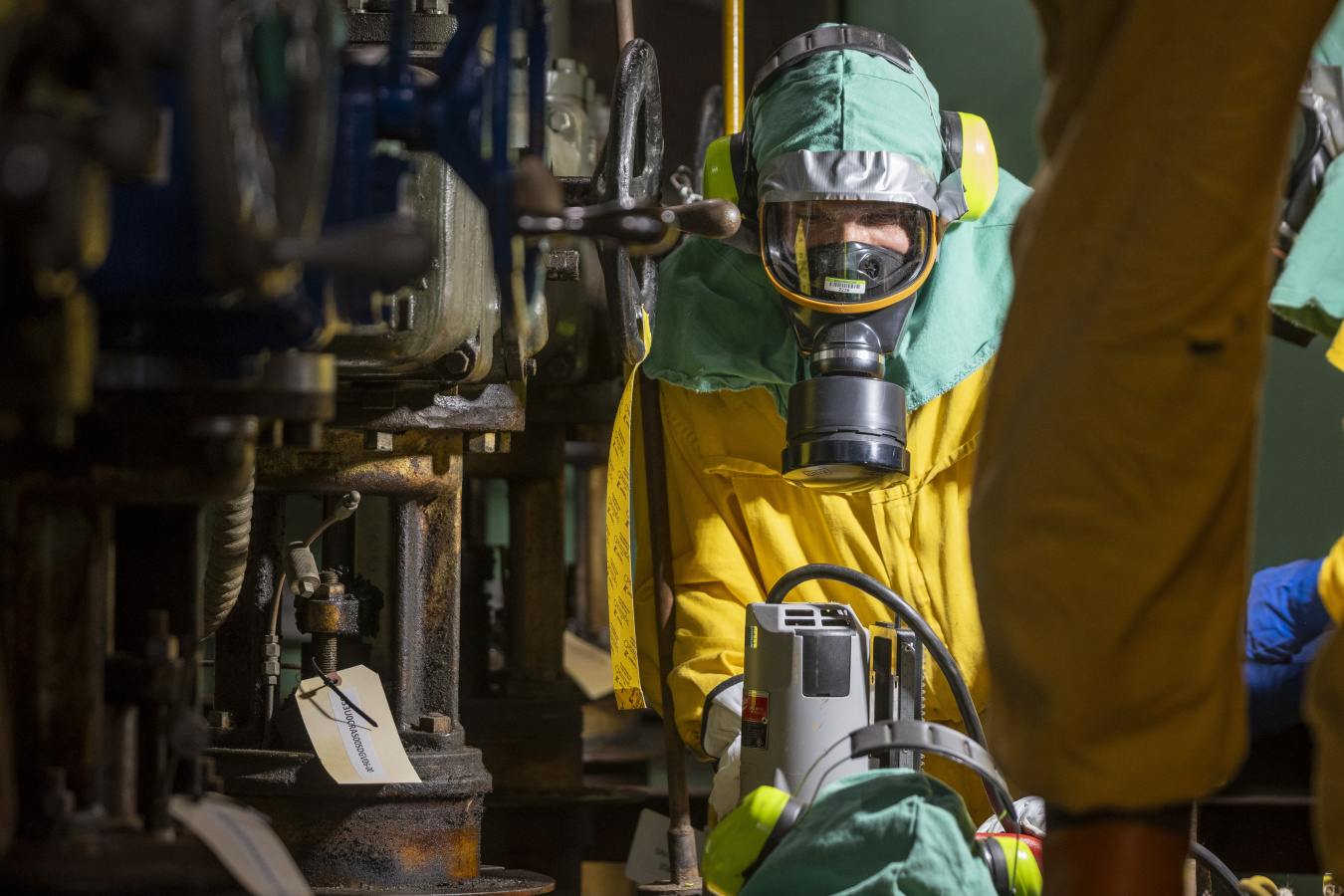
In May 2013, the United States Enrichment Corporation (USEC), a publicly held company that had leased the Paducah Gaseous Diffusion Plant (PGDP) facilities for enrichment operations for the 20 years following the Energy Policy Act of 1992, made the decision to cease enrichment and returned the leased facilities to DOE. DOE and USEC completed the transition and return of the sites process buildings and other facilities in October 2014. Since deactivation activities began, optimization of the site's infrastructure, such as the consolidation of the site’s four switchyards and replacement of its large coal-fired steam plant, continues to ensure the changing needs of the site are being met while reducing future operations and maintenance costs.
When deactivating a process building, there are key priorities Paducah follows. Protecting the workforce, public and environment are the main focuses. The Paducah Site complies with regulations and requirements and allocates decommissioning work to reduce risk. In addition, fulfilling commitments to stakeholders and facilitating low-cost surveillance and maintenance after a facility is deactivated is essential.


Paducah Cleanup Progress
Since the return of the Paducah Gaseous Diffusion Plant facilities to DOE in October 2014 after 20 years of private operation, the DOE has been able to establish a fully integrated baseline or forecast of time and resources that will be required for the site to be fully remediated. Cleanup of the Paducah Gaseous Diffusion Plant site is anticipated to be completed in 2065 at an approximate total cost of $17 billion.
After the final converter in the C-333 Process Building was segmented in January 2026, crews turned their attention to deactivation activities in the C-337 Process Building. In addition, the highly trained and qualified workforce continues deactivation and remediation activities in other areas of the site to ensure stable operations and continued cost reductions through utility optimization and elimination of maintenance.
Working with the U.S. Environmental Protection Agency and state of Kentucky, the Paducah Site is advancing a holistic approach called Decision 2029, that's consolidating regulator cleanup decisions, allowing for accelerated cleanup and freeing up land at the site for future use as quickly as possible.
Deactivation of the C-333 Process Building began in 2019. In preparation for demolition, nearly 500 pieces of large process gas equipment called converters were downsized in the Material-Sizing Area. This was completed in early 2026. The MSA was specifically constructed to complete segmentation, analyze non-destructive assay measurements and downsize materials safely.
Deactivation of the C-337 Process Building began in 2025. Crews are using lessons learned from the C-333 Process Building to help guide deactivation activities in the facility. As of April 2026, crews continue to remove structural and infrastructure interference to support continued deactivation activities. Crews are also focused on converter/compressor disconnection and wet air passivation.
The Paducah Site is home to one of the largest groundwater contamination plumes in the entire Environmental Management complex, although its size and off-site migration have been significantly reduced and/or reversed over the past three decades. The key source of the groundwater contamination plume, trichlorethylene, or TCE, originates from the former C-400 Cleaning Building. To further reduce the northwest plume centroid, a Centralized Watse Water Treatment will be installed. PPPO’s Decision 2029 is intended to result in a more holistic approach for tackling groundwater contamination and accelerating necessary decision making.
Recent optimization of the Northeast Plume Pump-and-Treat system included the installation of two new extraction wells, fourteen monitoring wells, eight wells to measure water levels and a new treatment unit.
R-114 is to support uranium enrichment operations. The Paducah Site continues activities to remove and dispose of R-114 refrigerant, which not only eliminates hazardous materials but also provides environmental benefits equivalent to the removal of thousands of vehicles off the road by eliminating a known greenhouse gas. Approximately 2.5 million pounds of refrigerant remain at Paducah as PPPO works to eliminate this ozone-depleting greenhouse gas in the near future.
PPPO continues to work with federal and state regulators on a Record of Decision (ROD) to make a final waste disposal decision in Paducah. This effort is currently in the investigation and design phase to support a final ROD by 2029. The site conducted field investigations that began in 2024 and concluded in early 2026 to confirm the feasibility of a representative location for a potential On-Site Waste Disposal Facility. If approved, the site aims for first waste placement by 2032.
By the Numbers
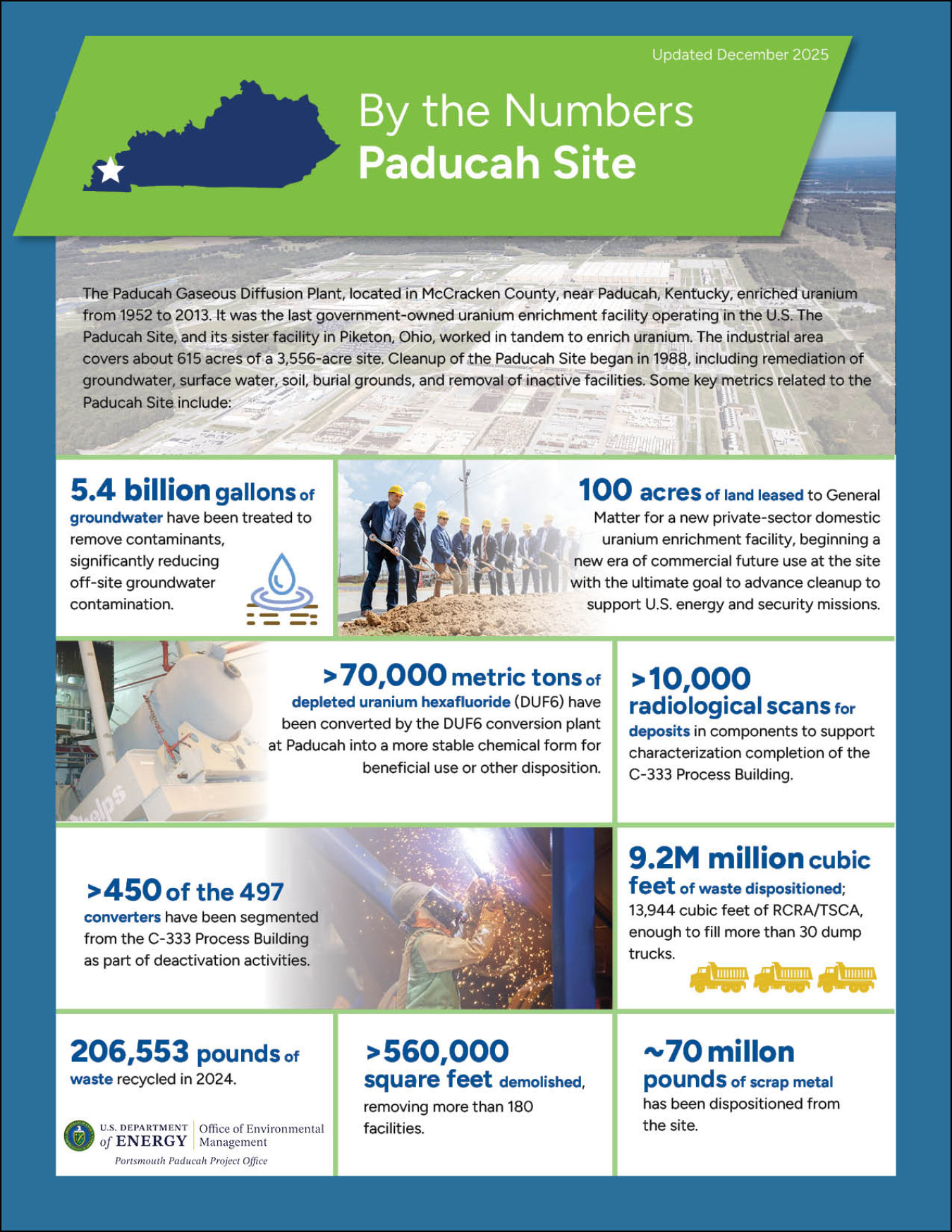
From square feet of buildings demolished to gallons of groundwater treated and more, check out By the Numbers for the Paducah Site.