



Leaders from the U.S. Department of Energy’s offices of Environmental Management and Nuclear Energy, Savannah River National Laboratory and the companies EnergySolutions and Orano discussed how government, industry and national laboratories can work together to advance recycling, strengthen domestic nuclear capabilities and tackle long-term waste challenges.
Office of Environmental Management
September 22, 2026 Estimated Read Time min
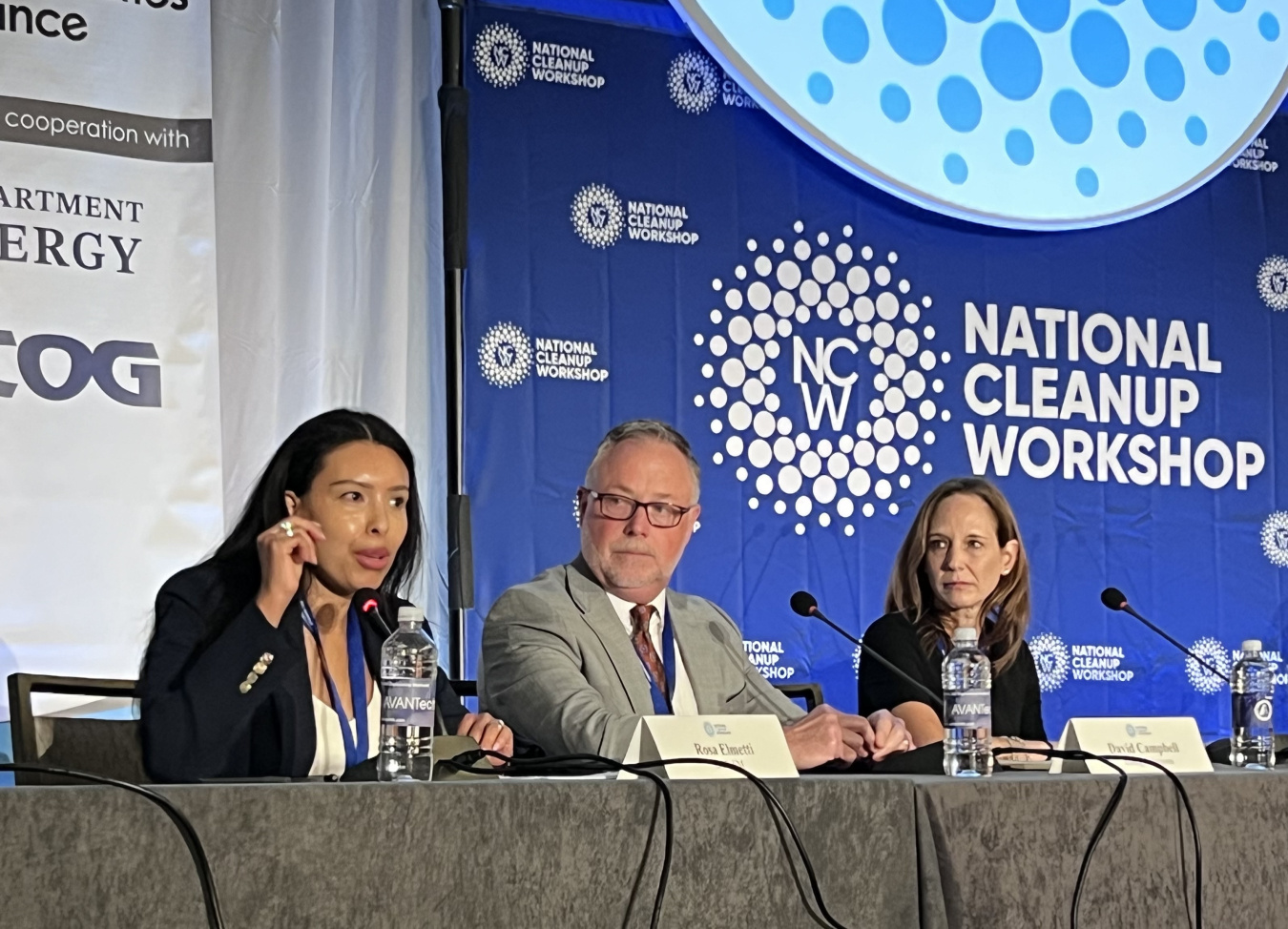
Panelists included, from left, Rosa Elmetti, lead federal program manager for nuclear materials and used nuclear fuel, U.S. Department of Energy Office of Environmental Management Office of Nuclear Materials; David Campbell, executive vice president, EnergySolutions; and panel moderator Kara Colton, director, Nuclear Energy Programs, Energy Communities Alliance.
ARLINGTON, Va. — Leaders from the U.S. Department of Energy’s (DOE) offices of Environmental Management (EM) and Nuclear Energy, Savannah River National Laboratory and the companies EnergySolutions and Orano discussed how government, industry and national laboratories can work together to advance recycling, strengthen domestic nuclear capabilities and tackle long-term waste challenges during a National Cleanup Workshop panel on Nuclear Lifecycle Innovation Campuses and the back end of the nuclear fuel cycle.
Rosa Elmetti, EM’s lead federal program manager for nuclear materials and used nuclear fuel, challenged the audience to think differently about DOE’s legacy inventories — not simply as liabilities to manage, but as strategic assets with value waiting to be unlocked.
“The back end does not have to be the end,” Elmetti said. “It can be where America’s next nuclear chapter begins.”
Elmetti highlighted EM’s work to advance next-generation recycling and conditioning capabilities to address challenging used fuels, recover uranium, strategic materials and valuable isotopes, and design smarter disposal into the process from the beginning.
“Recover the value. Put resources back to work. Optimize what remains,” Elmetti said. “That’s how cleanup becomes an enabler.”
The message from the panel was clear: The science exists, industry is ready to innovate and DOE brings materials, facilities and decades of experience to the table. The opportunity now is to turn that momentum into capability.
“The pieces are on the table,” Elmetti said. “Now it’s time to put them together — and build.”
To receive the latest news and updates about the Office of Environmental Management, submit your e-mail address.