The U.S. Department of Energy’s Office of Electricity (OE) is working to develop technical solutions, issue best practices, and strengthen coordination among utilities, national labs, and government agencies to prevent grid-related wildfire ignitions.
August 4, 2026 Estimated Read Time min
Anne Egger
Anne Egger is a Senior Project Manager in the U.S. Department of Energy’s Office of Electricity, where she helps lead the Grid Resilience and Innovation Partnerships (GRIP) Program and the Speed to Power through Accelerated Reconductoring and other Key Advanced Transmission Technology Upgrades (SPARK) initiative. She also manages technical assistance efforts that support the deployment of advanced transmission and grid modernization technologies to improve the reliability, resilience, and capacity of the nation’s electric grid.
Prior to joining the Department of Energy, Anne held engineering and planning roles at multiple electric utilities, where she specialized in transmission and distribution planning, distribution engineering, and demand forecasting. She also served in the U.S. Air Force as an avionics systems technician.
Anne holds a Master of Business Administration from Louisiana State University Shreveport and a Bachelor of Science in Electrical Engineering from Southern Illinois University Edwardsville.

Wildfires leave devastating and costly effects on U.S. communities. We at the Office of Electricity in the U.S. Department of Energy (DOE) are working to develop technical solutions, issue best practices, and strengthen coordination among utilities, national labs, and government agencies to prevent grid-related wildfire ignitions.
OE pioneers innovations to advance a 21st century electric grid. We pursue research, development, and demonstration (RD&D) of grid technologies like advanced conductors, grid models, communications systems, situational awareness platforms, and risk management grid controls.
These investments give us a unique perspective of the electricity transmission system and ways to improve its operations, especially related to risk management.
We also recognize that wildfire mitigation not only involves utilities using new grid technologies, but also sharing their operational lessons learned and best practices with their industry peers. Planning also plays a key part, such as siting new generation closer to where it is consumed to reduce the transmission lines required to deliver that generation.
Collectively, the goal within the electric utility industry is to prevent devastating losses to communities from grid-caused fires and to ensure that the grid is itself resilient to wildfires so that power can be restored quickly in the aftermath.
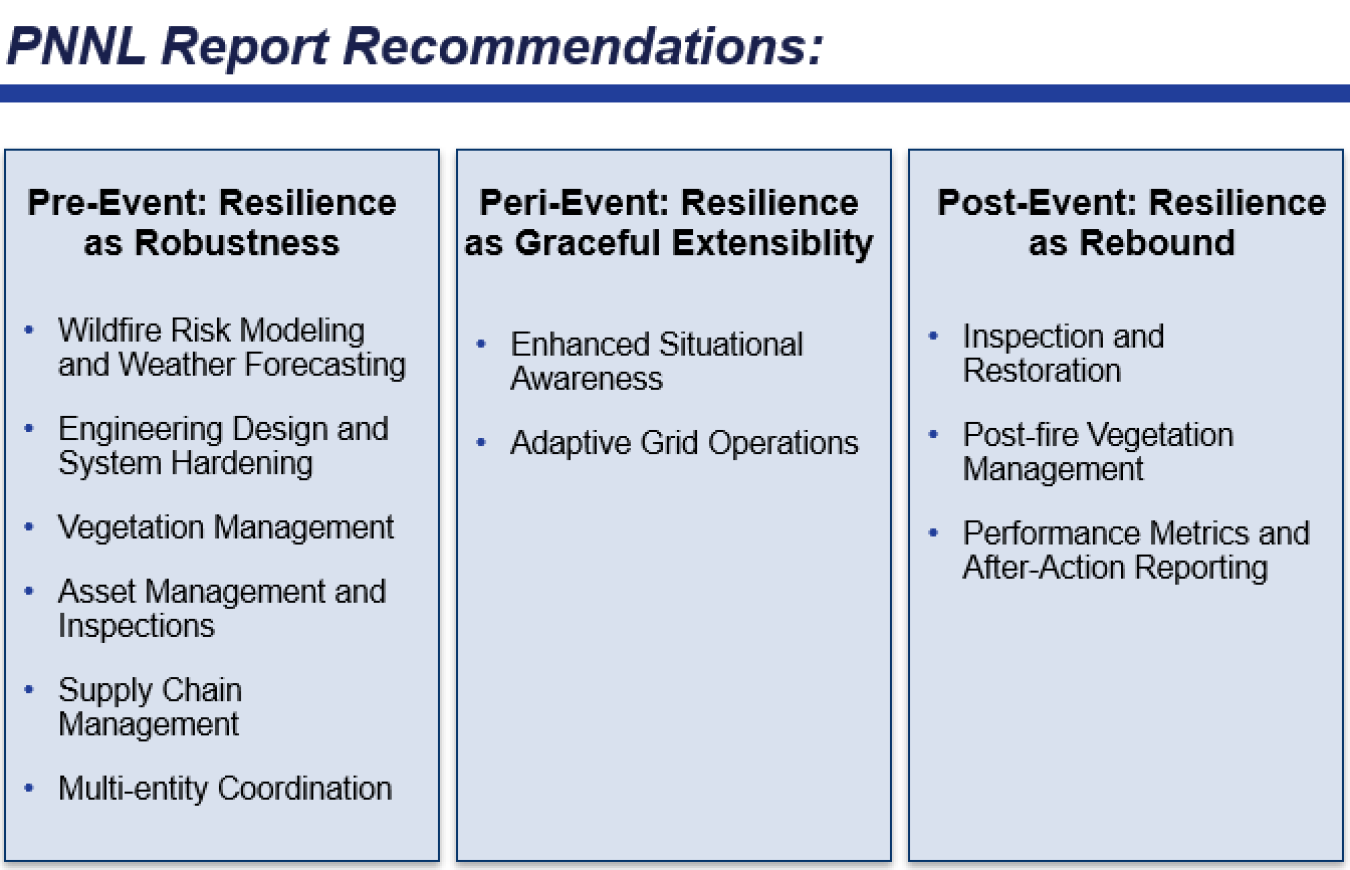
While utilities cause less than 3% of U.S. wildfire ignitions, burning 270,000 acres/year on average, wildfire-related costs and losses total up to $150 billion annually for the electric sector and can exceed $750 billion annually overall for U.S. public and private entities, according to the Pacific Northwest National Lab in its “Current Best Practices on Wildfire Risk Reduction” report funded by the Office of Electricity (See PNNL sidebar).
These costs include suppression, direct damage, economic losses, health impacts, and long-term recovery.
At DOE, we see the opportunity to encourage a coordinated risk management effort. It will require both policy and technical solutions working in concert. That was the objective of President Trump’s Executive Order, Empowering Commonsense Wildfire Prevention and Response, which directed federal agencies to consider establishing best practice regulations to reduce the risk of wildfire ignition from the electricity system. This role for governing authorities was emphasized in the North American Electric Reliability Corporation’s recent report entitled, “Reducing the Risk of Wildfire Ignition by the Bulk Power System.”
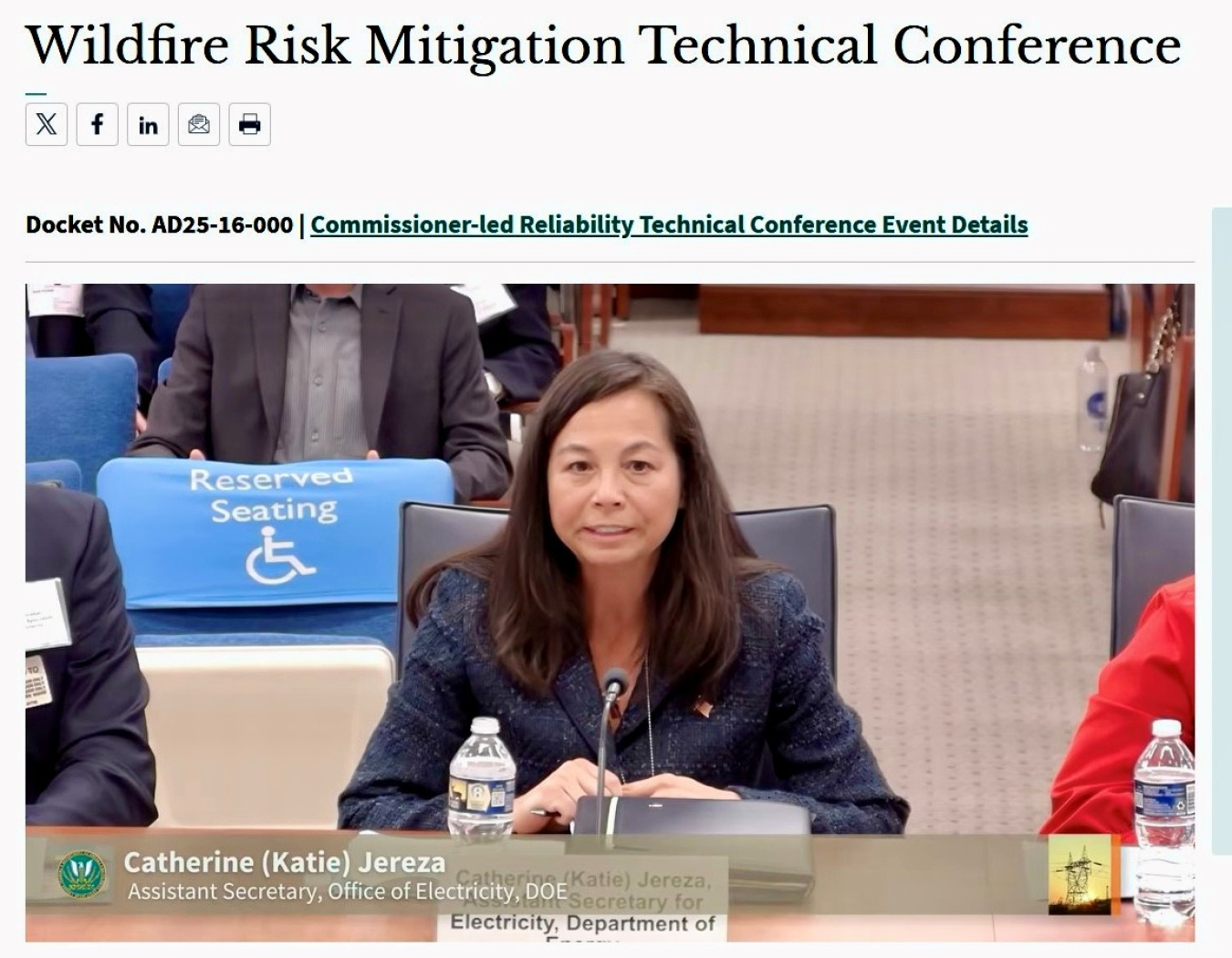
At the October 21, 2025 Federal Energy Regulatory Commission (FERC)’s Wildfire Mitigation Technical Conference, Office of Electricity Assistant Secretary Katie Jereza’s testimony focused specifically on the importance of addressing the risk based on three areas:
Federal, state, and local agencies and electric utilities can work together to reduce the likelihood of fire ignition or the wildfire impact to;
- manage vegetation
- implement consistent wildfire hazard modeling
- define high wildfire threat zones
- implement early wildfire detection systems; and
- conduct training exercises on incidents like downed or swaying conductor wire in high winds.
More coordination is also needed to reduce the likelihood of ignition. Also, state and federal regulators can aid in further promoting more effective and/or additional mitigation measures through Wildfire Mitigation Plan templates and sharing and helping implement best practice guides customized to the state or regional level.
Opportunities for better coordination include:
- Removing multi-agency barriers to completing risk mitigation work, such as environmental permitting times, delays to remove obvious hazardous vegetation, or resolving overlapping jurisdiction through rulemakings.
- Adding DOE as a National Interagency Fire Center partner to enhance collaboration and create cohesive policies for wildland firefighting, especially around the electricity system, which DOE operates through its Power Marketing Administrations.
OE also has a key role in ensuring best practices reduce the risk of wildfire ignition from the electric system and continuing to advance the R&D of grid technologies related to wildfire prevention and mitigation. This includes:
- Microgrids, sectionalizing, real-time monitoring tools, improved density of weather stations, and uncrewed aerial systems (drones) to minimize outages, outage duration, and the number of affected customers.
- Pre-event training exercises that enhance utility response times and reduce the time to action and improved coordination among incident management teams.
- Wildfire monitoring, progression, and forecasting data needs to be developed at a higher-cadence and shared among all parties (via common operating picture dashboards and common data access protocols).
- Dynamic line rating technology, which provides real-time monitoring of conductor temperature to understand the precise thermal and clearance limits of a transmission line under current weather conditions, which could prevent line sag leading to fault conditions or vegetation contact and ignition.
Remote sensing and AI/Machine Learning models, which report the vegetation state in relation to energy infrastructure. The input data can include the use of high-resolution satellite imaging, aircraft-collected LiDAR, and/or drone-based image collections.
Opportunities to improve wildfire hazard considerations in transmission planning include:
- The use of local wildfire risk models and risk-informed planning that consider historical conditions and 10- to- 20-year planning horizons.
- Use of a risk-adjusted cost-benefit analysis that uses risk models and evaluates a set of potential transmission routes and other factors.
- System planning and design for new transmission corridors so that one hazard event doesn’t take out critical lines servicing major load centers.
Use of an asset health index that combines observation data, models, and risk assessment to prioritize mitigation strategies.
A Coordinated DOE Approach
OE is committed to working with colleagues in other DOE offices, including the Office of Cybersecurity, Energy Security, and Emergency Response, and with utilities and other stakeholders on implementing best practices and responding to incidents.
If you would like to hear OE Assistant Secretary Katie Jereza’s testimony as well as testimony from others who participated in the conference, watch the recording on the FERC website.