How the Department of Energy’s support for basic research in 1985 set the foundation for today’s quantum technology.
July 28, 2026 Estimated Read Time min
Shannon Brescher Shea

Shannon Brescher Shea (shannon.shea@science.doe.gov) is the social media manager and senior writer/editor in the Office of Science’s Office of Communications and Public Affairs. She writes and curates content for the Office of Science’s Twitter and LinkedIn accounts as well as contributes to the Department of Energy’s overall social media accounts. In addition, she writes and edits feature stories covering the Office of Science’s discovery research and manages the Science Public Outreach Community (SPOC). Previously, she was a communications specialist in the Vehicle Technologies Office in the Office of Energy Efficiency and Renewable Energy. She began at the Energy Department in 2008 as a Presidential Management Fellow. In her free time, she enjoys bicycling, gardening, writing, volunteering, and parenting two awesome kids.
Electrons zipping through transistors, powering the screens on our smartphones. Light zooming from distant stars to Earth, moving faster than anything else in the universe. Protons enabling MRI machines to analyze people’s injuries.
Quantum mechanics explains the behavior of subatomic particles like electrons, photons, and protons. In contrast to classical physics that we can observe with our senses, particles in the quantum realm have unusual behaviors. Even though quantum particles make common technologies possible, we don’t experience these behaviors in our everyday world.
That’s why a discovery in 1985 was such a big deal. In a laboratory in the University of California, Berkeley, a team of three scientists showed that a system you could see could demonstrate quantum behavior. Or as they said in one of the journal articles covering the experiments, the system was “big enough to get one’s grubby fingers on.”
Four decades later, John Clarke, Michel Devoret, and John Martinis were awarded the Nobel Prize for that research. Over those four decades, quantum researchers have transformed what at the time seemed like an interesting discovery into a full-blown technological field. Building on that fundamental research supported by the Department of Energy’s Office of Science, scientists have turned superconducting qubits into one of the most promising approaches towards quantum computing.
Why quantum behavior?
As you may know, light can behave as both a wave and particle. That duality applies to all subatomic particles, including electrons. Quantum mechanics explains how this dual nature affects particles’ interactions. These have big implications for the classical world around us.
“Quantum mechanics was created to explain phenomena that seem to defy classical physics,” said Irfan Siddiqi, a professor at the University of California, Berkeley.
In a classical system – like a basketball moving through the air – there are many variables, such as position and velocity. These variables change over time, like the ball slowing down. However, each variable has a single, real value at any moment. By measuring the object’s original state, you can figure out where the ball will end up.
But this doesn’t work for quantum states. They don’t have specific, definite values at any time until they are measured. While the quantum particle starts in a unique state and changes according to the equations of motion, it doesn’t have a consistent end state. Scientists use probabilities to describe how likely it is to get any possible end state.
While there are many types of quantum behavior that are important for quantum technology, the Nobel Prize winning experiments focused on two: quantization and quantum tunneling in electrical circuits.
Quantization
Quantization is the idea that quantum particles have discreet, specific amounts of energy or momentum.
Think back to that basketball. It can have a range of possible energies as it moves toward the hoop, depending on how hard it’s thrown, the wind, and other factors. If we measured the basketball’s energy, we could use decimals to measure it.
But an electron can’t have this range of energy. Instead, it only has chunks of energy. We could only measure the electron’s energy levels in the quantum equivalent of whole numbers.
Quantum tunneling
Quantum tunneling is the ability of quantum particles to move through materials or energy levels that according to classical physics, they shouldn’t be able to.
Imagine a brick wall between the basketball and the hoop. There’s not enough energy to throw the basketball through the wall. Even if you threw a million basketballs, none of them would just appear on the other side of the wall.
But for quantum particles, some of them would make it through the barrier, whether a physical or energy one. There is a probability that some will show up on the other side.
Scientists first observed quantum tunneling in nature. Unstable nuclei demonstrate quantum tunneling as they break down. Fusion in the sun relies on it too. The temperature and pressure inside of the sun are too low for fusion to occur according to classical principles – yet it shines bright!
From quantum to classical
As bizarre as these effects seem, they make up the fabric of the world around us.
“In our classical world that we live in … everything is quantum mechanical,” said Yao Lu, an associate scientist at DOE’s Fermi National Accelerator Laboratory and the Superconducting Quantum Materials and Systems Center. “[But] we cannot really observe much in our day-to-day life of quantum behaviors.”
That’s because quantum effects are so fragile that the surrounding environment disturbs them. In addition, quantum effects in certain materials only happen at extremely cold temperatures. Earth’s warmer environment isn’t conducive to them.
“There’s a general rule in physics that the fundamental building blocks of physics are quantum mechanical [but] that by the time you can see it with your eye or touch it, that is all lost,” said Alicia Kollár, an assistant professor at the University of Maryland.
Being able to observe quantization and quantum tunneling on larger than quantum levels in 1985 provided real proof that quantum mechanics applies to bigger systems.
“What is the boundary between our classical world and quantum degrees of freedom?” said Lu. “That’s a very profound question.”
Josephson junctions and beyond
Before the Nobel Prize winning work, scientists had been working for decades to figure out the largest size system that would show these effects.
The first big step was in the 1960s. Superconducting materials move electricity without losing any of the energy to heat. In ordinary (non-superconducting) materials, electrons flow freely and push each other apart. It’s like a bunch of dancers bumping into each other as they each do their own thing. But when certain materials are cooled down enough, the electrons line up in pairs, like pairs of dancers circling around each other in a coordinated fashion. These pairs – called Cooper pairs – enable materials to be superconducting.
In 1962, physicist Brian Josephson proposed that these Cooper pairs could tunnel across an insulating barrier placed between superconductors. In this situation, the Cooper pairs would act as a single quantum unit. The first “Josephson junction” that sandwiched an insulator between two superconductors was developed only a year later.
From there, researchers theorized that they could design a Josephson junction that demonstrated quantum tunneling. By the 1980s, the hunt was on to show that scientists could demonstrate this phenomenon.
But none of the experiments were quite precise enough. In every attempt, an outside effect could potentially cause the change, not quantum tunneling.
Quantum tunneling in action
Enter the team of Clarke, Martinis, and Devoret.
Clarke had been working on superconductors for quite some time, with much of his research supported by the DOE Office of Basic Energy Research, the precursor of the DOE’s Office of Science. With his PhD student Martinis and postdoc Devoret, he decided to demonstrate quantum tunneling on a non-quantum scale. Supported by the Basic Energy Sciences program in the Office of Basic Energy Research, they developed an extraordinarily precise experiment.
“Those experiments that were done in the 80s were very difficult,” said Chuck Black, Deputy Associate Laboratory Director at DOE’s Brookhaven National Laboratory. “I have so much admiration for what that group has accomplished over many years and the quality and carefulness of the work.”
Starting with a Josephson junction, they created a small superconducting circuit. They then injected microwaves (the same type used to heat food) through wires to create a current. Using this current, they controlled and measured the circuit’s parameters.
As with the previous experiments, the system started with zero voltage. There was an energy barrier that prevented the superconducting electrons from moving across it.
To imagine this situation, think of a series of steps with a well at the bottom. The system starts with the electrons trapped in a well. Each stair represents an energy level. It requires a precise amount of energy to move up from one stair to the next. According to classical physics, particles should not be able to move up to the next step unless they have enough energy (thermal activation).
The team ensured that the current running through the system was lower than the amount the particle needed to escape. Therefore, the system should not have shown a voltage.
And yet it did! The system went from a zero to a non-zero voltage. This demonstrated that the charged particles tunneled through the energy barrier. Seeing trillions of particles collectively demonstrating a quantum behavior was completely new. In addition to tunneling, the superconducting electrons also acted in a quantized manner.
Unlike previous experiments, the team could prove that tunneling caused the change in voltage. They were able to eliminate almost all interference from the surrounding environment.
Many of their approaches set the stage for later advances in quantum research. The microwaves enabled precise control and special filters eliminated outside influences. The team even accounted for the smallest differences in heat, lowering the temperature of their experiment to -273.1 C.
“They really went through this heroic effort in really designing the experiments,” said Lu.
In the end, Clarke, Martinis, and Devoret declared that they had developed an artificial atom. Or in other words, they had laid out the essential ingredients of what physicists would come to call a qubit, the basic building block of quantum computers.
Moving from fundamental to applied science
The team’s discovery of quantum tunneling set the stage for decades of quantum research, although most people didn’t realize it at first. It wasn’t until the mid-1990s that people were seriously discussing quantum computation.
“It took some time for everyone to really understand what that discovery could make possible,” said Black. In fact, he did his PhD research in superconductors but didn’t anticipate studying them again once he took his first job.
Even though many people didn’t immediately recognize its significance, the landmark experiment shifted perspectives.
“[It] really took the picture of superconducting junctions in a sandwich and brought it from … something that was an esoteric, one-off effect to something that was really physical and manipulable,” said Nadya Mason, Dean of the University of Chicago Pritzker School of Molecular Engineering and quantum physicist.
Fundamentally, the experiment provided a bridge from merely observing quantum effects to potentially being able to control and use them. For the first time, a quantum system was large enough that scientists could potentially attach electronics to it.
For at least one early career researcher, the Nobel Prize had special significance. Jessica Tucker was in the middle of conducting her PhD research on superconducting qubits when the Nobel was announced.
“It actually undergirds what I’m doing today,” said Tucker, a quantum physicist and former intern at DOE’s Lawrence Livermore National Laboratory. “Seeing that recognized at a higher level … allows me to see how the lineage of my research is real and alive.”
The evolution of qubits
Qubits are the essential building blocks of quantum computers. They’re analogous to the digital bits that classical computers use to carry out binary operations.
However, qubits are very different from their classical cousins. Because of quantum physics, qubits have more than just the 1 and 0 options available for bits. Especially when they’re linked with other qubits, they have a huge number of possibilities. This radically increases the information they can process. Quantum computers have the potential to be much better than classical ones at certain problems, such as searching for catalysts and choosing the most efficient option among many.
Unfortunately, qubits are also far more sensitive to influences from the surrounding environment than bits. When a qubit’s quantum state is disturbed, it loses coherence – the ability to remain in a quantum state. It also loses the information it’s holding.
Figuring out how to maintain that coherence in a single qubit and then connecting qubits together is key to developing a quantum computer.
Referring to the first 25 years of qubit research, Black said, “The biggest advances in superconducting qubits through those years came from physics groups. And I say that with fondness, because I’m a physicist.”
By the 1990s, researchers had begun trying to create the first qubits. The earliest version only maintained its coherence for three nanoseconds – 3 billionths of a second. A decade later, the technology had come far enough along to improve how scientists were controlling and reading out qubits.
While the Nobel Prize-winning team used microwaves to add energy to qubits, a team from Yale University expanded the use of that technology. They started using microwaves to control and read out data instead.
Once again, classical science played a major supporting role. From his background in radio astronomy, Robert Schoelkopf brought expertise with microwaves and superconducting materials.
“We took a big step forward in 2004 when our Yale team introduced this concept called circuit QED (quantum electrodynamics),” he said. By reducing the amount of energy qubits lost to the environment, this approach vastly increased their potential lifetime.
By 2007, scientists were coupling together qubits that were not directly adjacent to each other. They were entangling them, which means linking them to share a common quantum state. With entanglement, anything that happens to one qubit affects the other. With this coupling, scientists could distribute information across qubits. If one lost coherence, others could make up for it.
“What allowed us to do it was advances in how stable the qubits could be,” said Schoelkopf.
By the late 2000s, researchers had developed the first electronic quantum processor. This was far more like a computer than had ever been developed before. Each qubit acted like a single atom despite being made up of millions of them. While the quantum state only lasted a microsecond, it was enough to start running simple computations.
Other scientists had started exploring how to tweak qubits’ designs, whether different types of Josephson junctions or the potential of 2D materials like graphene. In the latter research, the team found that when they sandwiched a normal conductor between superconductors, the normal conductor acted like a superconductor. Scientists had already known of this effect for a long time, but this was a new demonstration of it.
“What was exciting to me about that was that it was not just understanding. We have physical evidence of this state that had been proposed and assumed, but never shown,” said Mason.
As the science of qubits evolved, so did scientists’ understanding of them – much to their delight.
“Part of doing science is being comfortable with ‘Oh, I’m going to be wrong’,” said Angela Kou, an assistant professor at the University of Illinois Urbana-Champaign. “Often, surprises are the best thing because you learn the most information.”
Tackling decoherence
While early research focused on developing qubits’ basic structure, more recent research got into the nitty gritty.
“To actually make these things useful, you have to combine a lot of engineering science, fundamental physics, computer science,” said Kollár. “Can we do things in ways that are fundamentally better or fundamentally different constraints than we had before?”
One of the biggest challenges continues to be decoherence – losing the quantum state of a qubit. The longer the coherence time, the more operations a quantum computer can do. Decoherence occurs because an individual qubit falls out of its quantum state. A single qubit losing coherence can cause a domino effect on other qubits.
The most common cause of decoherence is energy loss. If a qubit loses just 0.1 percent of its energy to another mode, it can fail. Other sources include interference from natural radiation, cosmic rays, and heat.
Logically, the solution is to cut the qubit off from the surrounding environment. That would work fine – except for the fact that the quantum computers that qubits will be used in need electronics and controls. Scientists need to find the sweet spot between not enough and too much interaction between qubits and the environment.
“The fundamental challenge is to take this open quantum system and make it closed enough to do operations,” said Irfan Siddiqi, professor at University of California, Berkeley. “There’s no free lunch in quantum mechanics.”
Addressing material challenges
One of the major ways that researchers have reduced decoherence is by improving the materials in qubits. Defects in materials, including imperfections and unintended insulating layers, can be a major problem.
Some of this work has looked to improve long-used superconducting materials. The original 1985 tunneling study used niobium superconductors. Niobium is an excellent superconductor and can operate at higher temperatures than aluminum, another common material. However, it is difficult to engineer into qubits. In addition, niobium-based Josephson junctions have historically had shorter coherence times than those made of other materials.
In 2021, researchers at Princeton University worked with staff members at DOE’s Brookhaven National Laboratory to investigate how the properties of niobium affect coherence. They established a clear relationship between decoherence time and defects on the material’s surface. A later 2024 study combined niobium with other metals. Instead of a sandwich of two layers of niobium with a filling of niobium oxide, researchers at the Q-NEXT center (a DOE QIS Research Center) created something more like a club sandwich with several layers. By using both niobium and aluminum, they improved the coherence time to be 150 times better than its niobium predecessors.
Investigating tantalum layers
Other research has focused on trying new materials.
As Black pointed out, as brilliant as the Nobel Prize-winning team and later physicists were, they weren’t materials scientists. “If we think about classical computers, the first transistor discovered in Bell Labs was made of germanium, not from silicon. … We would never be where we were these days with electronics if we had stuck with germanium,” he said. “Clarke, Devoret and Martinis were using aluminum and niobium because … those are the archetypal superconductors. They were not chosen because someone was like, ‘I want to make a quantum computer.’”
The Co-design Center for Quantum Advantage (C2QA) – a DOE QIS Research Center directed by Black – is focused on finding the best materials for qubits. It brings together quantum physicists, materials scientists, and computer scientists from 28 institutions across the country. The Superconducting Quantum Materials and Systems Center – a DOE QIS Research Center led by DOE’s Fermilab – has also made major advances in materials for qubits.
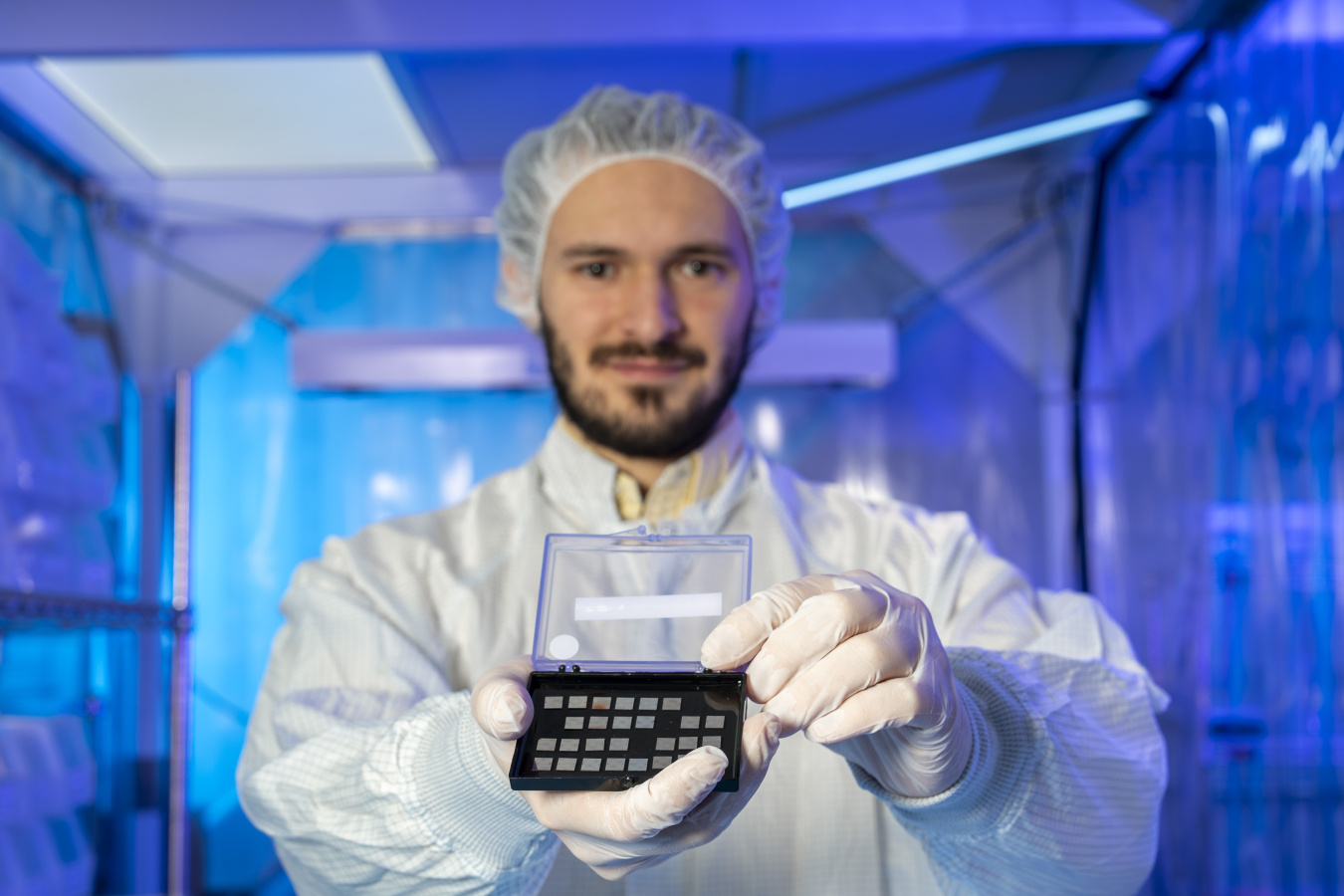
One of the big advances has been using tantalum. Tantalum is easier to work with, is more robust, is less reactive, has fewer defects, and can hold up better in processing than aluminum or niobium. As a result, tantalum qubits last more than five times longer than ones made from other materials.
A 2023 study investigated why tantalum was so effective. Supported by C2QA, scientists from Brookhaven and Princeton University grew thin films of tantalum on a sapphire base. They found that there was a thinner layer of tantalum oxide between the two tantalum layers of the sandwich compared to niobium. The layer forms when the qubit is exposed to air and the metal reacts with oxygen. This layer has a lot of defects that can cause decoherence.
A study the next year used computer simulations to better understand the interactions that lead to that filler layer. In their analysis, they found yet another layer! This suboxide layer had features of both the tantalum and the amphorous oxide.
A third study in 2025 dug into the chemistry and behavior of tantalum and found yet another layer! This one was between the tantalum and the substrate it grew on, not the two layers of tantalum.
These layers muck up the processes that keep qubits coherent. Or as Siddiqi said, “You can call it something fancy, but it’s quantum junk.”
Knowing that these layers were a barrier to improving coherence, scientists studied how to prevent them from forming. One approach was to protect the metal from oxygen. In a 2024 study by C2QA, the team added a layer of magnesium to the mix. Besides protecting the tantalum from oxygen, it also increased its purity and allowed it to be a superconductor at higher temperatures. While a very thin layer did form, it was a lot smaller and less disruptive than previous approaches.
Putting it all together
The latest jump forward has also been from C2QA, led by researchers from Princeton University. In fall 2025, the team built a superconducting qubit with a coherence time three times longer than the best previous versions. It lasted 15 times longer than the industry standard! To prove it worked, the team built a fully functioning quantum chip. Using these components in the best quantum processors that exist could make them run more than 1,000 times better.
These improvements came from holistically considering the materials challenges. By growing tantalum layers on silicon instead of sapphire, they reduced the layers of “quantum junk” and its impacts. As current electronics are based on silicon, silicon-based qubits are also much easier to produce. The team also minimized contamination that occurs during production.
Perhaps most importantly, these improvements didn’t require any major changes in qubit architecture. This design would be compatible with the most common processors in use today.
Describing the work done by C2QA, Black said, “It’s been this marriage of really good superconducting device people with really good materials scientists and premier facilities for doing materials science.”
Controlling the controls
Even if scientists resolve the materials issues, there are still plenty of challenges.
One of the major issues is that controlling a quantum system can destroy its quantum state. “The field is discovering that control is really a bottleneck,” said Tucker. She sees a lot of promise in using machine learning for closed-loop control of these systems. Machine learning would allow the system itself to inform the best way of running it rather than relying solely on a simulated model. "Real hardware always has imperfections that a simulation doesn't fully capture," she said. "When your optimization loop runs on the device, the hardware itself helps tell you what to correct."
The controls need to be fast and precise. To accomplish this, researchers have continued to draw on knowledge from high-frequency microwave engineering – a key field in classical engineering.
“Once we leveraged a lot of this established expertise that we can borrow from engineers in other fields, we’re able to achieve record-setting results,” said Lu.
Keeping an eye on error correction
Unfortunately, researchers will never be able to eliminate decoherence. That’s where error correction comes in. By pinpointing where the qubit has lost information, computer scientists can fix it as it happens.
Of course, it’s never that easy in quantum computing. In fact, fixing an error can cause more errors. It’s likely that simply correcting errors will take up most of a useful quantum computer’s time and resources.
By 2016, researchers achieved “break even” on quantum error correction, showing that they could correct errors as they occurred. That meant that a qubit could maintain coherence and hold on to its information longer than its individual parts. By 2023, a C2QA team supported by DOE’s Office of Science – which included Devoret – was able to double the time past break even. That showed there was no fundamental barrier that would keep error correction from further improvement.
“When you get the right people on the right question, you can blast open doors that have been stuck closed for ages and ages,” said Kollár. “That’s one of the things I really like about interdisciplinary research.”
The future of superconducting qubits
It will still be some time before quantum computers are common in scientific research, but the work is well on its way.
“Quantum computing is such a different paradigm for how to think about information and how to simulate the natural world or compute problems,” said Schoelkopf. “We haven’t reached that breakaway moment that happened in regular computing when … people started thinking of all of the new things you could use a computer for.”
Artificial intelligence may play a role in advancing quantum technology. The DOE’s Genesis Mission seeks to combine AI, quantum, and supercomputing to double the productivity of research.
Wherever superconducting qubit research goes from here, its rapid evolution has been astonishing.
“It has turned a technology from a dream into something really viable,” said Mason.
Over the past forty years, that progress came about through careful, precise experiments that led to small improvements. Step by step, each finding contributed to the larger story of superconducting qubits.
Or as Black said, “The fact that it works at all is unbelievable. I’m so proud of us as human beings, that we’ve been able to make so much progress.”