



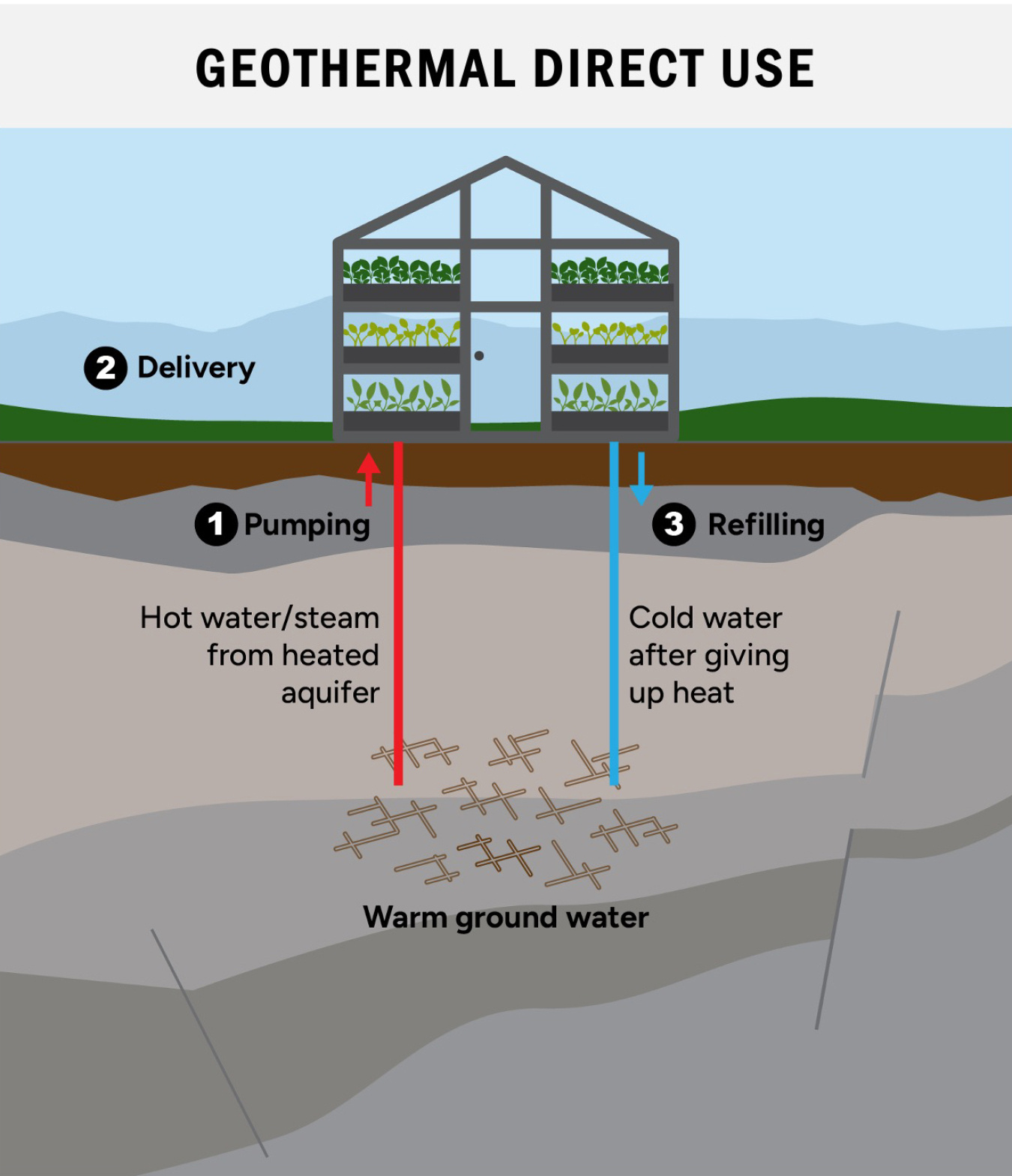
Geothermal direct use is the use of geothermal energy for heating or other applications without first converting it to electricity.
Direct-use geothermal applications use wells—usually deeper than those for geothermal heat pumps—that tap into subsurface temperatures of 80–300°F. Rather than using fluid warmed by subsurface temperatures to drive turbines that generate electricity, wells for direct use draw hot water from the subsurface to directly provide it to buildings, space heating, or heat for industrial processes. Once the heat brought to the surface by the subsurface fluid has been used, the cooled water can be injected back underground or disposed at the surface. Industrial applications for this technology can include fish farming, greenhouses, food processing like that employed for agricultural drying and beer brewing, and drying pulp, paper, lumber, and other materials.
One of the most common configurations for direct-use geothermal applications is in thermal energy networks (TENs), as part of a networked system where hot water is piped from underground directly into heat exchangers or buildings.
Deep Direct Use
Deep direct use, or DDU, draws on lower-temperature geothermal resources for large-scale residential, commercial, and manufacturing heating and cooling, as well as underground thermal energy storage, (UTES). Deeper than geothermal heat pumps and other conventional direct-use systems, DDU is deployable at a similar temperature range—between 100°F and 300°F—but at a much larger scale. DDU is an emerging technology that, to date, has not been broadly demonstrated in the United States. If proven feasible, DDU could deliver direct energy and thermal energy storage from geothermal resources nationwide, thus helping to support energy intensive sectors such as military installations, medium-to-large scale commercial buildings, manufacturing facilities, and data centers.
In 2016, the Office of Geothermal released a funding opportunity of up to $4 million to fund DDU feasibility studies exploring large-scale, low-temperature deep-well geothermal systems coupled with advanced direct-use applications and cascaded surface technologies. The Office of Geothermal selected six projects in June 2017 to conduct research that evaluated the feasibility of harvesting heat from geothermal brines and using it directly to heat (or cool) buildings, as well as for other beneficial thermal processes.
Current DDU Projects
Cornell University – Techno-Evaluation of Earth Source Heat at Cornell University
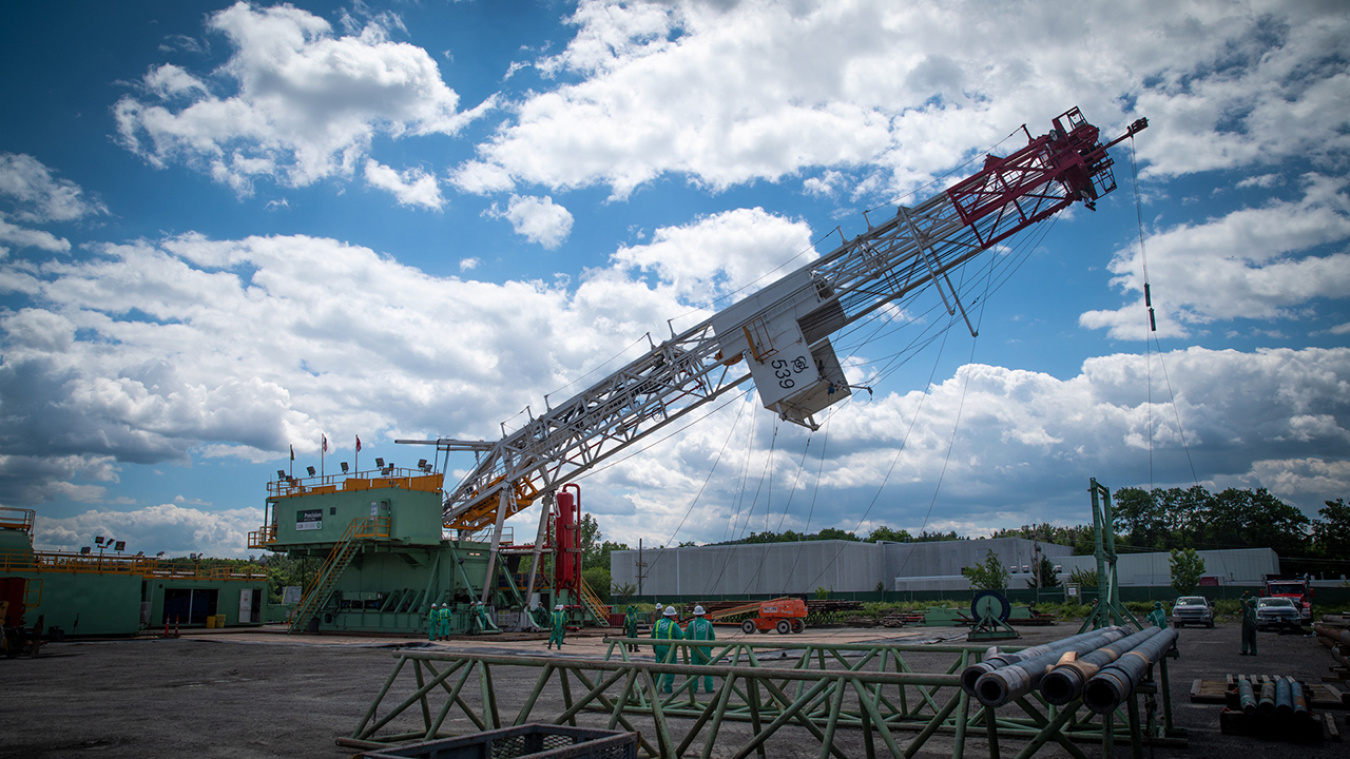
Cornell University’s DDU project team on the “Techno-Economic Evaluation of Earth Source Heat at Cornell University” project has successfully collected subsurface temperature and geological data at their site and concluded that the temperatures and geology are conducive to heating the campus. The borehole at the site reached total vertical depth of 9,790 feet and traversed nearly 2,000 feet of prospective reservoir in the temperature range needed for campus heating. This drilling provided a comprehensive dataset that allowed for modeling the levelized cost of heat and offered additional insights into the feasibility of DDU systems in the Northeast, where few wells of similar depth and size already exist. Enabling this technology for Cornell will not only serve the campus’s goals, but also provide a demonstration site and new Northeast U.S. geothermal drilling benchmark for other institutions or communities exploring geothermal as an energy solution.
WVU – Geothermal Deep Direct Use Combined with Reservoir Thermal Energy Storage on the West Virginia University Campus-Morgantown, WV
Through this project, WVU is performing a risk assessment and resource quantification for the development of an integrated Geothermal District Heating and Cooling (GDHC) and underground thermal energy storage (UTES) system for the West Virginia University (WVU) Morgantown campus, in order to update the current steam heating and cooling system. As of June 2026, the project team characterized campus energy demand, drilled an exploratory well, analyzed collected samples and data, and created and refined models (geomechanical, geothermal sources and storage, fluid flow and fracture stimulation) to aid in evaluating the technical and economic feasibility of a geothermal district heating system at this site, and is moving into the project’s next phase.
Further Reading
- GeoBridge – Direct Use
- Overview of Available Low Temperature/Coproduced Resources in the U.S. (2015)
- Final Report: A Technical and Economic Analysis of an Innovative Two-step Absorption System for Utilizing Low-temperature Geothermal Resources to Condition Commercial Building (2015)
- Geothermal Direct Use Technology and Marketplace Workshop Summary (2015)